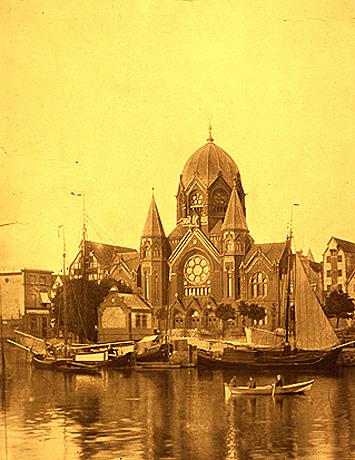
קהילת יהודי קניגסברג
(שמה הרוסי של העיר קלינינגרד Kaliningrad)
עיר נמל לחוף הים הבלטי, ברפובליקה של רוסיה. לפני מלחמת העולם השנייה (1945 - 1939) הייתה בירת פרוסיה המזרחית, גרמניה, ואחרי מלחמת העולם השנייה - ברוסיה; בעבר חלק מברית המועצות.
בשנת 1540 ישבו בקניגסברג שני רופאים יהודים, אך התיישבות יהודית של ממש לא הייתה שם לפני המחצית השנייה של המאה ה-17, עת סוחרים יהודים מפולין ומליטא החלו להשתתף בירידי העיר. ב-1680 הותר להם לפתוח בית תפילה למשך כל ימי היריד.
ב-1704 קודש בית עלמין ונוסדה חברה קדישא. שלש שנים אחר כך התמנה רב במקום. בשנת 1716 ישבו בעיר 38 משפחות יהודיות, וב-1756, כאשר מספר היהודים בקניגסברג הגיע ל- 300 נפש, נחנך שם בית הכנסת הראשון.
זרם קבוע של מהגרים יהודים אל העיר העלה את מספר בני הקהילה ל- 1,027 ב-1817, 5,082 ב- 1880 ו-4,049 ב-1925.
קניגסברג, כמוה כברלין, הייתה מרכז תנועת ההשכלה היהודית, ומשפחות יהודיות משכילות השתלבו בחברה הנוצרית. הידועה בהן משפחת פרידלנדר (H. J. FRIEDLAENDER) בעלת מפעלי טקסטיל.
סטודנטים יהודים למדו באוניברסיטה של קניגסברג כבר משנת 1712, רובם למדו רפואה. ביניהם היה מרקוס הרץ (MARCUS HERZ, 1747 -1803), רופא והוגה דעות יהודי.
ב-1783, בהשפעת רעיונותיו של משה מנדלסון (1729 - 1786), הקימו אברהם אוישל (EUCHEL) ומנדל ברסלאו (BRESLAU) אגודה לעידוד השפה העברית והחלו בהוצאתו לאור של העתון "המאסף".
במאה ה-18 ובמאה ה-19 היו כמה בתי דפוס עבריים בקניגסברג, אולם, מטעמי צנזורה או מטעמים אחרים, כתובים רבים שהודפסו שם נשאו שמו של מקום אחר או שכלל לא צויין מקום ההדפסה.
בתי ספר לא היו לקהילה עד 1920, השנה שהתיישב בעיר אשר פראנקולם (FRANCOLM), מורה הלכה של היהדות הרפורמית, ופעל להקמת בית ספר יהודי דתי. הוא נתקל בהתנגדות הרוב האורתודוקסי בקהילה ותכניתו לא יצאה אל הפועל. המשיך בדרכו יוסף לוין זלשיץ (SAALSCHUETZ) שהיה מרצה לארכיאולוגיה באוניברסיטת קניגסברג, פירסם מאמרים חשובים בתחומו, אך לא קיבל תואר פרופסור משום יהדותו. באותה תקופה היה גם המדינאי היהודי יוהאן יקובי (JACOBY) פעיל בקהילה ובשנת 1847 הוא פרסם תזכיר בזכות אמנציפציה ליהודים.
הרב יעקב ז' מקלנבורג (MECKLENBURG) כיהן כרב הקהילה בשנים 1830 - 1865, ואחריו כיהן הרב יצחק במברגר (BAMBERGER) עד שנת 1896.
ב-1870 הקימו האורתודוקסים קהילה נפרדת, אולם הצטרפו אחר כך שוב לקהילת האם. בשנים 1897 - 1920 היה הרמן פוגלשטיין (VOGELSTEIN), מראשי היהדות הליברית בגרמניה, מנהיגה הרוחני של הקהילה. פליקס פרלס (PERLES), בן זמנו, התמנה ב-1924 לפרופסור של כבוד לעברית מודרנית ולארמית באוניברסיטת קניגסברג וזאת בזכות עבודתו המדעית בחקר התנ"ך ובבלשנות. באותה תקופה יהודים מילאו תפקידים חשובים גם בפקולטה לרפואה; ביניהם היו לודויג ליכטיים (LICHTHEIM), יוליוס שרייבר, מקס יפה ואלפרד אלינגר (ELLINGER). ד"ר רודולף פיק (1890 - 1955), משפטן וזמר אופרה מצליח, היה חזן ראשי בעיר בשנים 1924 - 1938.
בשנת 1925 היו חמשה בתי כנסת בקניגסברג והקהילה החזיקה מוסדות צדקה וגמילות חסדים למיניהם.
בשנת 1933 ישבו בקניגסברג 3,200 יהודים.
תקופת השואה
עם עליית הנאצים לשלטון בגרמניה במרס 1933 החלו פרופסורים יהודים לעזוב את אוניברסיטת קניגסברג, מצאו מקלט בארצות הברית, או עלו לארץ ישראל. אחרי שנאסר על ילדים יהודים ללמוד בבתי ספר כלליים, הקימה הקהילה ב-1935 בית ספר יהודי משלה. בפרעות "ליל הבדולח", ליל 9 בנובמבר 1938, נשרף כליל בית הכנסת הגדול, בתי הכנסת האחרים נחרבו גם הם. שוכני בית האבות וילדי בית היתומים הושלכו לרחוב, וגברים יהודים נאסרו ונשלחו לחדשיים וחצי למחנות ריכוז. ביניהם היה גם ד"ר פיק, מששוחרר היגר לאנגליה, ואחרי קום המדינה עלה לישראל והצטרף לאופרה הישראלית.
ב-1939 נותרו בקניגסברג 1,585 יהודים, 763 מהם גורשו לטרזיאנשטאט בסוף 1941 וראשית 1942 (59 נותרו בחיים כשהמחנה שוחרר), וב-1944 נותרו רק 60 משפחות יהודיות בעיר.
היהודים שישבו בעיר אחרי המלחמה גורשו בידי הרוסים ב-1948, עם גירוש האזרחים הגרמנים מקניגסברג.
במשך השנים התיישבו בקניגסברג יהודים מרוסיה וממקומות אחרים בברית המועצות (לשעבר). בשנות התשעים למאה העשרים ישבו בעיר כ- 2,000 יהודים. בסוף שנת 1998 נתבקש רבי דוד שוודליק (SCHWEDLICK) מרוסטוב לארגן את הקהילה מחדש ולעמוד בראשה.
רבי שוודליק קיבל את השליחות הזאת מידי הרב יוסף צבי דונר (DUNNER), שחי בלונדון, ובאותה השנה מלאו לו 85 שנים. הרב דונר היה הרב הראשי האחרון של פרוסיה המזרחית.
באפריל 1998 ביקר הרב דונר בקניגסברג עם משלחת בינלאומית של רבנים, ומצא שבתי העלמין היהודיים ושרידי חמישה בתי הכנסת, שנהרסו בידי הגרמנים בימי המלחמה, לא החזיקו מעמד בשנות השלטון הקומוניסטי. מכל רכוש המקרקעין של הקהילה שרד רק בניין בית היתומים היהודי, וגם הוא לא הוחזר לבעלות הקהילה המתחדשת.
בסוף שנת 1999 היו המשימות המיידיות של הקהילה - לטהר ולקדש מחדש את אותו חלק של בית העלמין שהחומה שהייתה סביבו ניתנת לשיחזור. הקהילה מתכננת גם הקמתו של בית כנסת חדש, ברגע שיושג לכך מימון. בינתיים נשכרו כמה חדרים במבנה של גן ילדים, והם משמשים את בני הקהילה כמקום כינוס ותפילה.
דניאל סמבורסקי
(אישיות)קרל אלווין
(אישיות)Carl Alwin (aka Karl Alwin, Alwin Oskar Pinkus) (1891-1945), composer, conductor, born in Koenigsberg, Germany, (now Kalinigrad, Russia). He studied music, philosophy and literature at the University of Berlin. He was part of the Berliner Hofoper (1910), Assistant Director of the Bayreuth Orchestra (1912), and served in different orchestras at Halle, Poznan, Duesseldorf, and Hamburg, between 1914-1920.
For eighteen years (1920-1938) Carl Alwin was conductor at the Staatsoper of Vienna, until his dismissal by the new Nazi regime. He went in exile to the United States, where he conducted at the Chicago Civic Opera (1939-1940). He then moved to Mexico where he was music instructor at the conservatorium of Mexico City and conductor at Opera Nacional de Mexico (1941-1945). Carl Alwin was married to the opera singer Elisabeth Schumann.
לאה גולדברג
(אישיות)לאה גולדברג (1911 - 1970), משוררת וסופרת, נולדה בקניגסברג, פרוסיה המזרחית, גרמניה (היום קלינינגרד, רוסיה) ובילתה את שנות מלחמת העולם הראשונה ברוסיה. ב-1918 חזרה עם משפחתה לביתם בקובנו, ליטא. למדה באוניברסיטה של קובנו (מ-1928), ברלין (מ-1930) ובון, וסיימה את לימודיה בשפות שמיות ב-1933. באותה שנה חזרה לליטא ולימדה ספרות בגימנסיה העברית של קובנו. ב-1935 הגיעה לארץ-ישראל והועסקה בעבודות עריכה בהוצאות שונות. מ-1952 לימדה ספרות באוניברסיטה העברית בירושלים, והקימה את המחלקה לספרות השוואתית. עמדה בראש המחלקה עד למותה.
ספרי השירה שלה כוללים את טבעות עשן (1935), על הפריחה (1948, ובו משירי הנחל), ברק בבוקר (1956, ובו השיר בהרי ירושלים וסדרת הסונטות אהבתה של תרזה די מון). לאה גולדברג הייתה גם מבקרת ספרות פורה, כתבה ספרים לילדים, פרוזה ותרגומים. נפטרה בירושלים.
צבי סנונית
(אישיות)צבי סנונית (1933-1966) מלחין, נולד בקניגסברג, גרמניה, ועלה לארץ-ישראל ערב מלחמת העולם השנייה. בילדותו לימד אותו אביו לנגן בכינור ואמו ליוותה אותו בפסנתר. בגיל 12 החל ללמוד בקיבוץ משמר-העמק, שם התמסר לפעילות מוסיקלית כללית – ארגן תזמורת ופרסם ידיעון. היצירה הראשונה שלו הייתה המוסיקה שהלחין למחזה, שהורכב מטקסטים מאת מאייקובסקי, נרודה, שלונסקי ופן, והוצג על ידי בני כיתתו. אחרי שסיים את לימודיו באקדמיה למוסיקה בתל-אביב ב-1953 התחיל לכתוב ביקורת מוסיקה בעיתון "על המשמר" ולימד בבית הספר לאמנויות תלמה ילין ובאקדמיה למוסיקה בתל-אביב. ב1965-1964- המשיך את לימודיו באקדמיה למוסיקה בבאזל, שווייץ.
יוהאן יעקובי
(אישיות)Johann Jacoby (1805-1877), physician and liberal statesman, born in Koenigsberg, Prussia (now Kaliningrad, Russia), the son of a well-to-do businessman. In 1823 he enrolled at the University of Koenigsberg to study philosophy and medicine. After completing his course of study in 1827, he started to practice medicine in his home town and became well known for his research into the causes of cholera and his efforts to treat the disease. However, he devoted more and more time to represent the interests of his fellow Jews and other citizens. In 1833 he published a pamphlet in support of the complete emancipation of the Jews. In it Jacoby pointed out that the edict of 1812 did not make the Jews equal citizens of Prussia, but merely alleviated some of the restrictions under which they lived. He insisted that Jews should be given total equality as a matter of right instead of having privileges doled out to them as favors. He advocate religious reform and was a member of the commission set up to recommend changes in the synagogue service.
Fighting for the establishment of a liberal and democratic Germany, in 1841, on the eve of the meeting of the provincial parliament, Jacoby published a pamphlet, claiming that the people were as a matter of right entitled to a binding constitution. The author sent a copy to the king, together with a letter complaining that the pamphlet had been confiscated by the police of Leipzig, and appealing for royal protection. The response came in the form of arrest for subversive criticism of the law. In 1842 Jacoby was found guilty and sentenced to two and a half years' imprisonment, but was acquitted on appeal. Meanwhile the pamphlet was republished in Strasburg and Paris. Three years later his two pamphlets entitled "Preussen im Jahre 1845" and "Das Königliche Wort Friedrich Wilhelms III", again moved the authorities to proceed against him. On the outbreak of the agitation of 1848 Jacoby was recognized as one of the leaders of the democratic movement. He took a leading part in the deliberations of the preliminary parliament convened at Frankfurt am Main in 1848. On the opening day of the National Assembly, he issued an appeal maintaining that it was the duty of the Prussian deputies not to pursue a selfish Prussian policy, but to work to make Germany a free and united country. A few weeks later he left Frankfurt and went to Berlin, where he was elected a member of the Prussian National Assembly and continued to take part in the proceedings of the National Assembly after its removal to Stuttgart in 1849. When he returned to Königsberg in October he was arrested for treason on the charge of having taken part in the "Stuttgart Rumpparlament", but was acquitted and returned to his medical practice.
Jacoby did not long remain out of political life. At the assembly of the electors of Königsberg in 1858, he delivered a speech on the principles of the Prussian democracy and soon afterwards he was elected to the Prussian Chamber of Deputies. In 1863, he delivered a speech to the electors of Berlin denouncing militarism and the Junkers, for which he was sentenced to six months' imprisonment. He violently opposed Bismarck, the Austrian war, the reorganization of the army, and the North-German Bund and claimed that the working classes must have a greater participation in the government. After the Franco-Prussian war of 1870, unlike many Jewish politicians, Jacoby opposed the annexation of Alsace-Lorraine.
עמנואל יעקובוביץ
(אישיות)Immanuel Jacobovits (1921-1999), Chief Rabbi of the United Hebrew Congregations of the British Commonwealth from 1967 to 1991, born in Königsberg, East Prussia, Germany (now Kaliningrad, Russia), where his father Julius was a community rabbi. The family moved to Berlin in the 1920s, where his father became dayan on the Beth Din of the orthodox community, but fled the country in 1938 and went to England. In the United Kingdom he completed his higher education, and studied at the Etz Chaim Yeshiva in London after which he was ordained as a rabbi. He also studied in Jews' College and the University of London.
His first position was as rabbi of the Brondesbury synagogue. In 1949 he was appointed Chief Rabbi of the small Jewish community of Ireland. In 1958 he was elected rabbi of the Fifth Avenue Synagogue in New York, USA, a position he held until 1966, when he was elected to become Chief Rabbi of the United Hebrew Congregation of the British Commonwealth. He held this position until his retirement in 1991.
Created a life peer in 1988, Jacobovits was the first rabbi to receive this honour. He was a firm adherent of the "German-Jewish" Torah im Derech Eretz philosophy, having a broad knowledge of religious subjects as well as secular culture and philosophy. This made him a unique spokesperson for Orthodox Judaism, as he was able to transmit ideas to a much wider audience than other traditional orthodox rabbis.
In the House of Lords he became known as a campaigner for traditional morality. Lord Jakobovits aroused considerable controversy when, after the discovery of a possible genetic explanation for homosexuality, he suggested that he saw no "moral objection for using genetic engineering to limit this particular trend". He described homosexuality as "a grave departure from the natural norm which we are charged to overcome like any other affliction"; if there were genetic explanations for homosexuality, "the errant gene" should be "removed or repaired" in order to prevent the "disability". He called for a massive re-alignment of communal priorities towards Jewish religious education. With this on mind in 1971 he launched the Jewish Educational Development Trust (JEDT), arguing that British Jewry needed to invest heavily in Jewish education and, in particular, that it should double the capacity of Jewish schools. Jakobovits was also the president of the Conference of European Rabbis, in which capacity he worked on standardizing and regulating religious conversion to Judaism.
Rabbi Jakobovits was the most prominent figure in 20th century Jewish medical ethics, a subdiscipline in applied ethics which he virtually created, and a pioneer in religious bioethics. His speciality was the interaction between medical ethics and halakha. Thanks to his academic training, he set out his views on the matter in his comprehensive work, Jewish Medical Ethics, in which he often compared Jewish ethics with those of the Roman Catholics. Many later Jewish bioethicists often referred to his work on abortion, euthanasia, the history of Jewish medical ethics, palliative care, treatment of the sick, and professional duties. He held mildly Zionistic views. He maintained that sooner or later Israel would need to negotiate the territory it conquered during the Six Day War.
דויד פרידלנדר
(אישיות)David Friedlaender (1750-1834), banker, writer and communal leader and advocate of Jewish reform and assimilation, born in Koenigsberg, the son of Joachim Moses Friedlaender, a wholesale merchant who was a “protected Jew” in Prussia. He moved to Berlin, Germany, in 1771 and set up a silk factory. He was appointed advisor to the state commission into the textile industry and in 1791submitted a memorandum on behalf of the manufacturers asking for changes in the way the government regulated the industry. As the son-in-law of the rich banker Daniel Itzig, and a friend of Moses Mendelssohn, he occupied a prominent position in both Jewish and non-Jewish circles of Berlin. He worked for the emancipation of the Jews of Berlin and the various other reforms. In 1787 Frederick William II ask Friedlaender and Itzig to write a report on the grievances of the Jews. Under Friedlaender's leadership the Jews rejected the proposed improvements in their status which fell short of full emancipation. It was not until the edict of 1812, that the Jews living on Prussian territory succeed in obtaining equal rights from Frederick William III.
He was one of the founders of a Jewish free school (1778), which he directed for 20 years in association with his brother-in-law, Isaac Daniel Itzig. In this school, however, secular subjects were mostly taught at the expense of Jewish subjects. He proposed that the study of Talmudic law should be replaced by the study of the laws of the country. Friedlaender wrote several text-books, and translated the Hebrew prayer-book into German. The school had its own Hebrew printing press and bookshop.
Friedlaender believed that enlightened Jews and Protestants could unite around the eternal truths of Jewish monotheism. He rejected the Messianic messages of Judaism, prayers for the reestablishment of the Temple and the return to Jerusalem. He wished to reform synagogue worship to bring it into what he considered to be harmony with modern ideas and the changed social position of the Jews. In 1799 he wrote an open letter to the Protestant provost in Berlin (Oberconsistorialrat) Wilhelm Teller "in the name of some Jewish heads of families", stating that Jews would be ready to undergo a "dry baptism", meaning that they would agree to join the Lutheran Church on the basis of shared moral values provided that they were not required to believe in the divinity of Jesus and were not required to participate in certain Christian ceremonies. In this Open Letter he claimed that that most Mosaic rituals were largely obsolete so he was sure that Jews would agree in return to abandon many of the ceremonial features of their faith. His proposal "envisioned the establishment of a confederated unitarian church-synagogue". It elicited many hostile reactions including ones from Abraham Teller and Friedrich Schleiermacher who rejected the notion of a sham conversion to Christianity as harmful to Christianity and the State, although, in line with Enlightenment values, neither precluded the idea of more civil rights for unconverted Jews. Jewish reaction on Friedlaender's initiative was overwhelmingly hostile; it was called "a dishonorable act" and "desertion". Historian Heinrich Graetz called him an "ape".
The 1813 conferences on the reorganization of the Jewish cult held in the Jewish consistory at Kassel overwhelmingly rejected Friedlaender's ideas and claimed that they would reduce Judaism to a mere colorless code of ethics. In 1816, when the Prussian government decided to improve the situation of the Polish Jews, the bishop of Kujawy, consulted Friedlaender who gave the bishop an account of the material and intellectual condition of the Jews of Poland and made suggestions on how they might be improved.
Friedländer was persuaded by Moses Mendelssohn to start to translate Mendelssohn's commentary of the Bible into German. He translated Mendelssohn's Sefer ha-Nefesh, (1787), and Kohelet (1788). He wrote a Hebrew commentary to Pirkey Avoth ("Ethics of the Fathers") and also translated it into German (1791). He wrote a biography of Moses Mendelssohn, Von Ihm und über Ihn (1819). Friedlaender was assessor of the Royal College of Manufacture and Commerce of Berlin, and the first Jew to sit in the municipal council of that city. His wealth enabled him to be a patron of science and art, among those he encouraged were the brothers Alexander and Wilhelm von Humboldt.
חנוך יעקבי
(אישיות)
פרלס, פליקס
(אישיות)Felix Perles (1874-1933), rabbi, Bible scholar and linguist, born in Munich, Germany. He studied at the Universities of Munich and Vienna, and attended the rabbinical seminaries of Vienna and Paris, France, where he was ordained as rabbi. Felix was drawn into the Zionist movement in Vienna, Austria.
In 1899, he became chief rabbi in Koenigsberg, Germany (now Kaliningrad, Russia) and in 1924 became honorary professor of Modern Hebrew and Aramaic literature at the University of Koenigsberg. Like his father, Joseph Perles, Felix had wide scholarly interests: Bible criticism, Hebrew and Aramaic lexicography, apocryphal and pseudepigraphical literature, medieval Hebrew poetry, liturgy, Jewish dialects, and abbreviations.
His best-known works are Notes critiques sur le Texte de l'Ecclesiastique (1897); his critique of W. Bousset's Religion des Judentums im neutestamentlichen Zeitalter, kritisch untersucht (1902), and a collection of essays, Juedische Skizzen (1912, 1920?). His additional works include Analekten zur Textkritik des Alten Testaments (1895; new edition, 1922); Zur Althebraeischen Strophik (1896); Gesammelte Aufsaetze zur Sprach- und Sagenkunde von Max Gruenbaum (1901); Was lehrt uns Harnack? (1902); Zur Erklaerung der Psalmen Salomos (1902); Gedanken ueber Judentum (1924); Biblical Criticism and Jewish Science, Judaean Addresses, vol. 3 (1927). His Nachtraage zu meinen Analekten I und II was published in "Abhandlungen zur Errinerung an Hirsch Perez Chajes" (1933, pp. 194-203). He published Was verdankt die Welt den Pharisaaeren? of the English protestant Hebraist (1920), and Das pharisaeische Judentum (1913), which had several editions.
Felix Perles was a member of the Deutsche Morgenlaandische Gesellschaft.
אדוארד בירנבאום
(אישיות)אדוארד בירנבאום (1855-1922) , חזן ומלחין. נולד בקרקוב, פולין, למד מוסיקה חזנית אצל סולומון זולצר בווינה. ב-1874 התמנה חזן ראשי בבויטן (Beuthen), גרמניה (היום ביטום, פולין). באותה תקופה התחיל לאסוף חומר שעליו ביסס לימים את מאמרו הביקורתי על ספרו של אברהם בר, "בעל תפילה". האוסף של בירנבאום נמצא כיום בהיברו יוניון קולג', סינסינטי, אוהיו, וכולל קטלוג נושאים של נעימות בתי כנסת המחזיק כ-7000 פריטים. מ-1879 עד מותו, שימש חזן ראשי בקניגסברג. נודעה לו שם השפעה רבה, באמצעות עבודתו החינוכית האינטנסיבית והמגוונת. הוא הלחין יצירות ליטורגיות, וביניהן עשה למען, המלך, קדושה ולכה דודי. נפטר בקניגסברג, גרמניה (היום קלינינגרד, רוסיה).