Skip to website content >
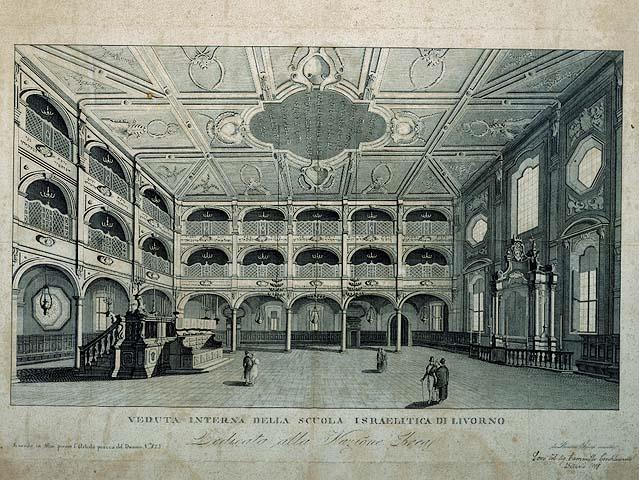
Interior of the synagogue in Livorno, Italy. Engraving, 19th cnetury(?)

The Jewish Community of Livorno

Livorno

Livorno (Leghorn) is the main port of the region of Tuscany on the Tyrrhenian Sea coast, in central Italy.

In the middle of the 16th century, when Livorno was a miserable, malaria-infested village, its rulers, the Medici family, decided to turn it into an important port and to attract immigrants, especially Jewish Marranos (crypto-Jews) from Spain and Portugal, to settle there. An invitation was accordingly issued by Cosimo I in 1548, but although of benefit to fugitive Crypt-Jews who could have found asylum there, his project met with little success. After 1590 Ferdinand I issued new invitations with more attractive promises. The official invitation issued on June 10, 1593, addressed to the ‘Levantines’ (westerners, Spaniards, Portuguese, Germans, and Italians) was mainly directed at the Jews of the countries concerned. The charter, known as ‘the Livornina’ guaranteed full religious liberty, amnesty for crimes previously committed, the opportunity for Marranos to return to Judaism unmolested, and the right to receive Tuscan citizenship, subject to the approval of the heads of the community (Massari) who were also permitted to exercise full civil jurisdiction among the Jews, and partly also criminal jurisdiction. Settlers were permitted to own houses, were exempted from wearing the Jewish badge, and from other restrictions. The community also had the right to inherit property left by Jews who died without direct heirs. Jews were also allowed to purchase land for a synagogue and a cemetery.

The Medicis went ahead energetically with improvements to the town and harbor, which in 1675 received the status of a free port. Livorno thus became an important port for the trade between the Atlantic and North Sea ports and those of the Mediterranean and the near east. Both international and internal commerce was transacted mainly by the foreign communities or ‘nations’ living in Livorno, of which the ‘Jewish nation’ soon became the largest and most influential. During the first few years the Jews were slow to arrive, but subsequently their numbers increased rapidly. There were 114 Jews in Livorno in 1601; 711 in 1622, 1,175 in 1642; and approximately 3,000 in 1689. The new settlers were either of Spanish origin who had arrived via North Africa or Turkey, or Crypto-Jews, mainly from Portugal; relatively few Jews came from the Italian states. Thus Portuguese and Spanish became the only languages used officially by the Jews in Livorno.

In 1614, the Livorno Jewish community separated from the community of Pisa, on which it had until then been dependent, and subsequently became far more important. The Jews continued to enjoy the protection of the Medicis, and the original promises given were adhered to, or only slightly revised. Even under the bigoted Cosimo III (d. 1723), the restrictions imposed upon the Jews in Livorno were not severe, mainly relating to the employment of Christian wet-nurses and Turkish slaves, and sexual relations with Christian women. When the sovereignty of Tuscany passed to the House of Lorraine in 1737, these privileges did not change. The Jews benefited from the enlightened reforms of Leopold I (1745--1790), and in 1780 obtained, among others, the right to a representative on the municipal council.

The number of Jews living in Livorno increased from 3,476 in 1738 to 4,327 in 1784, and to approximately 5,000 at the end of the 18th century, amounting to one-eighth of the total population. Among the larger Italian communities, Livorno Jews were the only ones not forced to live in a closed ghetto. Jewish residence was limited to a single, fairly large, open quarter, though Christians were not permitted to reside in the same quarter.

At first, Jews in Livorno specialized in certain industries, such as coral, which they exported as far as Russia and India, and soap and paper manufacture. Later, they utilized their family and commercial connections in various ports of the Mediterranean to develop widespread bilateral trade. To facilitate this exchange, the Jews in Livorno sent members of their families to Tripoli, Tunis, and Smyrna, from where others moved to Livorno. Jews from Livorno lived in separate communities in Tunis in 1685, and elsewere, calling themselves ‘Gorni’ (“from Ligorno” or Leghorn). This family and business exchange developed at the end of the 18th century, and even more so in the 19th century, particularly with Egypt.

In 1738, about 150 Jews owned houses in Livorno, and in 1765 one-third of Livorno`s 150 commercial houses were Jewish-owned. Jews also owned shops of all types in the town, and were generally prosperous. This situation deteriorated after the occupation of Livorno by the French. Not only was the port badly hit by the English blockade, but since parity was conceded to all by the French, the special privileges formerly held by the Jews were abrogated. They were partly restored in 1814, on the return of the Grand Dukes of Lorraine. However, after a few decades of recovery, the commercial importance of Livorno began to wane when Tuscany was annexed to the Kingdom of Italy in 1859, and other ports began to show competition. These events were reflected in the fluctuations of the Jewish population. It dwindled to 3,500 in 1838 and rose to 4,543 in 1852, after a temporary influx from other Italian towns; by the end of the 19th century, the number had diminished to 2,500.

The golden age of Jewish Livorno left many traces. Construction of a new synagogue began towards the end of the 16th century, but its enlargement and embellishment continued until 1789. The Livorno synagogue became the most admired in Italy, and was visited by the Grand Dukes of Tuscany and foreign sovereigns.

The community in Livorno maintained a varied and efficient network of institutions, including a considerable number for charitable or educational purposes. Most important were the institutions providing for the ransom of Jewish prisoners, assistance to the poor in the Holy Land, and dowries for poor girls. There were also a number of yeshivot in Livorno.

Some of the most eminent rabbis of their time taught in the yeshivot and synagogues; many of them inclined to Kabbalism. Among them were Joseph Ergas, Malachi B. Jacob Ha-Kohen, Hezekiah da Silva, Immanuel Chay Ricchi, and Chayyim Joseph David Azulai, who spent the last 30 years of his life in Livorno. The family of Sir Moses Montefiore originated from Livorno, and Sabato Morais, founder of the Jewish Theological Seminary of America, was born there. The famous painter, Amadeo Modiglani, was also born in Livorno.


In the second half of the 19th century, the dominant figure in Jewish scholarship in Livorno was the Kabbalist, Elijah Benamozegh.

Livorno also became a center of Hebrew printing. The first Hebrew press was set up by Jedidiah Gabbai (1650). Some 80 years later, Abraham B. Raphael Meldola, followed by his son Raphael, both with various partners, were active as Hebrew printers (1640--57). Sixteen other printers worked in Livorno between 1763 and 1870, the most important being the house of Solomon Belforte (established in 1838) which supplied the North African and Levantine market with liturgical books until the outbreak of World War II.

Distinct customs, dress and language were found among the Jews of Livorno. The dialect Baggito developed from Spanish, Hebrew and a Livornese dialect. Baggito did not become a literary language. One famous Jewish writer from Livorno, Guido Bedarida (1900-1962) wrote in the Livornese dialect.

Due to the large number of immigrant communities in Livorno, a special type of cuisine developed. Many Jewish recipes are currently part of mainstream Livornese and Tuscan dishes. Tomato cooking was brought to Italy through Livorno in the 16th century by Jewish immigrants from Spain and Portugal (originally brought to these countries from central America). Jewish cuisine was also strongly influenced by North African, Tunisian, Egyptian, Turkish and Greek cuisine. The first coffee shop was set up in Livorno by Jewish immigrants in 1632, before Venice (1646) and Vienna (1683).

In 1938 there were 2,332 Jews in Livorno. During World War II at least 90 Jews were sent to extermination camps from November 12, 1943. Others were killed in the surrounding mountains, where the German army was very active. The well-known synagogue was destroyed by the Nazis.

At the end of the war 1,000 Jews were living in Livorno. Owing to emigration and rapid demographic decline, their number in 1965 was reduced to about 600 out of a total of 170,000 inhabitants.

In 1967 after the Six Day War in Israel, a few hundred Jews from Libya and other Arab countries arrived in Livorno, partly attracted by the presence of a number of Jews from Tripoli. Today (2006) there are around 700 Jewish members in the Jewish community of Livorno.

In 1962 a new synagogue was built on the site of the old one. It is of modern architecture. Next to it there are the community center, a library, and the Jewish archive. There is also a Jewish museum in Livorno, holding ancient Jewish Livornese relics and in its courtyard some marble pieces from the old cemetery stones.

There are three Jewish cemeteries in Livorno. The first opened in 1648, the second in 1738 and the third, still in use was opened in 1837. Old headstones from the old Jewish burial sites from the mid 16th century and from the Jewish cemetery of Portoferrario on the Isle of Elba, dating back to the 16th and 17th century, are also collected there. At the entrance there are two marble plaques. One commemorates the dead from World War I and the other commemorates victims of the Holocaust.

Moses Montefiore (1784-1885), philanthropist, born in Leghorn, Italy, while his Sephardi parents were visiting there, he belonged to an old Italian family. At the age of 13 he was apprenticed to a firm of wholesale tea merchants and at the age 20 he began a successful career on the London Stock Exchange, with the help of wealthy relatives. Through marriage, he became related to the Rothschilds.

At the age of 40 he retired from business to devote himself to the service of others. In 1834 Montefiore was elected president of the Board of Deputies of British Jews, the representative Jewish body in the country, holding office for 44 years. In 1837 he was the first Jew to be elected Sheriff of London and was knighted. He did not allow his exercise of office to interfere with his Orthodox Jewish observance. He visited the Land of Israel seven times and 'Jerusalem' was emblazoned on his coat of arms.

He made many philanthropic contributions to the advance of the Jewish community there, including the development of agricultural settlement and building the first Jerusalem project outside the Old City. These missions were complemented by others to champion the cause of persecuted Jews elsewhere. In 1840 following the Damascus blood libel, he went to the Middle East and received a declaration from the Sultan of Turkey condemning the blood libel. He also went on missions to the Sultan of Morocco, the Russian Foreign Minister and to places in East Europe to protest at persecution of Jews. His hundredth birthday was an occasion for celebration throughout the Jewish world.

Immanuel Ben David Frances (1618-1710) Poet. Born in Leghorn (Livorno), Italy, he studied with Rabbi Joseph Fermo. Immanuel’s life was marked by a succession of misfortunes: his father died in 1640; he lost his first wife and their two children in 1654; in 1667 his second wife and their son died; and his beloved brother died the same year. Immanuel served as a rabbi in Florence and found consolation in his literary work.
His poetic work can be divided into three periods. In the first one, between 1643-1660, he wrote love poems and satirical epigrams, influenced by Tasso. During the second period, between 1664-1667, he devoted himself to oppose the messianic movement and its prominent representatives, among them Shabbetai Zvi (Zevi Muddah, The Banished Gazelle, satirical poems). In the final period, from 1670 until after 1685, Immanuel adapted his religious poetry for use in synagogue services. He died in Florence, Italy.

David Prato (1882-1951), rabbi, born in Livorno (Leghorn), Italy, he was chief cantor in Florence and from 1927 to 1936 rabbi of Alexandria where he founded the journal L'Illustration Juive followed by Cahiers Juives. He was chief rabbi of Rome, 1936-1938 but when conditions became impossible with the anti-Semitic laws of the Fascist government he moved to the Land of Israel. In 1945 he resumed his position in Rome. A keen Zionist, Prato was active in the Jewish National Fund and Keren Hayesod in Rome.

Michele Bolaffi (1768-1842), composer, born in Livorno, Italy. In 1793 he composed the music for the religious drama Simhat Mitzva by Daniel Terni, written for the inauguration of the synagogue in Florence. The music has not been preserved. Later he was active at the Livorno synagogue. His setting to Psalm 121 is still sung in the Florence synagogue at festivals.
Bolaffi went to England and in 1809 was appointed Musical Director to the Duke of Cambridge. For a short time he was engaged as Königlicher Kapellmeister in Hanover, Germany, and between 1815-1818 he served Louis XVIII of France as singer. His works include an opera Saul; Miserere for three voices and orchestra (1802); Sonetto on the death of Haydn (1809) and settings for psalms. He also wrote poems.

Abraham Issac Castello (1726-1789) Poet. Born in Ancona, Italy, Castello worked in the coral industry of Leghorn. He eventually became a cantor in Leghorn and later officiated as rabbi for the community.
His poetic repertoire includes poems published in Shema Shelomo (1788), Kol Millin (1765) and Minhah Hadashah (1785). He also composed a poem on the occasion of the consecration of the restored synagogue in Leghorn in 1789, which was published in Kol Rinah (1790). He died in Leghorn, Italy.

Shir HaMa'alot LeDavid ("A Song of Degrees of David" - in Hebrew - Psalm 122:1-9)

Original recording from Singing Dew: The Florence-Leghorn Jewish Musical Tradition. Produced by Beit Hatfutsot in 2002.

A famous piece for a cappella choir by Michele Bolaffi preserved in 19th century manuscripts as well as in the oral tradition of the Livornese Sephardim. This work is characteristic of Bolaffi’s style, showing the influence of choral music from early 19th century Italian opera. Contrasting sections for soloists and short contrapuntal passages (played in this recording on the keyboard) vary the simple homophonic style dominating the piece.

Text by Prof. Edwin Seroussi, originally published by Beit Hatfutsot in Singing Dew: The Florence-Leghorn Jewish Musical Tradition CD booklet.

Sheva Berachot ("Seven Blessings" - in Hebrew)

Original recording from Singing Dew: The Florence-Leghorn Jewish Musical Tradition. Produced by Beit Hatfutsot in 2002.

These seven blessings are recited as part of the Jewish wedding ceremony. In this recording the Florence tradition is sung, which is similar to that of the Jewish traditions from Livorno and Amsterdam.

LaMnatesach Al HaGittith ("To the Chief Musicain upon Gittith" - in Hebrew - Psalm 81)

Original recording from Singing Dew: The Florence-Leghorn Jewish Musical Tradition. Produced by Beit Hatfutsot in 2002.

A Psalm which is recited on Rosh HaShanah in Sephardic tradition. This version was composed by the Livornese Jewish composer, Michele Bolaffi.

Original recording from Singing Dew: The Florence-Leghorn Jewish Musical Tradition. Produced by Beit Hatfutsot in 2002.

A widespread Italian melody for this piyyut for Succoth (but actually sung on Simhat Torah) written by Rabbi Yehuda Halevy (c. 1075 - 1141). This melody usually appears in manuscripts with texts from the six Hallel psalms (113-118), especially with the verse "Pitchu Li Sha'arey Tsedek" ("Open to me the gates of righteousness," Psalm 118:19). It appears with this and other psalm verses in 18th century manuscripts from the Portuguese synagogue in Amsterdam under the name Allel d'Italia, that already by then were identified with the Italian Jewish tradition. Its musical style hints at possible origins in the art music repertoire of the early 18th century.

Text by Prof. Edwin Seroussi, originally published by Beit Hatfutsot in Singing Dew: The Florence-Leghorn Jewish Musical Tradition CD booklet.

Interior of the synagogue in Livorno, Italy.
Engraving, 19th cnetury(?)
ANU Databases
Jewish Genealogy
Family Names
Jewish Communities
Visual Documentation
Jewish Music Center
Place
אA
אA
אA
The Jewish Community of Livorno

Livorno

Livorno (Leghorn) is the main port of the region of Tuscany on the Tyrrhenian Sea coast, in central Italy.

In the middle of the 16th century, when Livorno was a miserable, malaria-infested village, its rulers, the Medici family, decided to turn it into an important port and to attract immigrants, especially Jewish Marranos (crypto-Jews) from Spain and Portugal, to settle there. An invitation was accordingly issued by Cosimo I in 1548, but although of benefit to fugitive Crypt-Jews who could have found asylum there, his project met with little success. After 1590 Ferdinand I issued new invitations with more attractive promises. The official invitation issued on June 10, 1593, addressed to the ‘Levantines’ (westerners, Spaniards, Portuguese, Germans, and Italians) was mainly directed at the Jews of the countries concerned. The charter, known as ‘the Livornina’ guaranteed full religious liberty, amnesty for crimes previously committed, the opportunity for Marranos to return to Judaism unmolested, and the right to receive Tuscan citizenship, subject to the approval of the heads of the community (Massari) who were also permitted to exercise full civil jurisdiction among the Jews, and partly also criminal jurisdiction. Settlers were permitted to own houses, were exempted from wearing the Jewish badge, and from other restrictions. The community also had the right to inherit property left by Jews who died without direct heirs. Jews were also allowed to purchase land for a synagogue and a cemetery.

The Medicis went ahead energetically with improvements to the town and harbor, which in 1675 received the status of a free port. Livorno thus became an important port for the trade between the Atlantic and North Sea ports and those of the Mediterranean and the near east. Both international and internal commerce was transacted mainly by the foreign communities or ‘nations’ living in Livorno, of which the ‘Jewish nation’ soon became the largest and most influential. During the first few years the Jews were slow to arrive, but subsequently their numbers increased rapidly. There were 114 Jews in Livorno in 1601; 711 in 1622, 1,175 in 1642; and approximately 3,000 in 1689. The new settlers were either of Spanish origin who had arrived via North Africa or Turkey, or Crypto-Jews, mainly from Portugal; relatively few Jews came from the Italian states. Thus Portuguese and Spanish became the only languages used officially by the Jews in Livorno.

In 1614, the Livorno Jewish community separated from the community of Pisa, on which it had until then been dependent, and subsequently became far more important. The Jews continued to enjoy the protection of the Medicis, and the original promises given were adhered to, or only slightly revised. Even under the bigoted Cosimo III (d. 1723), the restrictions imposed upon the Jews in Livorno were not severe, mainly relating to the employment of Christian wet-nurses and Turkish slaves, and sexual relations with Christian women. When the sovereignty of Tuscany passed to the House of Lorraine in 1737, these privileges did not change. The Jews benefited from the enlightened reforms of Leopold I (1745--1790), and in 1780 obtained, among others, the right to a representative on the municipal council.

The number of Jews living in Livorno increased from 3,476 in 1738 to 4,327 in 1784, and to approximately 5,000 at the end of the 18th century, amounting to one-eighth of the total population. Among the larger Italian communities, Livorno Jews were the only ones not forced to live in a closed ghetto. Jewish residence was limited to a single, fairly large, open quarter, though Christians were not permitted to reside in the same quarter.

At first, Jews in Livorno specialized in certain industries, such as coral, which they exported as far as Russia and India, and soap and paper manufacture. Later, they utilized their family and commercial connections in various ports of the Mediterranean to develop widespread bilateral trade. To facilitate this exchange, the Jews in Livorno sent members of their families to Tripoli, Tunis, and Smyrna, from where others moved to Livorno. Jews from Livorno lived in separate communities in Tunis in 1685, and elsewere, calling themselves ‘Gorni’ (“from Ligorno” or Leghorn). This family and business exchange developed at the end of the 18th century, and even more so in the 19th century, particularly with Egypt.

In 1738, about 150 Jews owned houses in Livorno, and in 1765 one-third of Livorno`s 150 commercial houses were Jewish-owned. Jews also owned shops of all types in the town, and were generally prosperous. This situation deteriorated after the occupation of Livorno by the French. Not only was the port badly hit by the English blockade, but since parity was conceded to all by the French, the special privileges formerly held by the Jews were abrogated. They were partly restored in 1814, on the return of the Grand Dukes of Lorraine. However, after a few decades of recovery, the commercial importance of Livorno began to wane when Tuscany was annexed to the Kingdom of Italy in 1859, and other ports began to show competition. These events were reflected in the fluctuations of the Jewish population. It dwindled to 3,500 in 1838 and rose to 4,543 in 1852, after a temporary influx from other Italian towns; by the end of the 19th century, the number had diminished to 2,500.

The golden age of Jewish Livorno left many traces. Construction of a new synagogue began towards the end of the 16th century, but its enlargement and embellishment continued until 1789. The Livorno synagogue became the most admired in Italy, and was visited by the Grand Dukes of Tuscany and foreign sovereigns.

The community in Livorno maintained a varied and efficient network of institutions, including a considerable number for charitable or educational purposes. Most important were the institutions providing for the ransom of Jewish prisoners, assistance to the poor in the Holy Land, and dowries for poor girls. There were also a number of yeshivot in Livorno.

Some of the most eminent rabbis of their time taught in the yeshivot and synagogues; many of them inclined to Kabbalism. Among them were Joseph Ergas, Malachi B. Jacob Ha-Kohen, Hezekiah da Silva, Immanuel Chay Ricchi, and Chayyim Joseph David Azulai, who spent the last 30 years of his life in Livorno. The family of Sir Moses Montefiore originated from Livorno, and Sabato Morais, founder of the Jewish Theological Seminary of America, was born there. The famous painter, Amadeo Modiglani, was also born in Livorno.


In the second half of the 19th century, the dominant figure in Jewish scholarship in Livorno was the Kabbalist, Elijah Benamozegh.

Livorno also became a center of Hebrew printing. The first Hebrew press was set up by Jedidiah Gabbai (1650). Some 80 years later, Abraham B. Raphael Meldola, followed by his son Raphael, both with various partners, were active as Hebrew printers (1640--57). Sixteen other printers worked in Livorno between 1763 and 1870, the most important being the house of Solomon Belforte (established in 1838) which supplied the North African and Levantine market with liturgical books until the outbreak of World War II.

Distinct customs, dress and language were found among the Jews of Livorno. The dialect Baggito developed from Spanish, Hebrew and a Livornese dialect. Baggito did not become a literary language. One famous Jewish writer from Livorno, Guido Bedarida (1900-1962) wrote in the Livornese dialect.

Due to the large number of immigrant communities in Livorno, a special type of cuisine developed. Many Jewish recipes are currently part of mainstream Livornese and Tuscan dishes. Tomato cooking was brought to Italy through Livorno in the 16th century by Jewish immigrants from Spain and Portugal (originally brought to these countries from central America). Jewish cuisine was also strongly influenced by North African, Tunisian, Egyptian, Turkish and Greek cuisine. The first coffee shop was set up in Livorno by Jewish immigrants in 1632, before Venice (1646) and Vienna (1683).

In 1938 there were 2,332 Jews in Livorno. During World War II at least 90 Jews were sent to extermination camps from November 12, 1943. Others were killed in the surrounding mountains, where the German army was very active. The well-known synagogue was destroyed by the Nazis.

At the end of the war 1,000 Jews were living in Livorno. Owing to emigration and rapid demographic decline, their number in 1965 was reduced to about 600 out of a total of 170,000 inhabitants.

In 1967 after the Six Day War in Israel, a few hundred Jews from Libya and other Arab countries arrived in Livorno, partly attracted by the presence of a number of Jews from Tripoli. Today (2006) there are around 700 Jewish members in the Jewish community of Livorno.

In 1962 a new synagogue was built on the site of the old one. It is of modern architecture. Next to it there are the community center, a library, and the Jewish archive. There is also a Jewish museum in Livorno, holding ancient Jewish Livornese relics and in its courtyard some marble pieces from the old cemetery stones.

There are three Jewish cemeteries in Livorno. The first opened in 1648, the second in 1738 and the third, still in use was opened in 1837. Old headstones from the old Jewish burial sites from the mid 16th century and from the Jewish cemetery of Portoferrario on the Isle of Elba, dating back to the 16th and 17th century, are also collected there. At the entrance there are two marble plaques. One commemorates the dead from World War I and the other commemorates victims of the Holocaust.

Written by researchers of ANU Museum of the Jewish People
Moses Montefiore

Moses Montefiore (1784-1885), philanthropist, born in Leghorn, Italy, while his Sephardi parents were visiting there, he belonged to an old Italian family. At the age of 13 he was apprenticed to a firm of wholesale tea merchants and at the age 20 he began a successful career on the London Stock Exchange, with the help of wealthy relatives. Through marriage, he became related to the Rothschilds.

At the age of 40 he retired from business to devote himself to the service of others. In 1834 Montefiore was elected president of the Board of Deputies of British Jews, the representative Jewish body in the country, holding office for 44 years. In 1837 he was the first Jew to be elected Sheriff of London and was knighted. He did not allow his exercise of office to interfere with his Orthodox Jewish observance. He visited the Land of Israel seven times and 'Jerusalem' was emblazoned on his coat of arms.

He made many philanthropic contributions to the advance of the Jewish community there, including the development of agricultural settlement and building the first Jerusalem project outside the Old City. These missions were complemented by others to champion the cause of persecuted Jews elsewhere. In 1840 following the Damascus blood libel, he went to the Middle East and received a declaration from the Sultan of Turkey condemning the blood libel. He also went on missions to the Sultan of Morocco, the Russian Foreign Minister and to places in East Europe to protest at persecution of Jews. His hundredth birthday was an occasion for celebration throughout the Jewish world.

Immanuel Ben David Frances

Immanuel Ben David Frances (1618-1710) Poet. Born in Leghorn (Livorno), Italy, he studied with Rabbi Joseph Fermo. Immanuel’s life was marked by a succession of misfortunes: his father died in 1640; he lost his first wife and their two children in 1654; in 1667 his second wife and their son died; and his beloved brother died the same year. Immanuel served as a rabbi in Florence and found consolation in his literary work.
His poetic work can be divided into three periods. In the first one, between 1643-1660, he wrote love poems and satirical epigrams, influenced by Tasso. During the second period, between 1664-1667, he devoted himself to oppose the messianic movement and its prominent representatives, among them Shabbetai Zvi (Zevi Muddah, The Banished Gazelle, satirical poems). In the final period, from 1670 until after 1685, Immanuel adapted his religious poetry for use in synagogue services. He died in Florence, Italy.

David Prato

David Prato (1882-1951), rabbi, born in Livorno (Leghorn), Italy, he was chief cantor in Florence and from 1927 to 1936 rabbi of Alexandria where he founded the journal L'Illustration Juive followed by Cahiers Juives. He was chief rabbi of Rome, 1936-1938 but when conditions became impossible with the anti-Semitic laws of the Fascist government he moved to the Land of Israel. In 1945 he resumed his position in Rome. A keen Zionist, Prato was active in the Jewish National Fund and Keren Hayesod in Rome.

Michele Bolaffi

Michele Bolaffi (1768-1842), composer, born in Livorno, Italy. In 1793 he composed the music for the religious drama Simhat Mitzva by Daniel Terni, written for the inauguration of the synagogue in Florence. The music has not been preserved. Later he was active at the Livorno synagogue. His setting to Psalm 121 is still sung in the Florence synagogue at festivals.
Bolaffi went to England and in 1809 was appointed Musical Director to the Duke of Cambridge. For a short time he was engaged as Königlicher Kapellmeister in Hanover, Germany, and between 1815-1818 he served Louis XVIII of France as singer. His works include an opera Saul; Miserere for three voices and orchestra (1802); Sonetto on the death of Haydn (1809) and settings for psalms. He also wrote poems.

Abraham Issac Castello

Abraham Issac Castello (1726-1789) Poet. Born in Ancona, Italy, Castello worked in the coral industry of Leghorn. He eventually became a cantor in Leghorn and later officiated as rabbi for the community.
His poetic repertoire includes poems published in Shema Shelomo (1788), Kol Millin (1765) and Minhah Hadashah (1785). He also composed a poem on the occasion of the consecration of the restored synagogue in Leghorn in 1789, which was published in Kol Rinah (1790). He died in Leghorn, Italy.

Shir HaMa'alot LeDavid for men's choir and organ

Shir HaMa'alot LeDavid ("A Song of Degrees of David" - in Hebrew - Psalm 122:1-9)

Original recording from Singing Dew: The Florence-Leghorn Jewish Musical Tradition. Produced by Beit Hatfutsot in 2002.

A famous piece for a cappella choir by Michele Bolaffi preserved in 19th century manuscripts as well as in the oral tradition of the Livornese Sephardim. This work is characteristic of Bolaffi’s style, showing the influence of choral music from early 19th century Italian opera. Contrasting sections for soloists and short contrapuntal passages (played in this recording on the keyboard) vary the simple homophonic style dominating the piece.

Text by Prof. Edwin Seroussi, originally published by Beit Hatfutsot in Singing Dew: The Florence-Leghorn Jewish Musical Tradition CD booklet.

Sheva Berachot

Sheva Berachot ("Seven Blessings" - in Hebrew)

Original recording from Singing Dew: The Florence-Leghorn Jewish Musical Tradition. Produced by Beit Hatfutsot in 2002.

These seven blessings are recited as part of the Jewish wedding ceremony. In this recording the Florence tradition is sung, which is similar to that of the Jewish traditions from Livorno and Amsterdam.

LaMnatesach Al HaGittith for men's choir and organ

LaMnatesach Al HaGittith ("To the Chief Musicain upon Gittith" - in Hebrew - Psalm 81)

Original recording from Singing Dew: The Florence-Leghorn Jewish Musical Tradition. Produced by Beit Hatfutsot in 2002.

A Psalm which is recited on Rosh HaShanah in Sephardic tradition. This version was composed by the Livornese Jewish composer, Michele Bolaffi.

Yona Ma Tehegi

Original recording from Singing Dew: The Florence-Leghorn Jewish Musical Tradition. Produced by Beit Hatfutsot in 2002.

A widespread Italian melody for this piyyut for Succoth (but actually sung on Simhat Torah) written by Rabbi Yehuda Halevy (c. 1075 - 1141). This melody usually appears in manuscripts with texts from the six Hallel psalms (113-118), especially with the verse "Pitchu Li Sha'arey Tsedek" ("Open to me the gates of righteousness," Psalm 118:19). It appears with this and other psalm verses in 18th century manuscripts from the Portuguese synagogue in Amsterdam under the name Allel d'Italia, that already by then were identified with the Italian Jewish tradition. Its musical style hints at possible origins in the art music repertoire of the early 18th century.

Text by Prof. Edwin Seroussi, originally published by Beit Hatfutsot in Singing Dew: The Florence-Leghorn Jewish Musical Tradition CD booklet.

Interior of the synagogue in Livorno, Italy. Engraving, 19th cnetury(?)
Interior of the synagogue in Livorno, Italy.
Engraving, 19th cnetury(?)