The Jewish Community of Kiev
Kiev
In Ukrainian: Київ / Kyiv
Capital of Ukraine.
Jewish merchants settled in Kiev, the important commercial crossroads of west Europe and the orient, from the 8th century. Chronicles relate that Jews from Khazaria tried to convert Vladimir, the prince of Kiev (10th century). A letter in Hebrew of the year 930 (found in the Cairo Genizah) approached the Jews of other communities to assist in the release of a Jew from Kiev who had been arrested for a debt.
Both Benjamin of Tudela and Petathiah of Regensburg mention Kiev in the 12th century. Rabbi Moses of Kiev corresponded with Jacob Ben Meir Tam in the west and with the Gaon Samuel Ben Ali in Baghdad. Under Tartar rule (1240-1320) the Jews were protected, earning them the hatred of the Christian population, and with the annexation of Kiev to Lithuania, the Jews were granted privileges ensuring the safety of their lives and property. Some of them leased the collection of taxes. The community grew in size and scholarship. In the 15th century rabbi Moses of Kiev wrote commentaries on the Sefer Yetzirah and on the commentaries of Abraham Ibn Ezra, and held disputations with the Karaites. In the Tartar raid (1482), many Jews were captured and in 1495 the community was expelled to Lithuania.
The community was reestablished when the decree was revoked (1503), but 100 years later the citizens obtained a prohibition from the king of Poland (who had united Kiev and Lithuania in 1569) forbidding Jewish settlement and acquisition of real estate (1619) Kiev. The few who remained were killed in the Chmielnicki massacres (1648-49) and with the annexation of the city to Russia in 1667 the prohibition on Jewish settlement was renewed.
The community was reestablished in 1793 with the second partition of Poland and the conflict with the Christian citizenry resurged. By 1815 there were 1,500 Jews and two synagogues and communal institutions. In 1827 Czar Nicholas I acceded to the citizens' demands and Jewish residence in Kiev was once again forbidden. In 1861 two suburbs were assigned to those Jews permitted to reside in Kiev - merchants, wealthy industrialists, their employees, members of the liberal professions, and craftsmen. Despite the prohibition, hundreds of Jews attended the annual fairs and lodged at two municipal inns - leased by Christians. Within ten years the Jewish population grew to 13,000 (12% of the population).
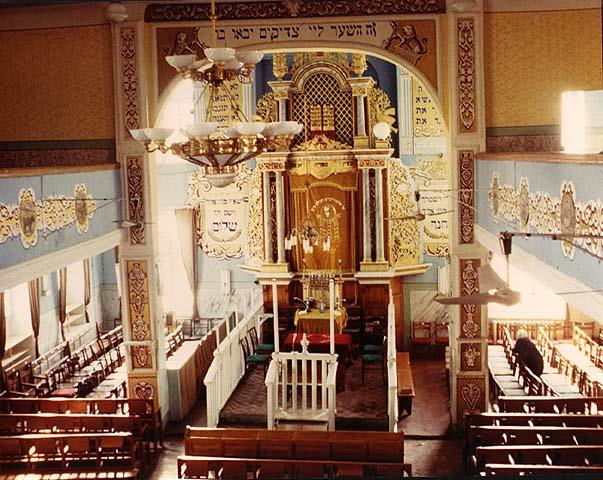
In May 1881 anti-Semitic pogroms broke out. Many Jews were wounded, Jewish property was damaged, and about 800 families ruined. Until the 1917 Russian revolution, the city became notorious for police "hunt attacks" on illegal Jews. Despite this, the Jewish population grew from 50,000 in 1910 to over 81,000 in 1913, and probably even more evaded the census. Many Jews were employed in factories in and around Kiev. Some were wealthy, such as the sugar industry magnates Brodsky and Zaitsev. Most were engaged in the liberal professions and there were 888 Jewish students in Kiev University in 1911 - the largest concentration of Jewish students in a Russian university. Hebrew writers lived in the city, notably J. Kaminer, J.L. Levin (Yehalel), M. Kamionski. L.J. Weissberg, E. Schulman, and A.A. Friedman. Shalom Aleichem lived in Kiev for a while and described it in his account of "Yehupets". A harsh pogrom hit Kiev on October 18, 1905, but despite the increased impoverishment of the lower classes, the Jewish community continued to be one of the wealthiest in Russia. In 1910 there were 5,000 Jewish merchants (42% of the town's merchants), but one quarter of the community still had to apply for Passover alms that year. A general hospital was established in 1862, a surgical hospital, a clinic for eye diseases (under the direction of M. Mandelstamm), and other welfare institutions. In 1898 a magnificent synagogue was built by means of a donation from L. Brodsky. From 1906 to 1921 S. Aronson was rabbi, and among the "government appointed" rabbis were Joshua Zuckerman and S.Z. Luria. During World War I residence restrictions were lifted for Jewish refugees from battle areas. In 1917 all residence restrictions were abolished and by the end of that year there were 87,240 Jews in Kiev (19% of the population). A democratic community was set up by the Zionist Moses Nahoum Syrkin and meetings and conferences of Russian Jews were held in Kiev. Books and newspapers were published by the different parties, and cultural and educational activities began in Hebrew and Yiddish. In spring 1919 the Jewish population reached 114,524. With the first Russian conquest of the town (February-August 1919) the running of the community was handed to the yevsektsyia and the systematic destruction of public life began. With the retreat of the red army, a self-defense army was founded, and when Petlyvra's forces entered the city they arrested them and 36 were executed. Denikin's gangs killed and pillaged the Jews until driven out by the red army (December 1919). Jews suffered from famine and typhus. With the addition of refugees from the Ukrainian pogroms the Jewish population swelled. In 1923 Kiev had 128,000 Jews - and by 1939 there were 175,000 (20% of the population). In the 20 years of Russian rule Kiev became the center of Yiddish culture, officially fostered by Moscow with a network of schools and higher education institutions for thousands of students. At its head was the department of Jewish culture of the Ukrainian academy of sciences which in 1930 became the institute of proletarian Jewish culture directed by Joseph Lieberberg. Valuable research work was published there and a group of intellectuals went to Birobidjhan to organize cultural and educational activities there. With the liquidation of Jewish institutions at the end of the 1930s, one of the most important centers of Soviet-Yiddish culture ceased to exist.
The Holocaust Period
The Germans occupied Kiev on September 21, 1941, and on the 29th and 30th of that month, aided by Ukrainian militia, killed tens of thousands of Jews at the ravine Babi Yar near the Jewish cemetery. After the liberation, a Soviet investigation committee reported that 195,000 citizens and prisoners of war were executed in Kiev in mobile gas vans or by shooting - more than 100,000 of them at Babi Yar. In May 1943 the bodies were burned in ovens dug into the mountainside. Attempts to found a memorial to those who perished in Babi Yar were thwarted by the authorities, and the place became a symbol in the argument against anti- Semitism in Russia, aided by intellectuals like Yevgeni Yevtushenko and Victor Nekrasov. Thousands of Jews who returned to liberated Kiev were confronted by the hatred of the residents, for many of them were survivors of the great massacre, but within 15 years the number of Jews grew to 200,000. About 15% said that Yiddish was their mother-tongue, as did 33% of the
Jews in the towns around Kiev. A synagogue was founded for 1,000 worshipers, and beside it a mikveh, a place for the ritual slaughter of poultry, and a Matzot bakery. Private "minyanim" were abolished. Rabbi Panets, the last rabbi of Kiev, officiated in 1960. During the leadership of Bardakh as chairman of the synagogue board, the atmosphere was relaxed and visitors from abroad were cordially received. In 1961 the situation worsened when Gendelman became chairman, and he was forced to resign six years later.
In 1957 four Jews were imprisoned for "Zionist activity". One of them, Baruch Mordekhai Weissman, kept a Hebrew diary which was smuggled out and published in Israel. In the same year the municipality closed the old cemetery near Babi Yar, permitting the Jews to transfer the remains to the new cemetery. Kiev continued to be a center for Yiddish writers, many of whom had been imprisoned by Stalin, among them Itzik Kipnis, Hirsch Polyanker, Nathan Zbara, Eli Schechtman, and Yehiel Falikman. The anniversary of Babi Yar became a rallying day. The engineer Boris Kochubiyevski was arrested in 1968 for "spreading slander about the Soviet regime" after he had applied for an exit permit to Israel for himself and his non-Jewish wife. In summer 1970 ten Jews from Kiev wrote an open letter and because of it renounced their Soviet citizenship and asked to become citizens of Israel. Traditional anti- Semitism flourished in the city with the appearance of T. Kitcho's book published by the academy of sciences of the Ukrainian republic.
In 1970 there were 152,000 Jews in Kiev (about 10% of the total population).
A religious awakening started among the Jews of Kiev' in spite of the decline in their number, following the collapse of the communist regime in the 1990's. Synagogue, Jewish schools and communal institutions were opened and expanded.
In 1997, following immigration to Israel, the Jewish population of Kiev numbered 110,000 people, being more than a third of the total number of Jews in the Ukraine.
Early 21st century
In the early 2000s, the Jewish population of Kiev was estimated at 100,000. Kiev was the center of Jewish life in Ukraine; the city hosts the main offices of all major Jewish organizations, including the American Jewish Joint Distribution Committee (JDC) and the Jewish Agency. The Federation of Ukrainian Jewish Communities (FUJC), the main umbrella organization of local Jewish organizations was established in Kiev in 1999. The Great Choral Synagogue of Kiev, also known as the Podil synagogue, is the oldest synagogue in Kiev, located in the historic district of Podil. Under the leadership of Rabbi Yaakov Dov Bleich, Chief Rabbi of Ukraine, the Podil synagogue serves as a community center and includes also a yeshiva, the Ohr Avner heder, the Or-Avner Perlyna kindergarten and school, a senior citizen home, an orphans home, a kosher restaurant, a funeral house, a social assistance center and a rabbinical court.
Additional synagogues in Kiev include the Brodsky Choral Synagogue, the largest synagogue in Kiev, and the Galitska Synagogue. The Center for Jewish Culture and History is located next to the Galitska synagogue and is responsible for various cultural activities for youth as well as for the general public. It also administrates the Jewish Museum. Additional Jewish organizations in Kiev include Conservative and Reform communities, the last one under the leadership of Rabbi Alexander Dukhovny.
Melech Chmelnitzki
(Personality)Melech Chmelnitzki (1885-1946), poet, born near Kiev, Ukraine (then part of the Russian Empire). Chmelnitzki studied medicine in Vienna, Austria and in 1919 began writing articles on medical issues for the New York Jewish daily Forward. In 1939 he immigrated to New York, USA.
Chmelintzki wrote impressionistic poetry and published three volumes of Yiddish poems. He was among the first to translate Yiddish poetry into Polish. He died in New York, USA.
Mikhail Kroshner
(Personality)Mikhail Yefimovich Kroshner (1900-1942), composer, born in Kiev, Ukraine (then part of the Russian Empire). Kroshner studied in Minsk and became interested in the folklore of Belarus, integrating folk tunes into his compositions. He didn't succeed in escaping the Nazi occupation (1941) and perished in Minsk in 1942.
Among his works are The Nightingale, ballet music (1939); The Drowned Man, cantata; Symphonic Dances and String Quartet, as well as songs and arrangements of Jewish folk songs for voice and piano.
Ephraim Katzir
(Personality)Ephraim Katzir (Katchalsky) (1916-2009), the fourth President of the State of Israel, born in Kiev, Ukraine (then part of the Russian Empire), where his parents had fled during World War I. He spent his early childhood in Kiev and in Lodz, Poland. In 1925, when he was 9 years old, the family immigrated to the Land of Israel and settled in Jerusalem.
Following his older brother Aharon (who later became known as one of Israel's foremost scientists and who was killed in a terrorist attack at Lod International Airport in 1972), Ephraim completed his academic studies at the Hebrew Gymnasium in Rehavia. In 1932, Ephraim began studies in the Biology Department at the Hebrew University, Mt Scopus. In the course of time, the brothers moved, one after the other, to the Chemistry Department that was opened at the university in the middle 1930s. Ephraim Katzir received his Master of Science degree from this department in 1938 and his Ph.D. in 1941. He was later appointed a teaching assistant at Hebrew University and began his scientific research. While a student at the Hebrew University, he served as a youth leader in the youth movement Hanoar Haoved and an active member of the Haganah. In 1939, he was graduated from the first officers' training course of the Haganah and was commander of a company of students in the field units. He took part in various activities of the organization in developing explosives and other munitions. In May 1948, at the height of the War of Independence, he was appointed Commander of the I.D.F. Science Corps.
Professor Katzir was one of the founding scientists of the Weizmann Institute of Science in Rehovot, which was inaugurated in 1949. He established the biophysics laboratory there and headed it until he was elected President. He trained many students in the department, some of whom are among the pillars of Israeli science, and he conducted and directed a series of important scientific studies. His work in developing polyamino acids as models of natural proteins helped greatly in understanding the biology, chemistry, and physics of proteins. His imprint is marked, among other places, in deciphering the genetic code, in understanding immune reactions, and in developing medicines and various synthetic materials. Professor Katzir developed his pioneering work in researching non-soluble (immobilized) enzymes that form the basis for important biotechnology industries. The methods that he developed served, in an expanded form, to produce antibiotics and other important substances. He was awarded the prestigious Japan Prize for his work in 1985. This prize joins a line of prizes and honors that Professor Katzir won both in Israel and abroad throughout his long professional career.
Professor Katzir was active not only in the field of science, but also in the public arena. He was one of the senior advisors of the defense ministers and security forces, and from1966 to 1968 he served as Chief Scientist of the IDF, directing its research and development activities. During this period, many innovations took place in the field, and new projects were started that both contributed greatly to the security of the country and had a profound influence on civilian industries.
Between 1966 and 1969, he accepted the invitation of Prime Minister Levi Eshkol to head a committee charged with advising the government on organizing its scientific research. This committee submitted detailed recommendations, including the appointment, in several government ministries, of Chief Scientists charged with promoting applied research in governmental institutions. This led to greater cooperation among the government, academia, industry, and agriculture. This also led to a dramatic increase in government spending both on applied research and science-based activities in the Israeli economy. One of the conspicuous consequences of this development was the establishment of science-based industries, with the encouragement and support of the Chief Scientist in the Ministry of Industry and Commerce. Professor Katzir was involved in various aspects of scientific education, founded the scientific journal Mada, and headed the Israeli Association for the Promotion of Science. He was one of the initiators and advocates of extracurricular clubs for “young scientists.”
Professor Katzir's presidency began on May 24, 1973. Four months later, the Yom Kippur War began, and, during that period, he made numerous visits to the front lines to meet combat soldiers, to visit the homes of bereaved families, and to visit the wounded in the hospitals. In November 1977, toward the end of Katzir's term, the President of Egypt, Anwar Sadat, made his historic visit to Jerusalem, and Katzir was his official host. Between these two dramatic high points, a very difficult war on the one hand and a dramatic breakthrough in the peace process on the other, President Ephraim Katzir participated heavily in education and social issues. He filled an important role in developing and implementing a program to establish Jewish studies at academic centers worldwide, helped institutions of higher education in Israel, and was attentive to the problems of the educational system. He also helped disadvantaged families and encouraged voluntarism, which he regarded as an important measure both for reducing social gaps in Israeli society and increasing solidarity and unity. At his initiative, the Presidential Award for Volunteerism was inaugurated, a prize granted annually in recognition of 12 individuals who distinguished themselves in volunteer work.
In all of his public appearances during his presidency, Professor Ephraim Katzir took care to remind the citizens of Israel of the dream of the founding fathers of Zionism to establish a model society as an integral part of restoring Jewish sovereignty in the historical homeland. At the same time, he never tired of telling his fellow scientists that they must leave their ivory towers and contribute toward improving society and solving its problems.
At the end of his presidency, in May 1978, Professor Katzir resumed his scientific activity. He was not content just to remain at the Weizmann Institute. Following his initiative, a Department of Biotechnology was inaugurated at Tel Aviv University, which he headed. Following the recommendations of the governmental committee, the government began to encourage biotechnological industries (whose scale of imports approaches one billion dollars annually). He also served as international President of the ORT vocational school network, helped establish other colleges, and continued to advise government agencies.
Official biography from the website of the President of Israel
http://www.president.gov.il/defaults/default_he.asp
Rosina Lhevinne
(Personality)Rosina Lhevinne (born Rosina Bessi) (1880-1976), pianist, born in Kiev, Ukraine (then part of the Russian Empire). She married pianist Josef Lhevinne in 1898, shortly after her graduation from the Moscow Conservatory. She almost gave up her own career in order to assist him with his teaching and appearances. Nevertheless, she gave numerous recitals with her husband. The couple settled in the USA in 1906 but went back to Berlin in 1907, returning to the USA in 1919. From 1938 Rosina Lhevinne taught at the Juilliard Graduate School in New York. Among her pupils were John Browning, Van Cliburn and James Levine. On occasion she performed publicly as a soloist, the last time in 1962. She died in Glendale, California.
Ilya Grigoryevich Ehrenburg
(Personality)Ilya Grigoryevich Ehrenburg (1891-1967), writer and journalist, born in Kiev, Ukraine (then part of the Russian Empire) to an assimilated middle-class Jewish family. Although he took very strong positions against anti-Semitism, Ehrenburg never associated with the Jewish community nor did he speak Yiddish. He considered himself to be a Russian. He was among the most prolific and notable authors of the Soviet Union who published around one hundred titles.
When Ehrenburg was four years old, the family moved to Moscow, Russia, where his father had been appointed to be director of a brewery. After the Russian Revolution of 1905 he was involved in illegal activities of the Bolshevik organisation. In 1908, the Tsarist secret police arrested and imprisoned him. After five months he was allowed to go into exile in Paris, France, where he started to work in the Bolshevik organisation, meeting Vladimir Lenin and other prominent exiles. He also began to write poems and translated some foreign writers' works into Russian. During the World War I Ehrenburg became a war correspondent for a St. Petersburg newspaper. He wrote a series of articles about the mechanized war that later on were also published as a book ("The Face of War"). His anti-communist poem, 'Prayer for Russia', appeared in 1917. His poetry of this time was also about of war and destruction.
Between 1921 and 1924 Ehrenburg lived in Berlin, Germany, and Belgium. His first novel, "The Extraordinary Adventures of Julia Jurenito and his Disciples" (1922) ridiculed both the capitalist West and the Communist system. He also viewed skeptically the era of the New Economic Policy in the Soviet Union. "Zhizn i gibel Nikolaya Kurbova" (1923) was about the downfall of a Soviet secret policeman and "The Love of Jeanne Ney" (1924) depicted a love affair between a Russian Communist and a French woman. "Out of Chaos" (1934) was an apologia for Socialist Realism, and in "Ne perevodya dykhania" (1935) the writer accepted the official Communist policy in economic and political matters.
During the Spanish Civil War, he wrote for the Soviet newspaper "Izvestiia". He met Ernest Hemingway in Madrid, Spain. In 1941, he returned to Moscow and listened to Stalin's radio speech after the Nazis had attacked the Soviet Union. His ambitious novel, "The Fall of Paris" (1941-1942), depicted the decline of capitalist France. Ehrenburg's reputation and position as the head of propaganda for the Red Army during the war, made him a target of Goebbel's propaganda. When he reported on Nazi atrocities after visiting concentration camps, he pleaded the U.S. public to believe him. Some of his articles during World War II were extremely anti-German and he was accused of orchestrating a hate-campaign. His article "Kill" published in 1942 — when German troops were deeply within Soviet territory — became a widely publicized example of this campaign. Ehrenburg was a prominent member of the Jewish Anti-Fascist Committee.
In 1954, Ehrenburg published a novel titled "The Thaw" which tested the limits of censorship in the post-Stalin Soviet Union. The novel gave its name to an entire era of Soviet cultural politics, namely, the liberalization after the death of Joseph Stalin.
During the remainder of his life Ehrenburg spent as a respected messenger of the Soviet state. Without being a member of the Communist Party, he moved freely in foreign countries and held important cultural positions. Ehrenburg published poetry, short stories, travel books, essays, and several novels, which combined patriotism with cosmopolitanism. Ehrenburg adapted his writings to Soviet political demands and avoided conflicts, that destroyed many other writers and artists.
Together with Vasily Grossman, Ehrenburg edited "The Black Book" that contains documentary accounts by Jewish survivors of the Holocaust in the Soviet Union and Poland. The book has special historical significance; detailing the genocide on Soviet citizens of Jewish ancestry, it is the first great documentary work on the Holocaust. Ehrenburg was also active as a poet till his last days, depicting the events of World War II in Europe, the Holocaust and the destinies of Russian intellectuals.
At his 70th birthday celebration he said “Even though my passport states that I am a Jew, I am a Russian writer” - implying even in 1961 Jews in the Soviet Union were not fully accepted as being members of the Russian people.
Reinhold Moritzevich Gliere
(Personality)Reinhold Moritzevich Gliere (1875-1956) , composer and conductor, born in Kiev, Ukraine (then part of the Russian Empire), to a family of Belgian origin. He taught at the conservatories of St. Petersburg (1913-1920); Kiev (1913-1920; from 1914, director) and Moscow (1920-1941). Among his students were Sergey Prokofiev and Aram Khachaturian.
His works belong to the national Russian tradition, bear the influences of mid-Asian folk music and are partly concerned with themes of the Revolution. He wrote, among other compositions, three symphonies (1900, 1907 and 1911); concertos (for harp, 1938; for voice, 1942); symphonic poems, operas (Shah-Senem, 1932-34; Lrache, 1943); ballets (Cleopatra, 1925; Red Poppy, 1927; The Bronze Horseman, 1949; Taras Bulba, 1952); chamber music, songs and piano works. He won both the Lenin and the Stalin Prize. He died in Moscow, USSR.
Eliezer Mordecai Gerovich
(Personality)Eliezer Mordecai Gerovich (1844-1913), cantor and composer.
Born in Ukraine (then part of the Russian Empire), he was sent to study music in Berdichev when he was eighteen years old. There he became assistant cantor at the so-called Choral Synagogue. He also studied cantorial music with Nissan Blumenthal in Odessa and attended the St. Petersburg Conservatory. In 1887 he was appointed chief cantor in Rostov-on-Don, a post he held until his death. Gerovich's compositions of synagogue music were based on traditional Jewish melodies and were collected in two volumes entitled Schire Tefilla and Schire Simra (1897). He died in Rostov-on-Don, Russia.
Nahum Nardi
(Personality)Nahum Nardi (born Nahum Naroditski) (1901-1977) , composer and pianist, born in Kiev, Ukraine (then part of the Russian Empire). He studied piano and composition in Kiev, Warsaw and Vienna and came to Eretz Israel in 1923. He gave piano recitals, but soon turned to composition. Enchanted by oriental music, he integrated the sounds into the songs he composed. For many years he collaborated with the singer Bracha Zefira and was her husband from 1931 to 1939, accompanied her on the piano and arranged music for her. His songs number in the hundreds and reflect the life of the country. Today they are an integral part of Israeli folklore. He died in Tel Aviv, Israel.
Mordechai Ze'ira
(Personality)Mordechai Ze'ira (1905-1968) Composer. He was born in Kiev, Ukraine. His involvement in the Zionist Youth Movement led to his arrest. In 1924 he came to Eretz Israel. He worked as a brick layer, a fisherman in Acre, and from 1933 in Rutenberg electrical plants. He never studied composition yet he is the author of many of Israel’s most popular songs. His music derives its inspiration from Russian revolutionary songs, folk Russian and Russian-Jewish songs, and the sounds and landscapes of the country. He died in Tel Aviv, Israel.
Golda Meir
(Personality)Golda Meir (1898-1978), Labour Zionist leader, diplomat and Israel's fourth Prime Minister, born in Kiev, Ukraine (then part of the Russian Empire) as Golda Mabovitch. In 1906 the family brought her to the United States and lived in Milwaukee. At school she joined a Zionist youth movement, Poalei Zion. She went on to marry Morris Myerson and the couple emigrated to Mandate Palestine in 1921. They initially joined Kibbutz Merhavia. Three years later they moved to Jerusalem, where Golda Myerson, now known as Golda Meir, became a staff member of the Histadrut labour federation and held a succession of positions in their trade union and welfare departments and also in the federation's construction corporation, Solel Boneh.
Later she was appointed head of the Histadrut political section where she was able to work to further the organization's aims of encouraging Jewish immigration to Palestine. Between 1932 and 1934 Meir worked as an emissary in the United States, serving as secretary of the Hechalutz women's organization. In 1946 she became director of the political department of the Jewish Agency in which capacity she met with King Abdullah of Jordan in an unsuccessful attempt to avoid war between Jews and Arabs when the British gave up their Mandate over Palestine. Elected to the Executive of the Jewish Agency, she was active in fundraising in the United States to help cover the costs of the Israeli War of Independence, and became one of the State's most effective spokesmen.
In June 1948, Meir was appointed Israel's first ambassador to the Soviet Union. In 1949 she was elected a Member of the Knesset and was chosen by Prime Minister Ben Gurion to be Minister of Labour during the years of mass immigration and resulting social unrest and high unemployment. She initiated policies of subsidized housing and social welfare in order to speed the integration of the newcomers into Israeli society.
Between 1956 and 1966 Meir was Minister of Foreign Affairs and inaugurated policies of assisting the development of the newly independent nations of Africa. At the same time, she endeavored to cement relations with the United States and other countries. When in 1969 Prime Minister Levi Eshkol died, she was chosen to succeed him. In the October 1969 elections, she led the Labour party to victory. Shortly after she took office, the "War of Attrition" broke out. Initially this war was a series of sporadic military actions along the Suez Canal, but they escalated into full-scale war which ended in a cease-fire agreement with Egypt in 1970. As Prime Minister, Meir concentrated much of her energies on the diplomatic front mixing personal diplomacy with skillful use of the mass media. Armed with an iron will, a warm personality and grandmotherly image she successfully solicited unprecedented amounts of financial and military aid for Israel.
Although she showed strong leadership during the surprise attack of the Yom Kippur War, securing an American airlift of arms while standing firm on the terms of disengagement-of-forces negotiations, the Prime Minister considered the very outbreak of war and Israel's unpreparedness to be a personal failure. Golda Meir therefore bowed to what she felt was the "will of the people" and resigned in mid-1974. She withdrew from public life and began to write her memoirs.