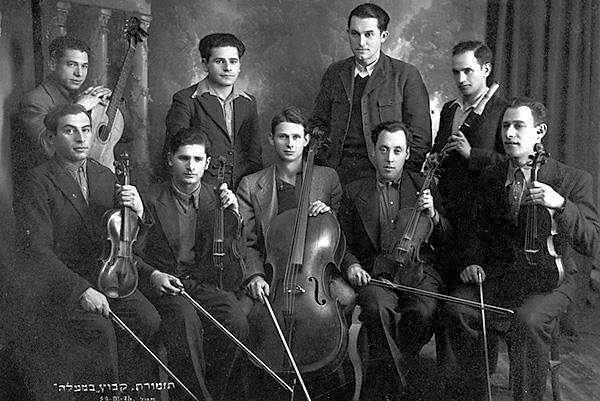
The Jewish Community of Klaipeda
Klaipeda
In German: Memel. The Jews adopted the German name Memel, former Memelburg.
A port on the Baltic sea where the Dange river flows into the Kury bay, western Lithuania.
The city was founded in the middle of the 13th century by the Teutonic knights and was part of Prussia. From its beginnings until the 15th century it was frequently attacked by its neighbors the Poles and the Lithuanians. In the first half of the 17th century the city was under Swedish rule for a short period. Twice it was occupied by the Russians in 1757 during the seven year war and in 1813 during Napoleon's retreat from Russia.
After World War I, Memel was separated from Germany and in 1919 placed under a French mandate from the League of Nations. A Lithuanian uprising in 1923 forced the French to leave. In 1924 "Status Memel" was approved according to which the city was annexed to Lithuania and recognized as the capital of an autonomous region.
Jews were residents of Memel as early as the 15th century and the city archives contain documents of "Jew-taxes". The community was dissolved in 1567 when the Jews were ordered to leave the city within five months. For almost a hundred years Jews were not allowed to enter Memel except once a week for business reasons and even then they were not allowed to sleep there. Only in 1643 Jews who had come to Memel for business on Friday especially during the short winter days, were allowed to stay in the city on the Sabbath.
After 20 years, in 1664 the Jew Moshe Jacobson de Yonge came from Amsterdam with his family at the invitation of prince Frederick Wilhelm of Brandenburg. De Yonge contributed greatly to the development of commerce and shipping and initiated the salt trade. He brought with him a cantor, a shochet (ritual slaughterer) and teacher. He established a synagogue for himself and his assistants. During a short period there was a renewal of the Jewish community in the city. But after 20 years de Yonge left Memel and once again there were no Jews there.
Each year the authorities published an edict forbidding the entrance of Jewish peddlers into the city. The announcements were posted on the walls of the town hall. Only at the yearly trade fair were Jews allowed to come with their merchandise. Documents in the city archives show that in 1798 a Jewish merchant rented 14 stalls. Jewish merchants from Lithuania and Russia brought agricultural produce and expensive furs. They bought merchandise from the west to sell it in turn in their countries. Hebrew books both religious and secular were sold at the fair, sometimes whole libraries of assimilated Jews from Germany whose interest in Hebrew literature had lapsed. These books were much in demand in Eastern Europe where Hebrew presses were scarce. The edict forbidding Jews except for a few court Jews to settle in Memel was in force during all the 18th century. When the philosopher Moses Mendelsohn, the "father of Jewish enlightenment" and a friend of many German men of letters came to Memel on business, he was not allowed to spend the night there.
The limitations on Jewish settlement in Memel were lifted in 1812 as a result of the emancipation granted to the Jews of Prussia that year. The Jewish community was renewed and according to the census of 1831 there were 600 Jews there in addition to the Jews who traveled to Memel for business reasons and stayed for a short time.
In 1823 the Jewish cemetery was consecrated. It was the first Jewish religious institution in Memel. Before that the Jews of Memel were buried in cemeteries in Lithuania. Licenses to cross the borders were difficult to obtain, witness the story of a corpse which was brought in a wagon with his pipe still in his mouth.
There were two groups in the Jewish community in Memel which established its character; the Jews who came from Germany and the polish and Lithuanian Jews. Although they kept their separate identities, it did not prevent them from living side by side cooperating fully and without tensions.
In the forties of the 19th century the first synagogue and ritual baths were built by the timber merchants from Poland and Russia who lived in Memel during the autumn. It was called the Polish shul. Later in the middle of the 19th century a study house was established by the Lithuanian Jews who also used it for prayer services. In the middle of the century the German Jews founded their own synagogue.
In 1847 the established Jewish communities of Germany and Eastern Europe gained autonomy and every Jew was obliged to belong to the congregation and pay taxes. The edict of the authorities demanding the union of the different congregations did not arouse opposition and in 1862 a united community was founded. It was organized with the help of outside experts who founded the necessary communal institutions. In 1860 rabbi Israel Salanter came to Memel. He had founded the Musar (ethics) movement in 1843 in an effort to strengthen Judaism vis-a-vis the various ideological movements that flourished in the 19th century. His purpose was to disseminate his message in the cities of Germany as a shield against assimilation. His stay in the city left its mark on the community. His home was the centre for Jewish intellectuals who came to hear his sermons. He also published 12 issues of the weekly "Hatvuna" which printed torah commentaries of the great scholars of the time. He helped the consolidation of the community institutions and in 1862 together with rabbi Yitzchak Ruelf organized the burial society which was recognized by the authorities. This event was the foundation of the organized Jewish community. Rabbi Salanter organized several groups among them "Chevrat Lomdei Gemara" and "Chevrat Shas" (study groups) and gained many adherents and followers for his movement.
In 1865 rabbi Yitzchak Ruelf of German background was appointed rabbi of the community and officiated at this post for 33 years. The rabbi who had an extensive secular education was active in many fields. He edited the newspaper "Memeler Dampfboote", published five volumes on philosophy and also published works concerning Jews like "The Defense of Jews" the "Jews of Russia" and others. He was one of the founders of the synagogue of German Jews. He took part in almost all the social and cultural activities in the city. He was called "Dr. Hilf" (help). During the years 1867-69 there was a famine in Lithuania and in 1868 a cholera epidemic. The Lithuanian Jews in Memel organized an aid committee and Dr. Ruelf was chosen as executive secretary. In 1869 the year the committee functioned the German Jews and "the alliance" organized groups to receive the many immigrants from Lithuania at the German Russian border and aid them. During the eighties Dr. Ruelf was one of the founders and leaders of the "committee for aid to Russian Jews" which collected donations from Jews of the Diaspora for Jewish victims of the pogroms in southern Russia. As a result of the pogroms, many refugees passed through Memel on their way to the west and overseas.
In 1894 rabbi Ruelf founded a free loan society and in 1897 a charitable society for the aid of the needy. With the help of donations from German Jews and the lumber merchants of Russia rabbi Ruelf organized a hospital where poor Lithuanian Jews could also receive treatment. With the passing of time the original building proved to be too small and with the aid of donations a new building surrounded by gardens was erected on a hill overlooking the beautiful countryside. The building dedicated in 1896, was built on a plot purchased by the banker Leopold Alexander who bequeathed his fortune to the hospital. His brother-in- law Leon Rostowski, a wealthy educated man donated much of his wealth to the hospital and erected a large new wing.
In 1880 an elementary school "Israelitische Religions Schule" was established where Torah studies, Hebrew and German were taught. A year later there were 86 pupils in the school. The young people studied in the government schools and attended Jewish schools in the afternoon. The tolerance prevalent in the community was the reason that even the Haskala (enlightenment) movement did not meet the harsh opposition so typical of many communities in Lithuania. The community in Memel was able to absorb new ideas without undue friction. In 1896 "Chevrat Kiryat Sefer" was established and its purpose was to acquaint German Jews with Jewish history and literature.
In 1886 after an edict to deport Russian citizens from Memel, the number of Jews in Memel decreased. Rabbi Ruelf saw to it that each deported family received some compensation according to the size of the family. Only 100 Jewish families remained in the city. They earned their livelihood from the trade with Russia which was concentrated in their hands. They were under strict supervision of the authorities.
The threat of deportation was real during World War I but not implemented against most of the Jews because of the help of local groups who were ready to testify to the loyalty of the Jews.
After World War I Jews from different places came to Memel because of the ease with which the French authorities granted Jews citizenship and the commercial opportunities in the port city. After the annexation of Memel to Lithuania in 1924 the Lithuanians who were interested in reducing the percentage of Germans in the area encouraged the movement of Jews to the city and in the period between the two world wars the number of Jews tripled. A Talmud Torah was added to the Jewish school network in 1927. In 1936 the first Jewish elementary school was founded.
As a result of the edict of 1812 granting emancipation to the Jews of Prussia, many Jews from Poland and Lithuania came to the city. They were the leading merchants in the trade of lumber, grains and linens. The lumber trade was almost completely in the hands of Jews. With the development of the city, the economy became more varied and Jews became clerks and doctors.
With the annexation of the district to Lithuania after World War I, the Jewish community grew and its economic and social structure changed. Like many Lithuanian Jews, the Jews of Memel invested their money in real estate in the city and countryside. There were Jewish estate owners and farmers.
In the middle of the twenties of the 20th century, a Jewish community bank was founded. There were also private Jewish banks. The local authorities encouraged the development of industry. The Jews opened factories and employed Jewish workers who came from the small towns of Lithuania among them graduates of the O.R.T. Schools. They took the place of the textile experts from Czechoslovakia. The workers and artisans were 40% of the Jewish breadwinners.
At the beginning of the 30s, 25% of the shops in the city and 20% of the factories were owned by Jews. On the eve of World War II 330 factories were owned by Jews, flour mills, wood processing plants, textiles, tobacco, chocolate and others. 70% of the German workers were employed there.
Until 1880, 80% of the Jews in Memel were of east European origin and had strong ties with their brethren in Lithuania and with the Zionist movement. Prominent Jews in the community were nationalist and had great influence. Dr. Ruelf was the first western rabbi who was against the "dissenting rabbis" an expression coined by Herzl to describe the German rabbis who prevented the convening of the first Zionist congress in Munich. He also influenced Dr. Wolfsohn who in his youth had spent some time in Memel and was to succeed Herzl as the head of the Zionist movement.
The annexation of Memel to Lithuania increased the influence of Zionism. The changes in the structure of the Jewish population strenghtenend nationalism and resulted in a Zionist majority in the Jewish community council. The rabbi of Memel in the period between the two world wars, rabbi Eleazer Yehuda Rabinowitz was famed for his researches. He was a member of the mizrahi movement in Lithuania. Many of his articles were published in the Zionist periodical "Die Yiddische Shtimme" which appeared in kovno and encouraged immigration to Eretz Israel.
Among the Jewish workers were many pioneers who wanted to prepare themselves for the new life in Eretz Israel. Those who could not emigrate remained in Memel. Which was a port city and industrial centre and so had favorable conditions for "Hachshara" groups. In 1919, during the period of French rule, an emissary from Kovno arrived who with the help of local groups organized a branch of "Hechalutz" the largest in Lithuania. The pioneers lived as a community (one of which was scheduled to join the Gdud Ha-Avoda in Eretz Israel) and worked in different places even in non-Jewish firms, in agriculture, fishing and industry. Many did their agricultural training on German farms and competed successfully with the German and Lithuanian workers. They also worked in the port and even on shipbuilding. A "Beth Hechalutz" (pioneers' home) of three stories was built with the aid of donations; it became a meeting place and cultural centre for the thousands of pioneers who passed through Memel and for the Zionists in the area. There was also a small hospital and rest home for the pioneers. Many pioneers succeeded in leaving Soviet Russia illegally due to the good relations between the Jewish merchants of Memel and the captains of the freighters most of whom were German. The pioneers were brought to Germany and from there they emigrated to Eretz Israel.
Most of the Zionist parties were active in Memel also Zionist pioneer youth movements. "HaShomer Hazair", Betar, Hanoar Hazioni and others. There were 400 members in the sport groups, Bar-Kochba and Maccabi. The nationalist spirit penetrated social societies like "Yiddishe Kultur Bund" (Jewish cultural society) or the Jewish history and literature club. The editor of the "Memeler Dampfboote" Arye Sheinhaus organized a Hebrew-speaking circle and through their initiative a Hebrew kindergarten was organized. There was also a women's Zionist organization.
In 1938 there were 6,000 Jews in Memel 12,5% of the total population.
The Holocaust Period
When the Nazis attained power in Germany in 1933, anti-Semitic propaganda increased and there were demands to return Memel to Germany. In 1937 the veto of the Lithuanian government prevented the adoption of a law passed by the local parliament forbidding Jewish artisans to work in Memel. The Nazis continued their agitation, smashed windows of synagogues. In 1937 they attacked Jewish summer campers. In 1938 they demanded the adoption of the Nuremberg laws. In the summer of 1938 there was a serious decline in the situation of the Memel Jews. The local authorities acted according to orders from Berlin. Terror was applied, particularly against Jewish doctors. Many Jews in Memel left their businesses. After the Munich pact in 1938, the Jews began to leave the city. During that year about 50% left. At the end of 1938 the Nazis held 26 out of 29 seats in the local parliament and in practice they ruled the city.
After the ultimatum Germany gave Lithuania in March 1939 the German army occupied Memel. The last Jews in Memel went to kovno and other places in Lithuania. The ORT network opened vocational courses for adults and the ort school in Kovno absorbed the young refugee students. When the war between Germany and the Soviet Union broke out in June 1941 all of Lithuania was occupied by the Germans. The fate of the Memel refugees was like that of their Jewish brethren in their new homes.
In January 1945 Memel was liberated by the Soviet army and annexed to the Lithuanian republic of the Soviet Union.
In 1967 there were 1,000 Jews in Memel but there was no Jewish organization there.
Ben-Gurion surrounded by Zionists at the railroad station in Memel, Lithuania, 1933
(Photos)on his arrival at the railroad station
in Memel, Lithuania, April 25, 1933.
(The Oster Visual Documentation Center, Beit Hatfutsot,
courtesy of Israel Sperling, Tel Aviv)
Isaac Ruelf
(Personality)Isaac Ruelf (1831-1902), rabbi and Zionist, born in Rauisch-Holzhausen near Marburg, Germany. He was ordained a rabbi in 1857 and received his secular education from the universities of Rostock and Marburg, receiving a Ph.D. degree. He then became rabbi in Memel and in this post engaged in relief work for Russian Jewry and immigrants from eastern Europe. In 1883 he wrote a treatise Arukhat Bat Ami which anticipated the ideas of political Zionism. With the rise of Herzl he joined the Zionist movement, attending the first five Zionist Congresses. He spent his last years in Bonn, actively working for the dissemination of Zionism in Germany. Ruelf wrote a number of philosophical works.
Israel Ben Zeev Wolf Lipkin Salanter
(Personality)Israel Ben Zeev Wolf Lipkin Salanter (1810-1883), rabbi, born in Žagarė, Lithuania (then part of the Russian Empire), where his father was rabbi. He studied in a yeshiva in Salant, hence his name. Salanter was a child prodigy who delivered casuistic homilies before scholars when he was only ten. However, he became critical of casuistry and concentrated on the study of ethical literature (Musar). He headed a yeshiva in Vilna, 1840-47, and in Kovno,1849-57. In both centers he found a wide following for his Musar teachings. In 1857 Salanter moved to Germany and lived in Koenigsberg. In 1860 he settled in Memel. While there he acquired German citizenship, adopted German dress and preached in German. His most successful achievement was the Musar yeshivot in which, apart from Talmud studies, time was set apart for the study of ethics. His own homilies drew large audiences. One of the most famous episodes in his life was during a cholera epidemic, when from the pulpit he ordered the congregation to eat on Yom Kippur and set himself as an example. In 1880 he moved to Paris to give spiritual leadership to the eastern European Jewish community there. In 1883 he returned to Koenigsberg where he died. Salanter left no writings but his teachings were published by his disciples.
David Wolffsohn
(Personality)David Wolffsohn (1856-1914), Zionist, born in Darbenai, Lithuania (then part of the Russian Empire), he had a traditional education. He lived in Memel (now Kalipeda, Lithuania) and Lyck (now Elk, Poalnd) before becoming partner in a lumber concern in Koen (Cologne), Germany, where he lived from 1888 for the rest of his life.
Early attracted to Zionism he founded in 1893 the Koeln Association for the Furtherance of Agriculture and Handicrafts in Eretz Israel. After the appearance of Herzl's "Jewish State", Wolffsohn journeyed to Vienna to seek him out and became Herzl's close lieutenant. It was Wolffsohn who chose the blue and white colors for the national flag. He accompanied Herzl on his journey to the Middle East in 1898 and in 1901 became the first president of the Jewish Colonial Trust, the financial arm of the World Zionist Organization. After Herzl's death, Wolffsohn was elected his successor as president of the World Zionist Organization (1905). In this capacity he traveled extensively and maintained the political activities of the movement. He was not reelected in 1911, but remained president of the Jewish Colonial Trust.
Mordecai Ish-Shalom Friedman
(Personality)Mordecai Ish-Shalom Friedman (1902-1991), Mayor of Jerusalem, born in Varniai, Lithuania (then part of the Russian Empire). After attending yeshivot he was active in the He-Halutz labor pioneering organization in Lithuania, organizing He-Halutz in Memel (now Klaipėda). In 1923 he settled in the land of Israel where he worked on construction and road building projects for over ten years and was a member of Tel Yosef. In 1935 he became secretary of the Workers Trade Unions in Jerusalem. Ish-Shalom was elected to the Jerusalem Muncipal Council as a representative of Mapai, serving from 1950 to 1955. In 1955 he became deputy mayor and served as mayor from 1959 to 1965. Later, in 1969, he again became deputy mayor, under Mayor Teddy Kollek. He was president of the Jerusalem Bank for Development and Mortgage.
Veivirzenai
(Place)Veivirzenai
Verzhan in Jewish sources
A small town in the Kretinga district, north-western Lithuania. In 1928-1940 in independent Lithuania.
The Verzhan Jews made a living from agriculture and shop keeping. The community had a synagogue and a prayer-house and a line of officiating rabbis. The last rabbi, Rabbi Nataniel Yoseph Gras perished with his community during the holocaust.
In the spring of 1939 many Jewish refugees from the port town of Memel (Klaipeda in Lithuanian), which had been conquered by the Germans settled in Verzhan. At the beginning of World War II there were about 200 Jewish families in Verzhan.
The Holocaust Period
After the outbreak of World War II (September 1, 1939) and the conquest of Poland by the Germans, Lithuania came under Soviet rule and at the end of summer 1940 was annexed by the Soviet Union.
Immediately after the German attack on Soviet Russia (June 22, 1941) the Germans conquered the western region of Lithuania including Verzhan. The town was in the 25 km zone where the SS command had decreed the extermination of all its Jews. At the end of June or the beginning of July 1941 150 Jewish men from Verzhan were taken to a forced labour camp and all the remaining Jewish men were murdered. The women and children were sent to a nearby agricultural estate, the women worked for the Lithuanian peasants and received food for themselves and their children as payment. After some weeks a band of Lithuanians serving as Germans' henchmen in the murder of the local Jews arrived at the estate. The local priest tried to prevent the murder; his appeals to the authorities were to no avail. The women and children were murdered on the estate and buried in a shallow mass grave.
Plunge
(Place)Plunge
In Jewish sources Plungian
A small town in the Telsiai district, north-eastern Lithuania.
Before World War I (1914-1918) Plungian was about 12 km distant from the German border (the region by the Baltic sea which was then under German rule and called east Prussia).
The Jewish presence in Plungian dates from the very beginning of Jewish settlement in Lithuania. In the Jewish cemetery there are tombstones from the 16th century. In 1847 there were 2,197 Jews in Plungian, in 1897 - 2,502 Jews, 50% of the general population. At the beginning of the 20th century with the emigration of Lithuanian Jews to South Africa there was a decrease in the number of the Plungian Jews. In 1921 during the period of Lithuania's independence (1918-1939), there were 2,200 Jews in Plungian.
There were six prayer houses in Plungian, among them the synagogue, the shul built at the beginning of the 19th century; and the prayer house built in the second half of the 19th century. There existed a small yeshiva, a heder (religious school), a Talmud tora; during the period of Lithuania's independence there functioned a Jewish Yiddish elementary school and a Hebrew school of the tarbuth (culture) network, 100 Jewish pupils studied in secondary school. There existed two libraries, in Yiddish and in Hebrew and a reading room in the name of J. L. Peretz.
The last rabbi to officiate in Plungian was Rabbi Abraham Mordecai Wessler.
Plungian served as a commercial center for its rural neighborhood; before World War I it traded with the Port of Memel and with markets in east Prussia. The town held two weekly markets and two big yearly fairs. Most of the Jews made a living from trade. In independent Lithuania the markets beyond the borders were closed; many Jews emigrated to South Africa, the USA and Argentine. In 1923 the number of Jews in Plungian decreased to 1,815. Lithuanian pressure forced the Jews to give up their main trade ventures and the Jewish families made a living from artisanship and a few from agriculture. A chocolate factory employing 30 workers belonged to Jews as did a flour mill, saw mill and an electric power station.
In 1929 the Jewish bank had 321 members. At the same time a Jew acted as vice chairman in the town council.
Between the two world wars there were branches of all Zionist organizations in Plungian as well as of the sport organizations Maccabi and Hapoel, a Zionist women's group and youth movements. Hehalutz had a training program for young people who later went to Eretz Israel. There were Jews in the local underground communist organization.
Prior to World War II there were 1,700 Jews in Plungian.
The Holocaust Period
After the outbreak of World War II (September 1, 1939) and the conquest of Poland by the Germans, Lithuania came under Soviet rule and at the end of summer 1940 was annexed by the Soviet Union.
When the Germans attacked Soviet Russia (June 22, 1941) many Jews attempted to escape from Lithuania; only few succeeded to join the retreating officials of the Soviet regime, the rest was forced to return to Plungian. Already on the second day of the war a local committee of nationalistic Lithuanians was set up in order to take over the town. The populace was told to receive the Germans with pleasure. On June 26 the Germans entered the town, distributed vodka to the population and called for the extermination of the enemies of the people, meaning the Jews and the communists.
On the same day Jews connected with the Soviet regime were murdered in the main square of the town. On the second day of the Lithuanian committee's rule, the Jews were ordered to leave their homes and transfer to buildings in the synagogue yard. Only a few sick Jews and Jews whose professions were necessary to the local population (like physician, pharmacist, smith) stayed in their homes. The Jews were kept under heavy guard. They were exposed to brutal maltreatment of which many died. Young people were taken day by day for forced labor.
When the date was set for the extermination of the Plungian Jews, the Lithuanians set several fires in the town, accused the Jews of arson and under this pretext returned all the workers to the staging point in the synagogue yard. During this action a number of Jews were murdered. Some dozens of young Jews were also murdered on the way from the farms to the synagogue yard.
On July 13, 1941 Lithuanian policemen opened fire around the synagogue; later they took out the Jews in groups to a place where pits had been dug beforehand and shot them into the grave pits. Many Jews were brutally murdered on the way to the pits. Close to 2,000 Jews are buried in mass graves in the killing fields near Plungian.
The synagogue was used last time in 1940. The building survived WW2, but was demolished in 2008.