Skip to website content >
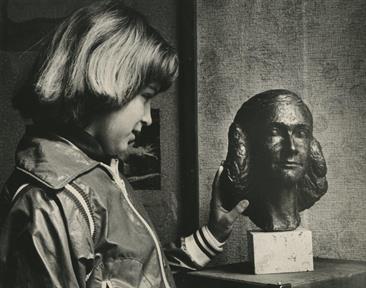
Young visitor in Ana Frank House, Amsterdam, Holland, 1977

Anne Frank

Anne (Annelies Marie) Frank (1929-1945), author, born in  Frankfurt on Main, Germany. She was taken with her family to Amsterdam after the Nazis seized power in 1933. After Holland was invaded in 1940, her father prepared for the eventuality of hiding and in July 1942 the family and a few friends moved into the attic of the vacant annex of her father's business premises where they were hidden by four of her father's employees. For the next two years they remained in the attic and Anne kept a diary of their life. In Aug. 1944, after being tipped off, the Germans arrested them all and send them to death camps. Anne and her sister were sent to Bergen-Belsen Nazi concentration camp where they died of typhus in March 1945. Her diary was discovered by one of those who had hidden them and given to her father who survived the war. First published in 1947, it became a recognized world classic translated into numerous languages. The house in which they hid, known as the Anne Frank House, became a center of pilgrimage for visitors from all parts of the world and houses the Anne Frank Foundation established to fight anti-Semitism and racism.

FRANK

Surnames derive from one of many different origins. Sometimes there may be more than one explanation for the same name. This family name is a toponymic (derived from a geographic name of a town, city, region or country). Surnames that are based on place names do not always testify to direct origin from that place, but may indicate an indirect relation between the name-bearer or his ancestors and the place, such as birth place, temporary residence, trade, or family-relatives.

The Franks were a group of Germanic tribes living between the river Main and the North Sea, whom the Romans called Franci/Francos in the 3rd century CE. Franconia, first used in a Latin charter of 1053, Francia, France and Franken were names applied to a portion of the land occupied by the Franks which became one of the stem-duchies of medieval Germany. The present name of France in German, Frankreich, that is "empire of the Franks", has its origins in the establishment of the Frankish monarchy in Gaul by Clovis in the 5th century, and the eventual transformation of the Regnorum Francorum Occidentalium ("the western kingdom of the Franks"), as defined by the treaty of Verdun (843), into the heartland of the modern French state. Jews lived on the territory of France since the 4th century. Franco means "free/generous" in Spanish. In Ladino (Judeo-Spanish), it is the equivalent of the Arabic Franji/Ifranji, that is "Franks". Since the 12th century, these three terms were used in the east Mediterranean Muslim countries to designate all Europeans. In the 16th and subsequent centuries, the word Franco is found in Sephardi rabbinic literature as a name for European Ashkenazi Jews. In Eastern Europe, it first came to mean a Jew who was a Turkish subject, and then a Sephardi Ladino-speaking Jew. The family name Frank may also me associated with places such as Frankenberg and Frankenau in Hesse, Germany, Frankenburg in upper Austria, Frankenstein (Zabkowice) in Poland, and others. During the Inquisition in Spain, the members of a pre-15th century Spanish Franco family moved to Amsterdam, Venice, Tunis, Crete and London. The name is documented in Salonika (Greece) in 1492 and Bordeaux (France) in 1528. The Italian Franchi, as well as the German Frank and Frankel, are found in the 16th century. Franks, Franck, Franke, Frankenburger and Fraenkel are recorded in the 17th century, Franc and Franklin in the 18th, and Franchetti in the 19th century. The Jewish family name Frank probably originated in the central Rhineland area (western Germany). It is documented in the early 16th century with the Polish Rabbi Menachem Mendel Frank.

Distinguished bearers of this name include Jakob Ben Jehuda Loeb Frank (1726-1791), also known as 'Santo Senor' ("the sacred master"), who was the Polish founder of the Frankist sect which succeeded the Shabbatean Messianic movement; the German chemist Adolph Frank (1834-1916), whose work laid the foundations of Germany's Kali industry; and the German teacher and cantor, Rafael Frank (1867-1920), who invented the modern Frank-Ruehl Hebrew printed letters.
Young visitor in Ana Frank House,
Amsterdam, Holland, 1977
Photo: Leni Sonnenfeld
The Oster Visual Documentation Center, Beit Hatfutsot, Sonnenfeld collection)

Eva Heyman (1931-1944), author of a short diary written in the Oradea ghetto, before being deported to the Nazi death camp at Auschwitz, born in Oradea, Romania. Her parents divorced in 1933 and her mother remarried and moved to Budapest in Hungary. Eva remained in Oradea where she grew up in the home of her mother’s parents who owned a pharmacy in the town. After August 1940, Oradea was part of the territories in northern Transylvania that were occupied by Hungary.
In May 1944 a ghetto was set up in Oradea. Eva began writing a diary in February 1944 describing the anti-Jewish persecutions, the forced relocation in the ghetto, the terror and the violence, the looting of Jewish properties, and then the deportations to Auschwitz. Eva along with her grandparents were deported to Auschwitz on June 3rd, 1944. Her grandparents were sent to the gas chambers immediately after the arrival, Eva was selected for human experiments by Josef Mengele. She was sent to gas chamber on October 17, 1944, after contracting typhus in the camp. Her diary was discovered and preserved by Mariska Szabo, a Christian cook who lived in her grandparents’ house. It was published by her mother, Ágnes (Agi), in Budapest in 1948 and later translated into several languages. Many times Eva Heyman is called Anne Frank of Transylvania or Anne Frank of Oradea.
The University of Oradea opened the Eva Heyman Jewish History Research Center in 2012. The statue of Eva Heyman was unveiled in 2015 in Nicolae Bălecescu Park in Oradea, a place from where 3,000 Jews were deported daily to Auschwitz between May 24 and June 3, 1944. "Eva Stories", a project that screens excerpts from the diary, was launched in May 2019 on Instagram. The project, which is based on a 50-minute film, went viral with over 100 million views in 14 hours and 200 million google searches.  

Frankfurt am Main

Also known as Frankfurt on the Main, Frankfurt, Frankfort

A city in Hesse, Germany.

There has been a continuous Jewish presence in Frankfurt for nearly 900 years, the longest of any city in Germany. After the destruction brought on by the Holocaust, the Jewish community of Frankfurt began to be reestablished after the war. As of the 21st century, Frankfurt contains the fourth-largest Jewish community in Germany with about 7,200 Jews, nearly half of whom are immigrants from the former Soviet Union.

The Frankfurt Jewish community of the 21st century is home to two kindergartens, and the I.E Lichtigfeld School in the Philanthropin. It offers a number of social services and programs for seniors, in addition to the Senior Citizens' Home. There are regular Liberal (Reform) and Orthodox services, as well as a mikvah. The Jewish Adult Education Center (Judische Volkshochschule) offers classes, lectures, and excursions, as well as Hebrew and Yiddish language classes, for those interested in learning about Jewish history and culture. The community hosts a number of events, including the Jewish Cultural Festival. The Jewish Museum of the city of Frankfurt traces the history and development of the Jewish community of Frankfurt, and their interactions with the wider German world. There is also a kosher meat restaurant serving community members and tourists.

HISTORY

During the 12th century, Frankfurt had a flourishing, albeit small, Jewish community who were active merchants. In 1241 a riot broke out; Jewish houses were destroyed, and over three-quarters of the Jewish population (200 people at that time) were killed (West German liturgy has a special prayer recited on the Ninth of Av that commemorates the martyrs). This pogrom apparently originated in a dispute over the forced conversion of a Jew. The emperor, Frederick II, launched an official inquiry into the riot, as an infringement on his interests. At the end of the inquiry the city was granted a royal pardon—at the same time, the pardon also guaranteed the safety of the Jews of Frankfurt, and heavy penalties were imposed on those who would incite violence against the Jews.

By 1270 the city had again become a busy center of Jewish life. The community had a central synagogue (Altschul), a cemetery, a bathhouse, hospitals for locals Jews and migrants, a dance house for weddings and other social events, and educational and welfare institutions. For a long time, the prosperity of the Jewish community, and the profit that the local officials and emperor were able to gain from it, protected the Jews against persecution and anti-Semitism. This changed, however, in the wake of the Black Death; the Jews of Frankfurt fell victim to vicious attacks, similar to those experienced by Jewish communities across Europe. In 1349, shortly after Emperor Charles IV had transferred his rights over Jewish property to members of the city council in anticipation of the violence that was to come, the community was massacred; many set fire to their own homes rather than face death at the hands of an angry mob.

Jews were again allowed to live in Frankfurt beginning in 1360, though this time they had to apply individually for the privilege of living in the city; additionally, residence permits had to be renewed every year, and they came at a high monetary cost. Because of the emigration of the Jews to other areas after the pogrom of 1349, combined with the high price of returning to the city, there were only 12 tax-paying Jewish families living in Frankfurt during the first half of the 15th century. There were still issues with the surrounding non-Jewish community; the city council occasionally considered expelling the Jewish community, and beginning in the 1450s the Jews were forced to wear a distinctive badge, identifying them as Jewish.

In 1462 the Jews of Frankfurt were transferred to a specially constructed street, the Judengasse, which was delineated by walls and gates. In spite of the difficulties imposed by ghetto life, the community, in fact, became stronger and more diversified. Religious and lay leaders were elected by the Jewish taxpayers, and the continuous takkanot laid the basis for powerful, enduring, and jealously guarded, local traditions in all spheres of religious, social, and economic life. Conditions were economically favorable, and through heavy financial contributions and skillful diplomacy the Jews of Frankfurt managed to safeguard their privileges.By the end of the 16th century the Jewish community of Frankfurt had reached a peak period of prosperity.

In addition to its economic prosperity, Frankfurt also became a center of Jewish learning. Students from a number of other areas came to study at the yeshivahs of Eliezer Treves and Akiva ben Jacob Frankfurter. The Frankfurt rabbinate and rabbinical court were among the most prominent and authoritative of the religious authorities in Germany.

Economic and social tensions continued to simmer between the wealthy Jewish families of the city and the guild craftsmen and petty traders, many of whom were in debt to the Jews. These tensions eventually turned into outright violence when, in 1614, a mob led by the guild leader Vincent Fettmilch stormed the ghetto and went on a looting rampage. The Jews were expelled from the city. After the intervention of the emperor, however, Fettmilch, along with six others, were arrested and executed in Frankfurt's town square. Subsequently, the Jews were ceremoniously returned to the ghetto, and a stone eagle was mounted above the gates to the Jewish ghetto with the inscription "Protected by the Roman Imperial Majesty and the Holy Empire." These events were commemorated annually on the 20th of the Jewish month of Adar by the Frankfurt community in a holiday known as the "Purim Winz" ("Purim of Vincent").

During the 17th century the ghetto was overpopulated, leading to unhealthy conditions and resulting in a lack of significant population growth. The Jewish community was also taxed heavily, particularly during the Thirty Years' War (1618-1648). Additionally, their terms of residence were designed to keep their numbers from growing; the Judengasse could not be expanded, and allowed for a maximum of 500 families and 12 marriage licenses annually.

In 1711 a fire broke out in the house of the chief rabbi, Naphtali b. Isaac Katz, which destroyed nearly the entire Jewish Quarter. The inhabitants of the Jewish Quarter found temporary refuge in the homes of non-Jews, but had to return to the ghetto after it had been rebuilt.

The Jewish community of Frankfurt had long been dominated by a few wealthy families, some of whom were known by signs hanging outside of their houses; one of the more famous examples is the Rothschild ("red shield") family, which had its banking center in Frankfurt until the 20th century. The impoverished majority now challenged the traditional privileges of the wealthy, and the city council was repeatedly called to act as an arbitrator between them. The community was further weakened by religious and personal disputes, such as the Eybescheutz-Emden controversy regarding Sabbateanism.

Many in Frankfurt, particularly among the wealthy, were proponents of the enlightenment, as well as of the reforms to Jewish education sought by followers of Moses Mendelssohn in Berlin. This also led to tensions within the Jewish community. Forty-nine of the community's prominent members subscribed to Mendelssoh's German translation of the Bible in 1782; the chief rabbi of Frankfurt, Phinehas Horowitz, denounced it from the pulpit. Later, in 1797, there was a proposal to create a school with an extensive secular studies curriculum, the chief rabbi, Rabbi Horowitz was once again opposed, this time imposing a ban on the project. He was supported by most of the community's leaders, in spite of the fact that many of them had private tutors to teach their children secular subjects.

Meanwhile, the French Revolution was beginning to impact the Jews of Frankfurt, both physically and when it came to the question of their emancipation. In 1796 a bombardment destroyed most of the northern part ghetto. Around that time, the community began to experience greater openness, and more rights; in 1798 the prohibition on leaving the ghetto on Sundays and holidays was ended.

With the incorporation of Frankfurt into Napoleon's Confederation of the Rhine in 1806, the status of the Jews began to change. Ultimately, in 1811 the ghetto was abolished and a declaration of equal rights for all citizens expressly included the Jews. This victory, however, was short-lived; with Napoleon's downfall, the senate of the new Free City attempted to abolish Jewish emancipation, and opposed efforts made by the community's delegation to the Congress of Vienna. Amidst these negotiations surrounding Jewish emancipation were the anti-Jewish Hep! Hep! Riots of 1819. In the end, the senate grated Jews civil equality, while at the same time it reinstated many former discriminatory laws against the Jews.

At the same time that Jews and non-Jews were negotiated the Jews' emancipation, religious rifts within the community widened considerably. In 1804 members of the Jewish community of Frankfurt founded the Philanthropin, a school with a markedly secular and assimilationist curriculum that was also open to non-Jewish students. This school became a major center for Reform Judaism; the school also organized Reform Jewish services for students and their parents. That same year a Jewish Freemason lodge was established in Frankfurt; most, if not all, of the community's board were also members of the lodge. Meanwhile, in 1819 the Orthodox cheders were closed by the police, and the board blocked the establishment of a school for both religious and secular studies. The yeshiva, which had about 60 students in 1793, saw a decrease in the number of students coming to learn there.

In 1843 the number of Orthodox families was estimated at less than 10% of the community. Power was clearly in the hands of Reform Jews, who demanded that "Talmudic" laws, including circumcision and messianism, be abolished. A large conference of the Reform Movement was held in Frankfurt in 1844. A leading member of this group was Abraham Geiger, a native of Frankfurt and a communal rabbi from 1863 until 1870.

The Jews of Frankfurt finally achieved emancipation in 1864. Consequently, the power of the community board weakened considerably. This left an opening for the Orthodox community, who took advantage of the opportunity and formed a religious communal organization, the Israelitische Religionsgesellschaft, and elected Samson Raphael Hirsch as their rabbi in 1851. The Rothschild family made a large donation for the founding of a new Orthodox synagogue. Ultimately in 1876, after years of feeling ignored and slighted by the community board, the Orthodox organization seceded from the community and set up a separate congregation. At that point the community board was willing to make concessions, allowing those Orthodox Jews who did not want to secede to remain within the community.

The Jewish population of Frankfurt numbered 3,298 in 1817 (7.9% of the total population), 10,009 in 1871 (11%), 21,972 in 1900 (7.5%), and 29,385 in 1925 (6.3%). The comparative wealth of the Frankfurt Jewish community is evidenced by the fact that 5,946 Jewish citizens paid 2,540,812 marks in taxes in 1900, while 34,900 non-Jews paid 3,611,815 marks.

The Jews of Frankfurt were intellectually and culturally active. Leopold Sonnenmann founded the liberal daily newspaper, "Frankfurter Zeitung," and theOrthodox Weekly "Der Israelit," which was founded in 1860, was published in Frankfurt from 1906. The establishment of the Frankfurt University in 1912 was also largely financed by the Jews of Frankfurt. Jewish communal institutions and organizations included two hospitals, three schools, a yeshiva, religious classes for students who attended city schools, an orphanage, a home for the aged, many welfare institutions, and two cemeteries. The Jews of Frankfurt were also active in Jewish causes, providing aid and financial support for Jews in Palestine. In 1920 the philosopher Franz Rosenzweig set up an institution for Jewish studies where Martin Buber, then a professor at Frankfurt University, gave popular lectures.

THE HOLOCAUST

Official Nazi actions against the Jews began on April 1, 1933 with a boycott of Jewish businesses and professionals. Shortly thereafter, on April 7th, Jewish university teachers, white-collar workers, actors, and musicians were dismissed from their jobs. Between March and October 1933 over500 Jewish stores and businesses in Frankfurt were closed. As a result of the economic war being waged against the Jews, both the general and "secessionist" Orthodox communities were faced with financial collapse. They were saved by donors within the community, and the Jewish community worked to expand existing welfareservices, establishing new agencies for economic aid, reemployment, occupational training, schooling, adult education, and emigration.

In addition to expanding their aid and welfare efforts, the Jewish community of Frankfurt responded to their increasing isolation from German society by organizing their own cultural activities. In 1933 Martin Buber revived the Judisches Lehrhaus (Jewish Academy), which had originally been established by Franz Rosensweig during the 1920s, which sponsored a number of lectures and other intellectual programs. A Jewish symphony orchestra was established, as well as theater troupes and sports programs.

On October 26, 1938 Polish Jews were expelled from Germany. Among them were 2,000 Jews from Frankfurt. Though they were allowed to return to Frankfurt a few days later, they arrived to find that their homes had been sealed by the police, and they were unable to access them. The Jewish community hosted them in school buildings and private homes.

During the Kristallnacht pogroms of Nobember 1938, the synagogues of the two Jewish communities were burned down, along with other Jewish community buildings. Jewish homes and stores were looted. The Frankfurt Yeshiva, where Herschel Grynszpan had studied before going on to assassinate the German diplomat Ernst von Rath (which became the pretext for Kristallnacht), was also destroyed. Hundreds of Jewish men were arrested and sent to the Buchenwald and Dachau concentration camps.

Members of the Orthodox Religionsgesellschaft had to once again join the general community to form a single communal organization which the Nazis called Juedische Gemeinde. In 1939 this autonomous community was forcibly merged into the state-supervised Reichvereinigung. Jewish leaders were forced to transfer communal property to municipal ownership.

Because of emigration due to the rise of Nazism and Nazi policies, the population of the Frankfurt community decreased from 26,158 in 1933 to 10,803 in June 1941. Among the Frankfurt natives who emigrated in the wake of the Nazis' rise to power was Anne Frank, who was born in Frankfurt on June 12, 1929 and who left for Amsterdam with her parents, Otto and Edith, and her sister Margot, in 1933.

Deportations of the remaining population to Lodz began on October 19, 1941 and were followed by deportations to Minsk, Riga, Theresienstadt, and other camps. In September 1943, after the large-scale deportations ceased, the Jewish population in Frankfurt totaled 602.

Amsterdam

The most populous city and the constitutional capital of the Netherlands.

After the northern provinces of the Netherlands proclaimed their independence of Catholic Spain (1579), Crypto-Jews ("Marranos") of Spanish and Portuguese origin were attracted to Amsterdam where little inquiry was made as to their religious beliefs.

Portuguese Jewish merchants began to settle in Amsterdam in about 1590.

The intellectual life of the community, in both its religious and secular aspects, attained a high level. As a center of Jewish learning throughout the Marrano Diaspora, Amsterdam Jewry wielded a powerful influence and became a focus of intellectual ferment. It flourished during the 17th century under the leadership of Saul Levi Morteira, and subsequently under the Chakham Isaac Aboab de Fonseca.

Pupils from the Talmud Torah school officiated as rabbis in numerous Sephardim communities in western Europe and the Mediterranean countries. Most of the religious literature in Spanish and Portuguese intended for the guidance of the Sephardi communities was composed and printed in Amsterdam.

The first Jewish printer there was Manasseh Ben Israel, who began printing in 1627 and produced more than 70 books. The community included such diverse personalities as the rabbis Manasseh Ben Israel, Jacob Sasportas, the physicians Abraham Zacutus Lusitanus and Ephraim Bueno, the Kabbalist Abraham Cohen Herrera, the playwright Antonio Enriquez Gomez, the physician and thinker Isaac Orobio de Castro, the poet Daniel Levi de Barrios, and the rebel-philosophers Uriel da Costa and Baruch Spinoza. Jewish attachment to messianic hopes and yearning for a change from exile existence were powerfully demonstrated in the ferment aroused by Shabbetai Tzevi in the middle of the 17th century. The majority of the community in Amsterdam became ardent followers of the pseudo-messiah, and the leadership of the community remained for a long time in the hands of former Shabbateans.

Jewish merchants in Amsterdam were one of the first groups to engage in recognizably modern capitalist-type activities. Their foreign interests included trade with the Iberian Peninsula, England, Italy, Africa, India, and the east and west Indies. Jews in Amsterdam also engaged in industry, especially in the tobacco, printing, and diamond industries. By the end of the 17th century many Portuguese Jews in Amsterdam were active in the stock market, owning a quarter of the shares of the east India company. The economic position of the Sephardi Jews was jeopardized during economic crises in the republic, especially critical in 1763. After the French conquest of the Netherlands in of the 3,000 members depended on relief.

The first Ashkenazi settlers in Amsterdam arrived in the 1620s and their first synagogue was acquired in 1640. Their number rapidly increased and soon exceeded the Sephardi community. Jews from Poland found their way to Amsterdam after the Chmielnicki massacres in 1648-49, and after the Swedish invasion in 1655. The Polish Jews founded their own congregation in 1660, which maintained ties with the Council of the Four Lands. In 1671 a large and luxurious synagogue was built, and to meet the needs of the growing population, additional Ashkenazi synagogues were built in 1686, 1700, and 1730. Prominent Ashkenazi rabbis included David Ben Aryeh Leib of Lida, Eleazar Ben Samuel of Brody, Tzevi Hirsch Ben Jacob Ashkenazi ("Chakham Tzevi"), his grandson Saul Loewenstamm, and Saul's son Moses. At first the Ashkenazi Jews were in poor economic circumstances, and some became peddlers and old clothes dealers. Later, they developed trade with eastern Europe and Germany. Many served as agents in
procuring loans for the German states from Dutch banks on comparatively cheap terms. Others acted as diamond brokers for foreign courts. The cultural activity of the Ashkenazi Jews followed traditional Ashkenazi patterns of religious learning. Of special interest were publications in Yiddish, including a newspaper, the first in Yiddish that appeared twice weekly, the "Dienstagische und Freitagishe Kurant" (1686-87). The first newspaper for Jews was the Spanish weekly "Gazeta de Amsterdam" (1675-90).

After Holland was conquered by the French in 1795, Jewish civic emancipation was granted. In 1798 Moses Moresco became the first Jew to sit on the municipal council of Amsterdam. As the leaders of the community refused to permit revolutionaries to conduct propaganda among their members, the revolutionaries left the community and established a new "Adass Jeshurun" congregation (1797-1808).

King Louis Napoleon (1806-10) ordered the two Ashkenazi communities to reunite, and the leadership was henceforward retained by supporters of emancipation. The reestablished Dutch monarchy (1815) left the question of Jewish emancipation unaffected.

After the struggle for emancipation, the trend toward assimilation among the upper classes was intensified. Many, especially among the Portuguese community, adopted Christianity, notably Isaac da Costa. Leaders of the Ashkenazi community endeavored to introduce use of the Dutch language among their members and to uproot Yiddish.

Religious differences intensified. An attempt was made to introduce Reform Judaism. The appointment of Joseph Hirsh duenner to the directorship of the rabbinical seminary, and in 1874 as chief rabbi, inaugurated a marked change. Although strictly preserving the orthodox character of the community, he raised the academic level of the college and educated a group of rabbis who achieved a high standard of scholarship. He also included representatives from all sectors in the leadership, even the nonobservant such as the banker A.C. Wertheim. Jews now began to occupy important positions in Holland. Noted was the jurist Jonas Daniel Meyer (1780-1834), the Asser family, M.H. Godefroi, who became minister of justice, and the physician and economist Samuel Sarphati (1813-66), who contributed much to the industrial and cultural development of Amsterdam.

From the end of the 19th century, Amsterdam became a cultural center of the Netherlands. Writers included Herman Heyermans (1864-1924), Israel Guerido (1872-1932), J.I. de Haan (1881-1924), and Carry Van Bruggen de Haan (1881- 1932). The jurist T.M.C. Asser (1838-1913) won the Nobel Prize.

The favorable economic conditions after 1870, migration from the provinces to Amsterdam, and a high birth rate led to the growth of the Jewish population in Amsterdam from 30,000 in 1870 to 60,000 in 1900. Between 1905 and 1932, a sharp decline occurred in the birth rate.

The Holocaust Period

The Nazi rise to power in Germany immediately affected the Jews of Amsterdam by the influx of refugees to the city. On May 16, 1940 the Germans entered Amsterdam. In November, 1940, Dutch Nazis supported by German soldiers started demonstrations and riots in the Jewish quarter. These demonstrations were accompanied by violence against the inhabitants. Jewish resistance came into being. The civil governor of Amsterdam then appointed a Jewish council for Amsterdam. Their first task was to encourage the Jews to surrender their weapons. On February 22-23, 1941, a reprisal raid for resisting the riots was carried out on Himmler's Buchenwald. A few months later those who survived were sent to Mauthausen. On February 25, as a protest against the raid, a strike was carried out by almost all public employees and many private enterprises in Amsterdam and in several outlying districts. The Germans were interested in concentrating the Jews as far as possible into one city, Amsterdam, and in Amsterdam itself they concentrated the Jews into certain sections. When the "final solution" was to be implemented, the Jews were asked to volunteer for transport to the "east", supposedly in order to work there. In three massive raids (in May, June, and September 1943) approximately 13,000 people were arrested and transported to Westerbork from where almost all were sent to the extermination camps Auschwitz and Sobibor. During the last winter of the war many of the oldest Jewish buildings were severely damaged by the population, which used all available material as fuel for stoves, including the Ashkenazi "great synagogue" (built 1671) and the "new synagogue" (built 1750).

In recent years, practically the entire "Jewish quarter" has been demolished by the municipal authorities in the interest of modern traffic requirements. At the Jonas Daniel Meyer square, three synagogues are still standing, but the Ashkenazi great synagogue and the new synagogue were not reopened after the war and in 1955 were sold to the municipality. The Portuguese synagogue is still in use. The adjoining "Etz Chayyim" library is also still extant.

Of the estimated 12,000 Jewish inhabitants of Amsterdam, 5,000 are members of the Ashkenazi congregation, about 600 are affiliated with the Sephardi congregation, and some 750 are in the liberal congregation.

Amsterdam is the only city in Holland with Jewish day schools, all of which are owned by a private foundation, Joods Bijzonder Onderwijs (J.B.O.), with four day nurseries, two elementary schools, and a high school - the Maimonides Lyceum. Together, these seven schools had 450 pupils in 1969.

The only Jewish weekly in Holland, the Nieuw Israelietisch Weekblad, is published in Amsterdam and has a circulation of about 4,000. The diamond industry, which was predominantly in Jewish hands before the war, is now largely owned and run by non-Jews. Jews are well-represented in the textile industry. In addition, many Jews are found in the professions, especially in medicine. The Bibliotheca Rosenthaliana, the Judaica and Hebraica department of the University of Amsterdam library, is not maintained by Jewish auspices. The Hollandse Schouwburg, the monument to the 80,000 Jews who were deported from this place, is maintained by the municipality, and the Anne Frank house is supported by a private foundation.

ANU Databases
Jewish Genealogy
Family Names
Jewish Communities
Visual Documentation
Jewish Music Center
Personality
אA
אA
אA
Anne Frank

Anne (Annelies Marie) Frank (1929-1945), author, born in  Frankfurt on Main, Germany. She was taken with her family to Amsterdam after the Nazis seized power in 1933. After Holland was invaded in 1940, her father prepared for the eventuality of hiding and in July 1942 the family and a few friends moved into the attic of the vacant annex of her father's business premises where they were hidden by four of her father's employees. For the next two years they remained in the attic and Anne kept a diary of their life. In Aug. 1944, after being tipped off, the Germans arrested them all and send them to death camps. Anne and her sister were sent to Bergen-Belsen Nazi concentration camp where they died of typhus in March 1945. Her diary was discovered by one of those who had hidden them and given to her father who survived the war. First published in 1947, it became a recognized world classic translated into numerous languages. The house in which they hid, known as the Anne Frank House, became a center of pilgrimage for visitors from all parts of the world and houses the Anne Frank Foundation established to fight anti-Semitism and racism.

Written by researchers of ANU Museum of the Jewish People
FRANK
FRANK

Surnames derive from one of many different origins. Sometimes there may be more than one explanation for the same name. This family name is a toponymic (derived from a geographic name of a town, city, region or country). Surnames that are based on place names do not always testify to direct origin from that place, but may indicate an indirect relation between the name-bearer or his ancestors and the place, such as birth place, temporary residence, trade, or family-relatives.

The Franks were a group of Germanic tribes living between the river Main and the North Sea, whom the Romans called Franci/Francos in the 3rd century CE. Franconia, first used in a Latin charter of 1053, Francia, France and Franken were names applied to a portion of the land occupied by the Franks which became one of the stem-duchies of medieval Germany. The present name of France in German, Frankreich, that is "empire of the Franks", has its origins in the establishment of the Frankish monarchy in Gaul by Clovis in the 5th century, and the eventual transformation of the Regnorum Francorum Occidentalium ("the western kingdom of the Franks"), as defined by the treaty of Verdun (843), into the heartland of the modern French state. Jews lived on the territory of France since the 4th century. Franco means "free/generous" in Spanish. In Ladino (Judeo-Spanish), it is the equivalent of the Arabic Franji/Ifranji, that is "Franks". Since the 12th century, these three terms were used in the east Mediterranean Muslim countries to designate all Europeans. In the 16th and subsequent centuries, the word Franco is found in Sephardi rabbinic literature as a name for European Ashkenazi Jews. In Eastern Europe, it first came to mean a Jew who was a Turkish subject, and then a Sephardi Ladino-speaking Jew. The family name Frank may also me associated with places such as Frankenberg and Frankenau in Hesse, Germany, Frankenburg in upper Austria, Frankenstein (Zabkowice) in Poland, and others. During the Inquisition in Spain, the members of a pre-15th century Spanish Franco family moved to Amsterdam, Venice, Tunis, Crete and London. The name is documented in Salonika (Greece) in 1492 and Bordeaux (France) in 1528. The Italian Franchi, as well as the German Frank and Frankel, are found in the 16th century. Franks, Franck, Franke, Frankenburger and Fraenkel are recorded in the 17th century, Franc and Franklin in the 18th, and Franchetti in the 19th century. The Jewish family name Frank probably originated in the central Rhineland area (western Germany). It is documented in the early 16th century with the Polish Rabbi Menachem Mendel Frank.

Distinguished bearers of this name include Jakob Ben Jehuda Loeb Frank (1726-1791), also known as 'Santo Senor' ("the sacred master"), who was the Polish founder of the Frankist sect which succeeded the Shabbatean Messianic movement; the German chemist Adolph Frank (1834-1916), whose work laid the foundations of Germany's Kali industry; and the German teacher and cantor, Rafael Frank (1867-1920), who invented the modern Frank-Ruehl Hebrew printed letters.
Young visitor in Ana Frank House, Amsterdam, Holland, 1977
Young visitor in Ana Frank House,
Amsterdam, Holland, 1977
Photo: Leni Sonnenfeld
The Oster Visual Documentation Center, Beit Hatfutsot, Sonnenfeld collection)
Eva Heyman

Eva Heyman (1931-1944), author of a short diary written in the Oradea ghetto, before being deported to the Nazi death camp at Auschwitz, born in Oradea, Romania. Her parents divorced in 1933 and her mother remarried and moved to Budapest in Hungary. Eva remained in Oradea where she grew up in the home of her mother’s parents who owned a pharmacy in the town. After August 1940, Oradea was part of the territories in northern Transylvania that were occupied by Hungary.
In May 1944 a ghetto was set up in Oradea. Eva began writing a diary in February 1944 describing the anti-Jewish persecutions, the forced relocation in the ghetto, the terror and the violence, the looting of Jewish properties, and then the deportations to Auschwitz. Eva along with her grandparents were deported to Auschwitz on June 3rd, 1944. Her grandparents were sent to the gas chambers immediately after the arrival, Eva was selected for human experiments by Josef Mengele. She was sent to gas chamber on October 17, 1944, after contracting typhus in the camp. Her diary was discovered and preserved by Mariska Szabo, a Christian cook who lived in her grandparents’ house. It was published by her mother, Ágnes (Agi), in Budapest in 1948 and later translated into several languages. Many times Eva Heyman is called Anne Frank of Transylvania or Anne Frank of Oradea.
The University of Oradea opened the Eva Heyman Jewish History Research Center in 2012. The statue of Eva Heyman was unveiled in 2015 in Nicolae Bălecescu Park in Oradea, a place from where 3,000 Jews were deported daily to Auschwitz between May 24 and June 3, 1944. "Eva Stories", a project that screens excerpts from the diary, was launched in May 2019 on Instagram. The project, which is based on a 50-minute film, went viral with over 100 million views in 14 hours and 200 million google searches.  

Frankfurt am Main

Frankfurt am Main

Also known as Frankfurt on the Main, Frankfurt, Frankfort

A city in Hesse, Germany.

There has been a continuous Jewish presence in Frankfurt for nearly 900 years, the longest of any city in Germany. After the destruction brought on by the Holocaust, the Jewish community of Frankfurt began to be reestablished after the war. As of the 21st century, Frankfurt contains the fourth-largest Jewish community in Germany with about 7,200 Jews, nearly half of whom are immigrants from the former Soviet Union.

The Frankfurt Jewish community of the 21st century is home to two kindergartens, and the I.E Lichtigfeld School in the Philanthropin. It offers a number of social services and programs for seniors, in addition to the Senior Citizens' Home. There are regular Liberal (Reform) and Orthodox services, as well as a mikvah. The Jewish Adult Education Center (Judische Volkshochschule) offers classes, lectures, and excursions, as well as Hebrew and Yiddish language classes, for those interested in learning about Jewish history and culture. The community hosts a number of events, including the Jewish Cultural Festival. The Jewish Museum of the city of Frankfurt traces the history and development of the Jewish community of Frankfurt, and their interactions with the wider German world. There is also a kosher meat restaurant serving community members and tourists.

HISTORY

During the 12th century, Frankfurt had a flourishing, albeit small, Jewish community who were active merchants. In 1241 a riot broke out; Jewish houses were destroyed, and over three-quarters of the Jewish population (200 people at that time) were killed (West German liturgy has a special prayer recited on the Ninth of Av that commemorates the martyrs). This pogrom apparently originated in a dispute over the forced conversion of a Jew. The emperor, Frederick II, launched an official inquiry into the riot, as an infringement on his interests. At the end of the inquiry the city was granted a royal pardon—at the same time, the pardon also guaranteed the safety of the Jews of Frankfurt, and heavy penalties were imposed on those who would incite violence against the Jews.

By 1270 the city had again become a busy center of Jewish life. The community had a central synagogue (Altschul), a cemetery, a bathhouse, hospitals for locals Jews and migrants, a dance house for weddings and other social events, and educational and welfare institutions. For a long time, the prosperity of the Jewish community, and the profit that the local officials and emperor were able to gain from it, protected the Jews against persecution and anti-Semitism. This changed, however, in the wake of the Black Death; the Jews of Frankfurt fell victim to vicious attacks, similar to those experienced by Jewish communities across Europe. In 1349, shortly after Emperor Charles IV had transferred his rights over Jewish property to members of the city council in anticipation of the violence that was to come, the community was massacred; many set fire to their own homes rather than face death at the hands of an angry mob.

Jews were again allowed to live in Frankfurt beginning in 1360, though this time they had to apply individually for the privilege of living in the city; additionally, residence permits had to be renewed every year, and they came at a high monetary cost. Because of the emigration of the Jews to other areas after the pogrom of 1349, combined with the high price of returning to the city, there were only 12 tax-paying Jewish families living in Frankfurt during the first half of the 15th century. There were still issues with the surrounding non-Jewish community; the city council occasionally considered expelling the Jewish community, and beginning in the 1450s the Jews were forced to wear a distinctive badge, identifying them as Jewish.

In 1462 the Jews of Frankfurt were transferred to a specially constructed street, the Judengasse, which was delineated by walls and gates. In spite of the difficulties imposed by ghetto life, the community, in fact, became stronger and more diversified. Religious and lay leaders were elected by the Jewish taxpayers, and the continuous takkanot laid the basis for powerful, enduring, and jealously guarded, local traditions in all spheres of religious, social, and economic life. Conditions were economically favorable, and through heavy financial contributions and skillful diplomacy the Jews of Frankfurt managed to safeguard their privileges.By the end of the 16th century the Jewish community of Frankfurt had reached a peak period of prosperity.

In addition to its economic prosperity, Frankfurt also became a center of Jewish learning. Students from a number of other areas came to study at the yeshivahs of Eliezer Treves and Akiva ben Jacob Frankfurter. The Frankfurt rabbinate and rabbinical court were among the most prominent and authoritative of the religious authorities in Germany.

Economic and social tensions continued to simmer between the wealthy Jewish families of the city and the guild craftsmen and petty traders, many of whom were in debt to the Jews. These tensions eventually turned into outright violence when, in 1614, a mob led by the guild leader Vincent Fettmilch stormed the ghetto and went on a looting rampage. The Jews were expelled from the city. After the intervention of the emperor, however, Fettmilch, along with six others, were arrested and executed in Frankfurt's town square. Subsequently, the Jews were ceremoniously returned to the ghetto, and a stone eagle was mounted above the gates to the Jewish ghetto with the inscription "Protected by the Roman Imperial Majesty and the Holy Empire." These events were commemorated annually on the 20th of the Jewish month of Adar by the Frankfurt community in a holiday known as the "Purim Winz" ("Purim of Vincent").

During the 17th century the ghetto was overpopulated, leading to unhealthy conditions and resulting in a lack of significant population growth. The Jewish community was also taxed heavily, particularly during the Thirty Years' War (1618-1648). Additionally, their terms of residence were designed to keep their numbers from growing; the Judengasse could not be expanded, and allowed for a maximum of 500 families and 12 marriage licenses annually.

In 1711 a fire broke out in the house of the chief rabbi, Naphtali b. Isaac Katz, which destroyed nearly the entire Jewish Quarter. The inhabitants of the Jewish Quarter found temporary refuge in the homes of non-Jews, but had to return to the ghetto after it had been rebuilt.

The Jewish community of Frankfurt had long been dominated by a few wealthy families, some of whom were known by signs hanging outside of their houses; one of the more famous examples is the Rothschild ("red shield") family, which had its banking center in Frankfurt until the 20th century. The impoverished majority now challenged the traditional privileges of the wealthy, and the city council was repeatedly called to act as an arbitrator between them. The community was further weakened by religious and personal disputes, such as the Eybescheutz-Emden controversy regarding Sabbateanism.

Many in Frankfurt, particularly among the wealthy, were proponents of the enlightenment, as well as of the reforms to Jewish education sought by followers of Moses Mendelssohn in Berlin. This also led to tensions within the Jewish community. Forty-nine of the community's prominent members subscribed to Mendelssoh's German translation of the Bible in 1782; the chief rabbi of Frankfurt, Phinehas Horowitz, denounced it from the pulpit. Later, in 1797, there was a proposal to create a school with an extensive secular studies curriculum, the chief rabbi, Rabbi Horowitz was once again opposed, this time imposing a ban on the project. He was supported by most of the community's leaders, in spite of the fact that many of them had private tutors to teach their children secular subjects.

Meanwhile, the French Revolution was beginning to impact the Jews of Frankfurt, both physically and when it came to the question of their emancipation. In 1796 a bombardment destroyed most of the northern part ghetto. Around that time, the community began to experience greater openness, and more rights; in 1798 the prohibition on leaving the ghetto on Sundays and holidays was ended.

With the incorporation of Frankfurt into Napoleon's Confederation of the Rhine in 1806, the status of the Jews began to change. Ultimately, in 1811 the ghetto was abolished and a declaration of equal rights for all citizens expressly included the Jews. This victory, however, was short-lived; with Napoleon's downfall, the senate of the new Free City attempted to abolish Jewish emancipation, and opposed efforts made by the community's delegation to the Congress of Vienna. Amidst these negotiations surrounding Jewish emancipation were the anti-Jewish Hep! Hep! Riots of 1819. In the end, the senate grated Jews civil equality, while at the same time it reinstated many former discriminatory laws against the Jews.

At the same time that Jews and non-Jews were negotiated the Jews' emancipation, religious rifts within the community widened considerably. In 1804 members of the Jewish community of Frankfurt founded the Philanthropin, a school with a markedly secular and assimilationist curriculum that was also open to non-Jewish students. This school became a major center for Reform Judaism; the school also organized Reform Jewish services for students and their parents. That same year a Jewish Freemason lodge was established in Frankfurt; most, if not all, of the community's board were also members of the lodge. Meanwhile, in 1819 the Orthodox cheders were closed by the police, and the board blocked the establishment of a school for both religious and secular studies. The yeshiva, which had about 60 students in 1793, saw a decrease in the number of students coming to learn there.

In 1843 the number of Orthodox families was estimated at less than 10% of the community. Power was clearly in the hands of Reform Jews, who demanded that "Talmudic" laws, including circumcision and messianism, be abolished. A large conference of the Reform Movement was held in Frankfurt in 1844. A leading member of this group was Abraham Geiger, a native of Frankfurt and a communal rabbi from 1863 until 1870.

The Jews of Frankfurt finally achieved emancipation in 1864. Consequently, the power of the community board weakened considerably. This left an opening for the Orthodox community, who took advantage of the opportunity and formed a religious communal organization, the Israelitische Religionsgesellschaft, and elected Samson Raphael Hirsch as their rabbi in 1851. The Rothschild family made a large donation for the founding of a new Orthodox synagogue. Ultimately in 1876, after years of feeling ignored and slighted by the community board, the Orthodox organization seceded from the community and set up a separate congregation. At that point the community board was willing to make concessions, allowing those Orthodox Jews who did not want to secede to remain within the community.

The Jewish population of Frankfurt numbered 3,298 in 1817 (7.9% of the total population), 10,009 in 1871 (11%), 21,972 in 1900 (7.5%), and 29,385 in 1925 (6.3%). The comparative wealth of the Frankfurt Jewish community is evidenced by the fact that 5,946 Jewish citizens paid 2,540,812 marks in taxes in 1900, while 34,900 non-Jews paid 3,611,815 marks.

The Jews of Frankfurt were intellectually and culturally active. Leopold Sonnenmann founded the liberal daily newspaper, "Frankfurter Zeitung," and theOrthodox Weekly "Der Israelit," which was founded in 1860, was published in Frankfurt from 1906. The establishment of the Frankfurt University in 1912 was also largely financed by the Jews of Frankfurt. Jewish communal institutions and organizations included two hospitals, three schools, a yeshiva, religious classes for students who attended city schools, an orphanage, a home for the aged, many welfare institutions, and two cemeteries. The Jews of Frankfurt were also active in Jewish causes, providing aid and financial support for Jews in Palestine. In 1920 the philosopher Franz Rosenzweig set up an institution for Jewish studies where Martin Buber, then a professor at Frankfurt University, gave popular lectures.

THE HOLOCAUST

Official Nazi actions against the Jews began on April 1, 1933 with a boycott of Jewish businesses and professionals. Shortly thereafter, on April 7th, Jewish university teachers, white-collar workers, actors, and musicians were dismissed from their jobs. Between March and October 1933 over500 Jewish stores and businesses in Frankfurt were closed. As a result of the economic war being waged against the Jews, both the general and "secessionist" Orthodox communities were faced with financial collapse. They were saved by donors within the community, and the Jewish community worked to expand existing welfareservices, establishing new agencies for economic aid, reemployment, occupational training, schooling, adult education, and emigration.

In addition to expanding their aid and welfare efforts, the Jewish community of Frankfurt responded to their increasing isolation from German society by organizing their own cultural activities. In 1933 Martin Buber revived the Judisches Lehrhaus (Jewish Academy), which had originally been established by Franz Rosensweig during the 1920s, which sponsored a number of lectures and other intellectual programs. A Jewish symphony orchestra was established, as well as theater troupes and sports programs.

On October 26, 1938 Polish Jews were expelled from Germany. Among them were 2,000 Jews from Frankfurt. Though they were allowed to return to Frankfurt a few days later, they arrived to find that their homes had been sealed by the police, and they were unable to access them. The Jewish community hosted them in school buildings and private homes.

During the Kristallnacht pogroms of Nobember 1938, the synagogues of the two Jewish communities were burned down, along with other Jewish community buildings. Jewish homes and stores were looted. The Frankfurt Yeshiva, where Herschel Grynszpan had studied before going on to assassinate the German diplomat Ernst von Rath (which became the pretext for Kristallnacht), was also destroyed. Hundreds of Jewish men were arrested and sent to the Buchenwald and Dachau concentration camps.

Members of the Orthodox Religionsgesellschaft had to once again join the general community to form a single communal organization which the Nazis called Juedische Gemeinde. In 1939 this autonomous community was forcibly merged into the state-supervised Reichvereinigung. Jewish leaders were forced to transfer communal property to municipal ownership.

Because of emigration due to the rise of Nazism and Nazi policies, the population of the Frankfurt community decreased from 26,158 in 1933 to 10,803 in June 1941. Among the Frankfurt natives who emigrated in the wake of the Nazis' rise to power was Anne Frank, who was born in Frankfurt on June 12, 1929 and who left for Amsterdam with her parents, Otto and Edith, and her sister Margot, in 1933.

Deportations of the remaining population to Lodz began on October 19, 1941 and were followed by deportations to Minsk, Riga, Theresienstadt, and other camps. In September 1943, after the large-scale deportations ceased, the Jewish population in Frankfurt totaled 602.

Amsterdam

Amsterdam

The most populous city and the constitutional capital of the Netherlands.

After the northern provinces of the Netherlands proclaimed their independence of Catholic Spain (1579), Crypto-Jews ("Marranos") of Spanish and Portuguese origin were attracted to Amsterdam where little inquiry was made as to their religious beliefs.

Portuguese Jewish merchants began to settle in Amsterdam in about 1590.

The intellectual life of the community, in both its religious and secular aspects, attained a high level. As a center of Jewish learning throughout the Marrano Diaspora, Amsterdam Jewry wielded a powerful influence and became a focus of intellectual ferment. It flourished during the 17th century under the leadership of Saul Levi Morteira, and subsequently under the Chakham Isaac Aboab de Fonseca.

Pupils from the Talmud Torah school officiated as rabbis in numerous Sephardim communities in western Europe and the Mediterranean countries. Most of the religious literature in Spanish and Portuguese intended for the guidance of the Sephardi communities was composed and printed in Amsterdam.

The first Jewish printer there was Manasseh Ben Israel, who began printing in 1627 and produced more than 70 books. The community included such diverse personalities as the rabbis Manasseh Ben Israel, Jacob Sasportas, the physicians Abraham Zacutus Lusitanus and Ephraim Bueno, the Kabbalist Abraham Cohen Herrera, the playwright Antonio Enriquez Gomez, the physician and thinker Isaac Orobio de Castro, the poet Daniel Levi de Barrios, and the rebel-philosophers Uriel da Costa and Baruch Spinoza. Jewish attachment to messianic hopes and yearning for a change from exile existence were powerfully demonstrated in the ferment aroused by Shabbetai Tzevi in the middle of the 17th century. The majority of the community in Amsterdam became ardent followers of the pseudo-messiah, and the leadership of the community remained for a long time in the hands of former Shabbateans.

Jewish merchants in Amsterdam were one of the first groups to engage in recognizably modern capitalist-type activities. Their foreign interests included trade with the Iberian Peninsula, England, Italy, Africa, India, and the east and west Indies. Jews in Amsterdam also engaged in industry, especially in the tobacco, printing, and diamond industries. By the end of the 17th century many Portuguese Jews in Amsterdam were active in the stock market, owning a quarter of the shares of the east India company. The economic position of the Sephardi Jews was jeopardized during economic crises in the republic, especially critical in 1763. After the French conquest of the Netherlands in of the 3,000 members depended on relief.

The first Ashkenazi settlers in Amsterdam arrived in the 1620s and their first synagogue was acquired in 1640. Their number rapidly increased and soon exceeded the Sephardi community. Jews from Poland found their way to Amsterdam after the Chmielnicki massacres in 1648-49, and after the Swedish invasion in 1655. The Polish Jews founded their own congregation in 1660, which maintained ties with the Council of the Four Lands. In 1671 a large and luxurious synagogue was built, and to meet the needs of the growing population, additional Ashkenazi synagogues were built in 1686, 1700, and 1730. Prominent Ashkenazi rabbis included David Ben Aryeh Leib of Lida, Eleazar Ben Samuel of Brody, Tzevi Hirsch Ben Jacob Ashkenazi ("Chakham Tzevi"), his grandson Saul Loewenstamm, and Saul's son Moses. At first the Ashkenazi Jews were in poor economic circumstances, and some became peddlers and old clothes dealers. Later, they developed trade with eastern Europe and Germany. Many served as agents in
procuring loans for the German states from Dutch banks on comparatively cheap terms. Others acted as diamond brokers for foreign courts. The cultural activity of the Ashkenazi Jews followed traditional Ashkenazi patterns of religious learning. Of special interest were publications in Yiddish, including a newspaper, the first in Yiddish that appeared twice weekly, the "Dienstagische und Freitagishe Kurant" (1686-87). The first newspaper for Jews was the Spanish weekly "Gazeta de Amsterdam" (1675-90).

After Holland was conquered by the French in 1795, Jewish civic emancipation was granted. In 1798 Moses Moresco became the first Jew to sit on the municipal council of Amsterdam. As the leaders of the community refused to permit revolutionaries to conduct propaganda among their members, the revolutionaries left the community and established a new "Adass Jeshurun" congregation (1797-1808).

King Louis Napoleon (1806-10) ordered the two Ashkenazi communities to reunite, and the leadership was henceforward retained by supporters of emancipation. The reestablished Dutch monarchy (1815) left the question of Jewish emancipation unaffected.

After the struggle for emancipation, the trend toward assimilation among the upper classes was intensified. Many, especially among the Portuguese community, adopted Christianity, notably Isaac da Costa. Leaders of the Ashkenazi community endeavored to introduce use of the Dutch language among their members and to uproot Yiddish.

Religious differences intensified. An attempt was made to introduce Reform Judaism. The appointment of Joseph Hirsh duenner to the directorship of the rabbinical seminary, and in 1874 as chief rabbi, inaugurated a marked change. Although strictly preserving the orthodox character of the community, he raised the academic level of the college and educated a group of rabbis who achieved a high standard of scholarship. He also included representatives from all sectors in the leadership, even the nonobservant such as the banker A.C. Wertheim. Jews now began to occupy important positions in Holland. Noted was the jurist Jonas Daniel Meyer (1780-1834), the Asser family, M.H. Godefroi, who became minister of justice, and the physician and economist Samuel Sarphati (1813-66), who contributed much to the industrial and cultural development of Amsterdam.

From the end of the 19th century, Amsterdam became a cultural center of the Netherlands. Writers included Herman Heyermans (1864-1924), Israel Guerido (1872-1932), J.I. de Haan (1881-1924), and Carry Van Bruggen de Haan (1881- 1932). The jurist T.M.C. Asser (1838-1913) won the Nobel Prize.

The favorable economic conditions after 1870, migration from the provinces to Amsterdam, and a high birth rate led to the growth of the Jewish population in Amsterdam from 30,000 in 1870 to 60,000 in 1900. Between 1905 and 1932, a sharp decline occurred in the birth rate.

The Holocaust Period

The Nazi rise to power in Germany immediately affected the Jews of Amsterdam by the influx of refugees to the city. On May 16, 1940 the Germans entered Amsterdam. In November, 1940, Dutch Nazis supported by German soldiers started demonstrations and riots in the Jewish quarter. These demonstrations were accompanied by violence against the inhabitants. Jewish resistance came into being. The civil governor of Amsterdam then appointed a Jewish council for Amsterdam. Their first task was to encourage the Jews to surrender their weapons. On February 22-23, 1941, a reprisal raid for resisting the riots was carried out on Himmler's Buchenwald. A few months later those who survived were sent to Mauthausen. On February 25, as a protest against the raid, a strike was carried out by almost all public employees and many private enterprises in Amsterdam and in several outlying districts. The Germans were interested in concentrating the Jews as far as possible into one city, Amsterdam, and in Amsterdam itself they concentrated the Jews into certain sections. When the "final solution" was to be implemented, the Jews were asked to volunteer for transport to the "east", supposedly in order to work there. In three massive raids (in May, June, and September 1943) approximately 13,000 people were arrested and transported to Westerbork from where almost all were sent to the extermination camps Auschwitz and Sobibor. During the last winter of the war many of the oldest Jewish buildings were severely damaged by the population, which used all available material as fuel for stoves, including the Ashkenazi "great synagogue" (built 1671) and the "new synagogue" (built 1750).

In recent years, practically the entire "Jewish quarter" has been demolished by the municipal authorities in the interest of modern traffic requirements. At the Jonas Daniel Meyer square, three synagogues are still standing, but the Ashkenazi great synagogue and the new synagogue were not reopened after the war and in 1955 were sold to the municipality. The Portuguese synagogue is still in use. The adjoining "Etz Chayyim" library is also still extant.

Of the estimated 12,000 Jewish inhabitants of Amsterdam, 5,000 are members of the Ashkenazi congregation, about 600 are affiliated with the Sephardi congregation, and some 750 are in the liberal congregation.

Amsterdam is the only city in Holland with Jewish day schools, all of which are owned by a private foundation, Joods Bijzonder Onderwijs (J.B.O.), with four day nurseries, two elementary schools, and a high school - the Maimonides Lyceum. Together, these seven schools had 450 pupils in 1969.

The only Jewish weekly in Holland, the Nieuw Israelietisch Weekblad, is published in Amsterdam and has a circulation of about 4,000. The diamond industry, which was predominantly in Jewish hands before the war, is now largely owned and run by non-Jews. Jews are well-represented in the textile industry. In addition, many Jews are found in the professions, especially in medicine. The Bibliotheca Rosenthaliana, the Judaica and Hebraica department of the University of Amsterdam library, is not maintained by Jewish auspices. The Hollandse Schouwburg, the monument to the 80,000 Jews who were deported from this place, is maintained by the municipality, and the Anne Frank house is supported by a private foundation.