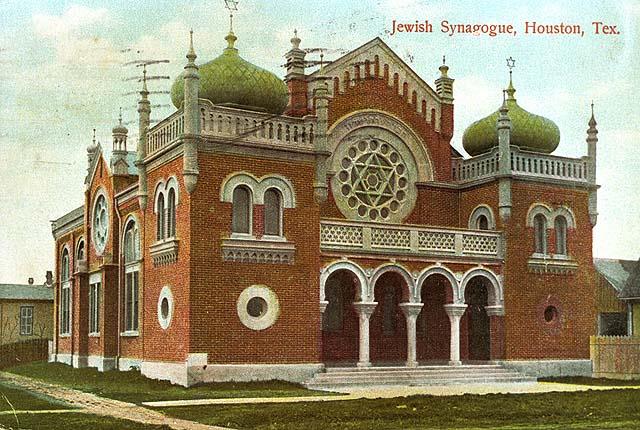
The Jewish Community of Houston
Houston
Port and industrial center in Southeastern Texas, USA.
21ST CENTURY
In 2017 there were 63,700 Jews living in Houston. The vast majority of Houston’s Jewish community was living in areas that were affected by Hurricane Harvey in 2017. Three of the five major synagogues in Houston experienced major flooding while many Jewish homes were flooded and sustained significant damage. A number of Jewish camps in the area provided shelter for both Jews and non-Jews who were forced to evacuate their homes.
HISTORY
Houston was founded in 1836. It is unknown when the first Jew arrived, but there are records of several Jews who came during the early years of the settlement. Eugene Chimene is often cited as the first Jew of Houston, although he is not listed until the census of 1860. The earliest available census regarding the population of Houston dates back to 1850, and it indicates a possible 17 Jewish adults out of a population of 1863; in 1860 the figures were 68 out of a total population of 3,768. The majority of these Jews were merchants and clerks who operated stores selling clothing and food. These Houston Jews were reported to be "comfortably situated" by contemporary sources. The 1860 census indicated that approximately 60% of the Jews were landowners (as compared with about 25% of other immigrant groups), but there were also some Jews with no personal and real-estate.
The Jews were informally organized in Houston until 1855 when a Hebrew Benevolent Society was founded. The "Occident" heralded its organization as he first "regular Jewish Society in the state of Texas".
On May 8, 1859 the first congregation, Beth Israel, was established, and in August of that year its synagogue, a wooden structure in the middle of the city, was dedicated. The congregation began as an Orthodox synagogue according to Polish sources, although the majority of Jews in Houston were of German origin. In 1856 a home was converted into a synagogue and in 1860 the Orthodox Beth Israel congregation was formed, with Z. Emmich acting as its first rabbi, cantor and ritual slaughterer. The congregation's first building was erected in 1870. The city then had a population of 9,382 of whom 245 were Jews. That population would almost double only 7 years later, to 471. The last decades of the 19th century witnessed the beginnings of Jewish immigration to Houston from Eastern Europe, replacing the earlier German one. As Beth Israel congregation became more liberal in outlook, two new Orthodox congregations were formed which eventually merged as congregation Adath Yeshurun in 1891. The first "B'nai B'rith" lodge and a "Hebrew Free Loan society" were organized, along with the beginnings of a YMHA. The new immigrants mostly incorporated in the retail trade as peddlers and shopkeepers, although there were several bankers among them as well as dealers in cotton. Henry S. Fox was one of the founders of the "Houston Cotton Exchange", Morris Levy was a member of the first "Houston Ship Channel Company", and Ed Klein established Houston's first department store.
The turn of the 19th century inaugurated a period of rapid growth in the Jewish community, spurred by the 1900 hurricane that drove many Jewish inhabitants inland from the Texas coast, and by the implementation of the "Galveston Plan". The city's first Jewish newspaper, "the Jewish Herald", went into publication in 1908. New synagogues were established and Jewish institutional life expanded with new organizations as a "Bikur Cholim Sociey", "Workmen's Circle" (1915), "Zionist Federation" (1903), "United Jewish charities" (1914),ant the weekly "Jewish Herald" (1908). The large military instillations near Houston during World War I brought an influx of Jewish Servicemen, many of whom remained in the city after their discharge. In 1917 the Jewish population of Houston was put at 5,000. By 1920 it had jumped to 10,000, close to seven percent of the city's total. The leading figure in the Jewish community during this period was Rabbi Henry Branston who accepted the 'Beth Israel' pulpit in 1900 and for the next 45 years presided over the congregation. Judge Henry J. Dannenbaum was nationally active in the fight against white slavery and served the city in its civic life, along with precipitation in Jewish communal affairs.
The Jewish community grew at a slower pace between the two world wars, reaching an estimated 13,500 in 1941. Ku Klus Klan activity in the rea in the 1920s and 1930s discouraged Jews from entering civic and political life as well as being afraid to stand out. Beth El, Texas' first Conservative congregation was formed in 1924. The "Jewish Community Council" was organized during those years. An annual "United Jewish Campaign" was instituted under the Council's direction. A charitable foundation left to the community by Pauline Sterne Wolff helped support many of Houston's Jewish institutions in the years to come. Religiously, the drift in the Jewish community was toward Reform. A unique event in national Jewish life occurred in Houston in 1943 when a radically anti-Zionist majority at congregation Beth Israel, the city's largest, passed a resolution of "Basic Principles" that excluded from the congregation all members professing an interest in Zionism. A minority of dissenters withdrew from the congregation to form a new synagogue; Emanu El. Beth Israel eliminated the "Basic Principles" from its membership application only in 1967.
The growth of Houston's Jewish community after World War II did not keep pace with the phenomenal growth pf the city as a whole, so that by 1970 the Jewish percentage in the total population had declined to less than two percent. To an extent, this may be attributed to the fact that, more than elsewhere in the United States, large chain stores and distribution outlets in Houston, have eliminated the traditional Jewish role of the individual entrepreneur. Nevertheless, Houston has remained a city rich in Jewish organizations. Among other institutions were 12-story Jewish institute for Medical Research and a $3,500,000 Jewish community center. In 1967 the "Houston Commission for Jewish Education" was formed to coordinate Jewish educational activities.
Few Houstonian Jews participated in local political life. The first Jew to be elected to political office in Houston in the 20th century was Richard Gottlieb, who was chosen to the city's council in 1969. Jews have been more prominent in business, among them Joe Weingarten, one of the pioneers in the supermarket field, Simon Sakowitz, one of Houston's leading merchants. In the field of education, Norman Hackerman became president of Rice University in 1970, and Joseph Melnick, one of the world's leading virologists, was dean of the graduate research department of the Baylor College of Medicine. D.H. White edited and published the weekly "Jewish Herald-Voice".
The 1970s saw a tremendous growth in Houston's Jewish community, which grew from 25,000 to 45,000. The growth was a reflection of the boom in the Houston economy that lasted through the mid-1980s. The 1970s and 1980s also saw tremendous growth in Jewish institutions.
By 1995, the Houston Jewish community had five Jewish day schools with an enrollment of over 1,000 children. More than 3,000 children participated in other forms of Jewish education throughout the community. In the mid-1990s the community had 30 congregations representing every stream of Judaism and geographically located in all corners of the city. Houston's "Jewish Community Center" provides early childhood services, a campsite for day and resident camping, and a satellite facility in West Houston.
Through the 1980s and 1990s, the Jewish Federation raised 3 million dollars for neighborhood renewal in Israel and in excess of 10 million dollars for the rescue and resettlement of Jews from the former Soviet-Union. In 2014, they raised nearly $14 million for local, national and international Jewish causes.
Houston is home to 6 million "Holocaust Education Center and Memorial Museum", opened in 1996. The museum features a permanent exhibit telling stories of Holocaust survivors living in the Houston area. Its Memorial Museum is the fourth-largest Holocaust memorial in the United States. Visitors of the museum can access the Boniuk Library which includes more than 5,000 volumes on the Holocaust and several archives.
The Jewish community of Houston has grown to incorporate many different traditions and branches. In the early 21st century it was one of the largest Jewish communities in the south and continued to contribute to the cultural and economic life of them region. A 2001 study from Rice University placed the Jewish population of Greater Houston at approximately 47,000. In 2003, the total population of Houston was just over 2 million.
By the 21st century, Houston was host to a variety of organizations, committees, schools and kosher services. The "Jewish Federation of Greater Houston", "Jewish Family Service" and the "Hebrew Free Loan Association" are just a few which serve the Jewish community, providing financial assistance and social services. The "Seven Acres Jewish Geriatric Center" is an assisted living facility which is supported by the Federation.
Other important Jewish institutions include the city's "JCC" and the "Chabad Lubavitch Center". A partner of the Federation, the "Evelyn Rubenstein Jewish Community Center of Houston" offers numerous programs for children, families and young adults. Religious organizations like the "Chabad Lubavitch Center" and the "Hillel Foundation of Greater Houston" work to strengthen Jewish bonds within the community and function as community resources for Jewish students and professionals.
In the realm of education are several Jewish day schools. The "William S. Malev School" at Beth Yeshurun is Conservative, the "Irvin M. Shlenker School" at Beth Israel is Reform and the "Torah Day School of Houston"
is Orthodox and affiliated with the Chabad movement. Other schools include "Emery/Weiner", a secondary school, the "Robert M. Beren Academy", and Orthodox primary and secondary school, and the former Hebrew Academy. In 2008, the "Chai Learning Center" opened which houses a congregation and a number of classrooms. The Center was established by the Orthodox community and is affiliated with Hasidic Judaism.
Religious life in Houston covers a wide range of movements from Reform to Orthodox Judaism. By 2011, the city was home to twenty-three different synagogues. According to the Pew Research Center, Orthodox Jews are the fastest-growing segment of the Jewish population. In 2012, the Orthodox Union described Houston as being a city that offered affordable Orthodox living. While the number of congregations has grown, a 2001 study found that 60% of affiliated Jews are members of the city's three largest congregations, Beth Yeshurun, Beth Israel and Emanu-El. In 2011, Beth Yeshurun had a membership of 2,170 families, making it the largest Conservative congregation in the entire country. That same year, Beth Israel had 1,700 member families. Both Beth Israel and Beth Yeshurun are located in the Meyerland neighborhood of southwest Houston.
Houston's Jews have largely been concentrated in the Southwest part of the city. By the 1980s, a quarter of the Jewish population lived in only two of the city's zip codes. Close to half lived in the areas of Bellaire, Braeswood and Meyerland. While there are Jewish enclaves, there isn't a neighborhood where Jews comprise the majority. Since the 1980s, Jews have been gradually moving into the suburbs. At the same time, Jews from across the United States have been arriving in large numbers to Houston and the surrounding cities. In the 1990s, the Jewish community spread into areas such as Woodlands, Spring and Humble, where they formed congregations. According to Jewish Family Service, there are growing Jewish communities in the suburban areas of Pearland and Clear Lake. There is also a burgeoning community in Katy, an area known for its many Russian and Israeli Jews. However, despite the dispersion of Jews into the suburbs, the center of Houston's Jewish community has remained in Meyerland. This neighborhood in southwest Houston was named after the Meyer family who purchased thousands of acres of land.
Daniel Nijensohn
(Personality)Daniel Nijensohn (1945?- ), neurosurgeon, born and raised in Mendoza, Argentina, the son of the eminent Argentinian agronomist Leon Nijensohn. He graduated from medical school in Mendoza and then interned at the University of Buenos Aires, Argentina, teaching at hospitals and then at Baylor College of Medicine in Houston, Texas. He did his general surgical and neurosurgical training at the Mayo Clinic, Rochester, Minnesota.
He is a Diplomate of the American Board of Neurological Surgery, a Fellow of the American College of Surgeons, and Fellow of the American Association of Neurological Surgeons. He has been in practice in Connecticut since 1976. He is an Associate Clinical Professor of Neurosurgery at Yale University. He is Past President, Connecticut Neurosurgical Society, past Trustee of the New England Neurosurgical Society, and has been active in local, regional and national neurosurgical organizations. He has a special interest and expertise in the surgical treatment of spine disease as well as of intracranial disease such as brain and pituitary tumors and trigeminal neuralgia transphenoidal approaches to the pituitary, and the history of medicine and neurosurgery.
Maximilian Heller
(Personality)Maximilian Heller (1860-1929), rabbi, an outstanding leader in the Reform Judaism, born in Prague, Czech Republic (then part of the Austrian Empire). On both sides of his family he was descended from distinguished rabbis and scholars. He went to the United States in 1897, and after studying at the University of Cincinnati (B.L., 1882; M/L., 1884) and at the Hebrew Union College (ordained, 1884), he served for two years as associate to Rabbi Bernard Felsenthal of Chicago. In 1886 he became rabbi at Houston, Texas, but after five months received a call to Temple Sinai of New Orleans, where he served for more than forty years until his retirement in 1927.
In New Orleans, Heller was active in the civic and educational life of the community, especially in promoting the cause of education and in fighting for the abolition of the Louisiana State Lottery. From 1892 to 1896 he was a member of the State Board of Education, and he served on practically every board of the Jewish welfare and educational organizations in the city. In 1912 he was appointed professor of the Hebrew and Hebrew literature at Tulane University, where he served until his retirement in 1928. He was a charter member of the Central Conference of American Rabbis, and served as its president in 1909 to 1911. An enthusiastic advocate of Zionism from the beginning of the movement, he was prominent in the Zionist Organization of America, and was its honorary vice-president from 1911 until hid death.
Heller was a prolific journalist, he also was editor of the New Orleans Jewish Leader from 1896 to 1897, editorial writer for the Cincinnati American Israelite from 1902 to 1914, and a frequent contributor to the local press. He also wrote: The Temple Pulpit, a collection of his sermons; Jubilee Souvenir, on the occasion of the fiftieth anniversary of Temple Sinai (1922); My month in Palestine (edited posthumously by his son James G. Heller; New York, 1930).
Rosanna Dyer Osterman
(Personality)Rosanna Dyer Osterman (1809-1866), philanthropist, nurse, and pioneer, born in Germany. She immigrated to the USA as a youngster settling in Baltimore, MD. Along with her husband Joseph Osterman, she moved to Galveston, TX, in 1838, where they run a commercial and import-export business. The Ostermans built the first two-story residence in Galveston.
In 1852, Dyer Osterman brought Rabbi M.N. Nathan, the first rabbi to Texas, to consecrate the first Jewish cemetery in Texas. Her efforts led to the establishment of the first Jewish community in Texas – it is generally assumed that the first Jewish minyan in the state was held at the home of her brother Isadore Dyer in 1856.
Her skills as a nurse became evident during an epidemic of yellow fever in Galveston in 1853. The sick and the dying were sheltered and taken care of in tents that Dyer Osterman set up in the courtyard of her home. During the American Civil War, when Galveston was captured by the Union army, Osterman's home became a hospital for wounded soldiers from both the Union army and the Confederate army. According to a popular story, she helped the Confederate forces to recapture Galveston in January 1963. The Confederates changed their attack plans after Dyer Osterman advised them that the Union forces were informed of their original battle plans by a runaway slave.
Dyer Osterman died in an explosion of a steamboat W.R. Carter on Mississippi River in 1966. She left her sizeable fortune to various charities in the USA, including Jewish hospitals, and for building synagogues in Galveston and Houston.
Isabelle Ganz
(Personality)Isabelle Ganz (b.1957), mezzo-soprano, born in New York City, United States. She received her Ph.D. in Musical Arts in Voice and Music Literature from the Eastman School of Music. Ganz taught at the American Institute of Musical Studies in Graz, Austria, and teaches at the faculty of Houston Community College and the Texas Institute for the Arts in Education. She appeared as soloist with major orchestras and chamber ensembles throughout the United States and Europe and premiered many modern works.
Lawrence Foster
(Personality)Lawrence Foster (b. 1941), conductor, born in Los Angeles, United States. He started his musical career in 1960 with the newly established Young Musicians' Foundation Début Orchestra, which he directed until 1964, and two years later, at the age of 18, he became the conductor of the San Francisco Ballet, a position that he held until 1965.
In 1971, he was named music director of the Houston Orchestra. In 1980, he took over the leadership of the Monte Carlo Philharmonic and then of the Duisburg Philharmonic from 1982 to 1987. Between 1985-1990, he served as music director of the Lausanne Chamber Orchestra followed by music leadership of the Orquestra Simfònica de Barcelona i Nacional de Catalunya from 1994 to 2002. In 1995, he was named music director of the Aspen Music Festival and School, then he was music director of the Gulbenkian Orchestra of Lisbon, Portugal, from 2002 to 2013, and after 2009 he was also music director of a the Orchestre National de Montpellier and the Opéra National de Montpellier. As of 2019 Foster is the Artistic Director and Chief Conductor of the Polish National Radio Symphony Orchestra. His international career also included appearances with various opera houses, including in Paris, Marseilles, Hamburg, Frankfurt, and Bregenz, Austria.
Foster, the son of Romanian Jewish immigrants, became an expert in the music of the Romanian composer George Enescu and served as artistic director of the George Enescu Festival in Bucharest from 1998 to 2001. Among his many recordings, Foster recorded the complete works of Enescu.
Salomon Bochner
(Personality)Salomon Bochner (1899-1982), mathematician, born in Podgorze near Krakow, Poland (then part of Galicia in Austria-Hungary). His family moved to Germany in 1914. Bochner studied at the University of Berlin. He began his career as Harold Bohr’s assistant with important works on almost periodic functions. As a lecturer in Munich, Germany, from 1926 to 1933, when he fled Nazi Germany and immigrated to the United States. He obtained a position at Princeton University and was a visting scholar at the Institute for Advanced Study in Princeton from 1945 to 1948. He became a full professor at Princeton in 1959 holding this position until 1868, when he moved to Rice Univdersity in Houston, Texas, working there until his death.
Bochner worked on Fourier analysis and made his most important discoveries in this field. The high point of his creative period was his Vorlesungen ueber Fouriersche Integrale (Lectures on Fourier Integrals, 1932), a classic in mathematical literature. The Fourier transform is of great importance for a range of application-oriented fields within mathematics, e.g. for probability theory (characteristic functions). In 1955, Bochner wrote a similarly influential book, Harmonic Analysis and the Theory of Probability. Bochner’s most important result in the Vorlesungen is the characterization of the Fourier-Stieltjes transform of positive measures as positive definite functions. This result provided the starting point for the subsequent development of abstract harmonic analysis. Bochner’s book also contained the germ of the later development of the theory of distributions. It should also be noted that the extension of the Lebesgue integral to functions with values in a Banach space can also be traced back to the so-called Bochner integral.
Saul Balagura
(Personality)Saul Balagura (b.1943), poet and painter, born in Cali, Colombia, into a family of Jewish immigrants from Romania. He studied at Universidad del Valle receiving a doctorate in medicine, and then at Princeton University in New Jersey, earning a PhD in psychology. However, since a young age he was attracted by the arts. He had his first solo exhibition of paintings in 1960. In 1994 he decided to leave his scientific activities and to dedicate himself to painting. He opened a studio in Tesuque, New Mexico, and another one in Houston, TX. Many times his paintings are complemented by poems that explain his mainly expressionist style works. He has exhibited at numerous galleries in the United States and his series In Search of Hope about the Holocaust was displayed at Houston Holocaust Museum in 2008.
Uri Mayer
(Personality)Uri Mayer (b.1946), conductor and violinist, born in Targu Mures, Romania. His family immigrated to Israel and he grew up in Israel. Mayer attended the Tel Aviv Conservatory from 1958 to 1964 and studied at the Rubin Music Academy of Tel Aviv University. From 1964 to 1970, he was an assistant conductor of the National Youth Orchestra of Israel. He studied conducting at the Juilliard School of Music in New York from 1968 to 1970 abd during the same time he also conducted the New York Youth Symphony, performed with the New York Philharmonic Orchestra, and was the principal violinist of the American Symphony Orchestra under Leopold Stokowski, who offered him an assistant position in 1970. Meyer became the principal violinist of the Montreal Symphony Orchestra in 1970. From 1974 to 1976, he was the musical director of the University Philharmonia and the University of Michigan's Contemporary Directions Ensemble. He then returned to the Montreal Symphony Orchestra as the first violinist, and then becoming its assistant conductor in 1980. From 1981 to 1995, Mayer was the musical director of the Edmonton Symphony Orchestra. He was also the musical director of the Rice University Orchestra in Houston from 1986 to 1988 and the principal conductor of the Orchestra London Canada from 1988 to 1994. From 1991 to 1999, he was the artistic director of the Israel Sinfonietta, and from 1994 to 2000, he was the chief conductor of the Kansai Philharmonic Orchestra in Osaka, Japan.
San Antonio
(Place)San Antonio
City in South Central Texas, USA.
As early as 1715, three years before the founding of the city, several families from Northern Mexico settled on the banks of the San Antonio River; among them were the Carvajal family of Jewish descent. Two Jews from the Texas Army, surgeon Moses Albert Levy and Edward Israel Johnson, fought Mexican troops in San Antonio in 1835 during the Texas Revolution. A permanent Jewish community in San Antionio was established in 1850, after Texas had entered the Union and the US was simultaneously experiencing a wave of immigration of Jews from Central Europe.
By 1855 the Jewish community had established its own cemetery, the first of a number of community organizations that were to follow. In 1856 the community organized a Hebrew Benevolent Society (reorganized in 1885 as the Montefiore Benevolent Society), and in 1870 the Ladies' Hebrew Benevolent Society was formed. Though the Jews living in San Antonio had been meeting for years to hold services in private homes, by 1874 there were enough Jews living in San Antonio to form the first formal congregation, the Reform synagogue Temple Beth-El.
With the mass immigration of Central and Eastern European Jews beginning in the early 1880s, more Orthodox Jews began arriving in San Antonio. They founded their own cemetery in 1885, organized their own congregation, Agudas Achim, in 1889, and established a Talmud Torah in 1909. Their Rabbi, Moses Edelhertz, also worked as a shochet (kosher butcher), providing the congregation with kosher meat. Tensions, however, soon began to emerge within the Agudas Achim community over differing commitments to religious practice. In 1914 a group who wanted to maintain an adherence to Orthodox Judaism broke away from Agudas Achim to form B'nai Israel. Rabbi Solomon Solomon, who began in 1899 as the rabbi of Agudas Achim, left to become the rabbi of B'nai Israel a year after its founding. Another Orthodox congregation, Rodfei Sholom, had been established in 1909.
The two small Orthodox communities decided to merge, and became Rodfei Sholom B'nai Israel, later shortened to Rodfei Sholom. Rodfei Sholom had about 100 members; a synagogue building was constructed in 1918 and included a mikvah. In 1912 there were two kosher butchers in the community, which made kosher meat accessible to those in the community who needed it.
The first B'nai B'rith Lodge was chartered in 1874. Thirty years later, in 1904, a chapter of the Zionist Organization of America was formed. A chapter of the National Council of Jewish Women followed soon after, in 1907, and a chapter of Hadassah was established in 1918. In 1922, the San Antonio Jewish Social Service Federation was created to coordinate the many community groups.
During World War I, the influx of Jewish military personnel to South Texas created the need for hospitality services in San Antonio, a major military post. This was coordinated and supervised by the National Welfare Board, which continued its activities through 4 wars.
Jews have generally been accepted in all areas of industrial, commercial, and professional life in San Antonio, though the 1920s saw the Ku Klux Klan become particularly influential in Texas; while most of the violence that the KKK carried out was against African-Americans, Jews were attacked in their newspaper publications. In spite of some latent (and not-so-latent) prejudice, the Jews of San Antonio produced leaders in department stores, agriculture, banking, and professional fields such as medicine and law. Jews of San Antonio who have distinguished themselves through philanthropic and cultural activities include: Dan and Anton Oppenheim, pioneer bankers, ranchers, and Confederate officers, Mayer and Sol Halff, pioneer merchants and ranchers, Dr. and Mrs. Frederick Oppenheimer, art collectors and museum benefactors, Max Reiter, founder of the San Antonio Symphony Orchestra, Rabbi and Mrs. David Jacobson and Rabbi Amram Prero, Civic workers, Joe and Harry Freeman, agriculturalists and philanthropists, Sylvan Lang, a leader in legal education, and Perry Kallison, an agriculturalist and local radio personality.