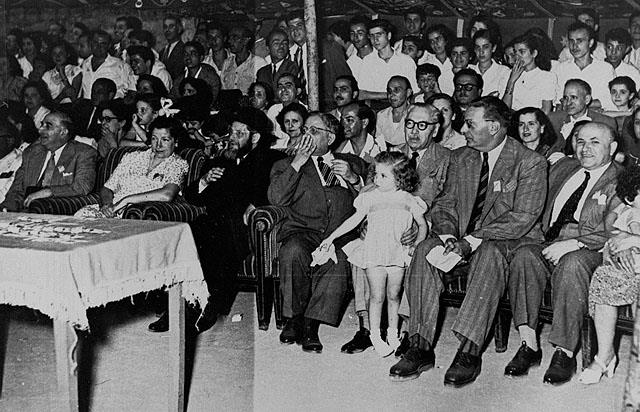
The Jewish Community of Beirut
Beirut
Arabic: بيروت French: Beyrouth
Capital of Lebanon
Beirut is the largest city in Lebanon, and also the country’s main seaport. It is also one of the oldest cities in the world.
This item includes attached files with maps of the former main Jewish residential district before 1948, along with the names of the prominent Jewish families that lived in the area.
21ST CENTURY
Restoration of the Magen Avraham synagogue, which was damaged during the Lebanese Civil War (1975-1990), began in May of 2009.
The Jewish cemetery of Beirut is located near Sodeco Square. It was slightly damaged during the Civil War. The cemetery has continued to serve the Jews of Lebanon.
In 2012 Nada Abdelsamad produced a documentary about the Jews of Lebanon, Lebanon’s Jews: Loyalty to Whom? The documentary featured interviews with Jews from Beirut and other areas in Lebanon, as well as of their former neighbors.
In 2004, one registered Jewish voter showed up at the polling booth during the municipal elections.
HISTORY
Jews were living in Beirut and the vicinity from the 2nd century BCE. The chronicle of Joshua the Stylite mentions the existence of a synagogue in Beirut at the beginning of the 6th century. According to Abiathar b. Elijah (late 11th century), Beirut and Gebal (Byblos) were subject to the Palestinian Gaonite (the main Talmudic academy and legal body of the Jewish community in Palestine, c. 9th-11th centuries).
By the time of the Crusader conquest (1100) Beirut was home to 35 Jewish families; when the Jewish traveler Benjamin of Tudela visited around 1170 he counted 50 Jewish households. In addition to the city’s permanent Jewish residents, Jews also frequently visited Beirut on their way to Eretz Yisrael.
According to the Jewish kabbalist and student of Nachmanides, Isaac b. Samuel of Acre many Jews were killed during the Muslim conquest of the city in 1291. Another student f Nachmanides who stopped in Beirut at the beginning of the 14th century did not note the presence of any Jews in the city. An anonymous pupil of the Italian rabbi Obadiah b. Abraham Bartenura wrote in a 1495 letter that "at Baroto (Beirut) there are no Jews, and I do not know the reason, because the Ishmaelites at Baroto are better than all the other people of the kingdom and are very well-disposed toward the Jews."
Beirut’s Jewish community was renewed after the expulsion from Spain in 1492, and in 1521 Moses Basola found 12 Jewish families from Sicily living in the city. During Basola’s stay, he also noted that Beirut’s Jews were particularly interested in the activities of David Reubeni, whom a Jewish merchant had encountered in Gaza. Abraham Castro was in charge of customs during this period.
David d'Beth Hillel, who visited Syria in 1824, observed that "there are [in Beirut] some 15 families [of] Jewish merchants, natives of the country who speak Arabic and have a small synagogue, their customs resembling those of the Jews of Palestine." The writer and poet Ludwig August von Frankl visited Beirut in 1856 and found 500 Sephardi Jews living there, most of whom worked as merchants and porters. Jews also began arriving in Beirut from Damascus, Smyrna, Aleppo, Constantinople, and even Russia.
Two blood libels were levied against the Jewish community during the second half of the 19th century, one in 1862 and another in 1890, both of which led to Christian attacks in the Jewish Quarter. Order was finally restored in 1890 by the Turkish authorities, and the rioters were arrested.
Community institutions during the late 19th century included a synagogue and 12 batei midrash. In 1878 the Alliance Israelite Universelle opened a school for girls; a school for boys followed a year later. A crafts school for girls, also under the auspices of the Alliance, opened in 1897. There were 271 students enrolled in the boys’ school and 218 enrolled in the girls’ school in 1901.
In 1880 there were about 1,000 Jews living in Beirut. By 1889 that number had grown to 1,500. Beirut’s Jewish population between 1892 and 1906 was 3,000, and between 1907 and 1910 their numbers grew to 5,000.
Beirut’s Jewish population grew after World War I (1914-1918), particularly after Beirut was established as the new capital of Lebanon. The community came to be regarded as the most highly organized in Lebanon and Syria. The main synagogue, Magen Avraham, was the center of the community’s institutions, which included the Alliance schools, the congregational schools, a B'nai B'rith lodge, and a Maccabi club.
Most of Beirut’s Jews were middle class. By the 20th century the Jews were no longer confined to a special quarter, but the poorer Jews tended to live on the streets that had once been part of the Jewish Quarter. Nonetheless, the former Jewish Quarter still played a significant role in the public imagination; after the establishment of the State of Israel (1948), anti-Jewish demonstrations were held, and mobs descended on the Jewish Quarter (the mobs were eventually dispersed by the Christian community).
The establishment of the State of Israel compelled Beirut’s Jewish community to make a number of changes. The newspaper Al-Alam Al-Israeili (The Israelite World) changed its name to Et Al-Salam (Peace). The Jewish community was also required to contribute a sum of money to the Arab League fund. In general, however, the Jewish community continued to live peacefully. Indeed, during Israel’s War of Independence (1948), the internal unrest in Lebanon during the ‘50s, and the Six-Day War (1967), the Lebanese authorities ordered the police to protect the Jewish Quarter in Wadi Abu Jamil. Additionally, wealthier Jews living among Christians and Muslims in the new suburbs were unharmed.
In contrast to many other Arab countries, Jewish life in Lebanon continued as usual after Israel’s establishment and through the subsequent wars. Indeed, after the establishment of Israel Lebanon’s Jewish population grew, as Syrian and Iraqi refugees began arriving after being expelled from their countries. Nonetheless, the community could still be subject to violence. In 1950 a bomb was planted by Muslim nationalists underneath the Alliance school building, causing it to collapse. The government also closed the Jewish Scouts and the Maccabi sports organization in 1953.
Nonetheless, the Alliance continued its work, and administered three other institutions. The organization’s educational programs enrolled 950 pupils in 1965. Additionally, 250 students attended the Talmud Torah, while the religious school Ozar HaTorah had 80 students.
During the 1950s and ‘60s, the community council, which was made up of nine members, was elected biennially. The council’s bikkur holim was responsible for medical treatment for the poor, as well as for their hospitalization if they were not Lebanese citizens. The council derived its income from the arikha (assessment) tax, which was paid by all men, as well as from endowments and synagogues. During this period most of Beirut’s Jews worked as merchants or as employees of trading and financial companies.
On the eve of the Lebanese Civil War, there were approximately 1,000 Jews living in Beirut, out of a total Lebanese Jewish population of about 1,800.
LEBANESE CIVIL WAR (1975-1990)
After the outbreak of the Lebanese Civil War, the Jews of Beirut, along with the city’s other minority populations, found themselves caught in the crossfire; many of Beirut’s Jews also lived near the border separating the city’s Christian and Muslim sectors. Jewish homes, businesses, and institutional buildings sustained extensive damage during the fighting. The Magen Avraham synagogue was among the buildings that was damaged during the war. As a result of the chaos and violence of the war, Lebanon’s Jews began leaving the country. By 1982 there were approximately 250 Jews remaining in Beirut, 150 in the western section, and 100 in the eastern section.
After the Israeli invasion of Lebanon in 1982, as well as the disorder that reigned after the Israeli withdrawal, the Jewish community of Beirut began to be targeted by radical Shia factions. 11 prominent members of the community, including the head of the community, Isaac Sasson, were kidnapped over a 3-year period (1984-1987); four bodies of the kidnapped victims were later recovered, while the fate of the rest has remained unknown. By the early 1990s the Jewish community in Beirut dropped to fewer than 100 members.
Michael Chesin
(Personality)Michael Chesin (1936–2015), Israel Supreme Court justice born in Beirut, Lebanon, the son of Shneur Zalman Cheshin. Cheshin studied at the Hebrew University of Jerusalem Law Faculty where in 1962 he was awarded a doctorate. From 1957 through the mid-1980s, he was a lecturer at the Hebrew University Law School. During the period 1962–1978, he was attached to the Ministry of Justice, first as deputy state attorney and from 1972 as deputy attorney general. From 1978 to 1991 he engaged in private law practice in Jerusalem. In 1992 he was named a member of the Israel Supreme Court, becoming deputy president in 2005 and retiring in 2006. With a reputation as an independent-minded defender of civil liberties, Cheshin was a supporter of Judge Aharon Barak's “activist” legal policies.
Esther Moyal
(Personality)Esther Moyal (1873-1948) Journalist.
Born in Beirut, Lebanon, to the family of Lazari (al-Azhari), she taught at the Scottish Church mission. In 1893 she was sent to Chicago to represent Lebanon at the International Women's Conference and was active in various women's organizations. In 1894 she married a medical student, Simon Moyal, in Jaffa and after he qualified, they settled in Cairo. There she founded the journal al-Aila (The Family) and became a regular contributor to the Cairo daily al-Ahram and the literary publication al-Hilal. Moving to Jaffa in 1908, Moyal helped to establish a women's organization in the town the following year. From 1913 she and her husband edited the Jaffa periodical "Sawt al-Uthmaniyya" ('The Voice of the Ottoman'). Her husband died in 1915 and she moved to Marseilles, returning to Jaffa in the mid-1940s. She wrote a life of Emile Zola and translated French books into Arabic.
BALAYLA
(Family Name)BALAYLA, BALAILA
This surname was chosen by the method of bibliomancy, i.e. the use of Jewish sacred books for divination. Some Jewish families that used this method for adopting a family name by opening randomly a Hebrew sacred book and choosing the first words they came across.
According to family tradition, the family name Balayla originated with Yichia Zerachia, who lived in Damascus, Syria, during the first half of the 19th century. Following the death in infancy of one of his children and the illness of another child, he asked his rabbi for advice. In accordance to the widespread practice among traditional Jews, the rabbi advised him to change his name. The rabbi opened the Book of Genesis and his finger stopped at the word "balayla" ("during the night", in Hebrew). Balayla, also spelled Balaila, became the family name of his two sons, Yaakov (Jacques) Balayla (Balaila) (b. 1855) and Joseph Balayla (Balaila) (1857-1951). The Balayla family moved to Lebanon, where the brothers Yaakov (Jacques) Balayla (Balaila) and Joseph Balayla (Balaila) were among the founders of the Magen Abraham synagogue and lay leaders of the Jewish community in Beirut, Lebanon.
Balayla is documented as a Jewish family name with the Canadian physician Dr. Jacques Balayla Department of Obstetrics and Gynecology at McGill University in Montreal, Canada, and with Dr. Isaac Balaila (Balayla), a lecturer and researcher at Technion - Israel Institute of Technology, the developer of the "Balaila Model" for manpower allocation in service systems.
Miriam Nachmias, Beirut, Lebanon, 2018
(Video)Miriam Nachmias was born in Beirut, Lebanon, into a family from Syria. In this testimony she recounts her family's history, their life in Syria and Lebanon, her illegal immigration to the Land of Israel and the life in Israel during the 1950s.
-------------------------
This testimony was produced as part of Seeing the Voices – the Israeli national project for the documentation of the heritage of Jews of Arab lands and Iran. The project was initiated by the Israeli Ministry for Social Equality, in cooperation with The Heritage Wing of the Israeli Ministry of Education, The Yad Ben Zvi Institute, and The Museum of the Jewish People at Beit Hatfutsot.
The Oster Visual Documentation Center, ANU - Museum of the Jewish People. The film was produced as part of the Seeing the Voices project, 2019
Moshe Zafrani Recounts His Life in Beirut, Lebanon, 2018
(Video)Moshe Zafrani was born in Beirut, Lebanon, in 1955. Moshe tells about life in Beirut, the Alliance school, about the synagogue's role as a social center, שמג about the cosmopolitan Jewish community. He also focuses on the Jewish neighborhood in Beirut, Wadi Abu Jamil, and tells about the attack that happened in the 1950s at the Alliance school, in which Madame Penso, the principal was killed. Moshe's father decided to immigrate to Israel in 1969 following the unrest after the Six Day War. Moshe Zafrani, an employee of the Israeli Ministry of Education, is one of the initiators of the project Rav Dori ("Multigenerational Connection") and also of the project "Seeing the Voices".
-------------------------
This testimony was produced as part of Seeing the Voices – the Israeli national project for the documentation of the heritage of Jews of Arab lands and Iran. The project was initiated by the Israeli Ministry for Social Equality, in cooperation with The Heritage Wing of the Israeli Ministry of Education, The Yad Ben Zvi Institute, and The Museum of the Jewish People at Beit Hatfutsot.
The Oster Visual Documentation Center, ANU - Museum of the Jewish People. The film was produced as part of the Seeing the Voices project, 2019
Isaac Hasbani
(Video)Isaac Hasbani is a Chicago based engineer. He was born in November 1947 to a Syrian Jewish family in Beirut. Both of Isaac’s parents came from Damascus and fled anti-Semitic riots before he was born. His mother was on vacation in Lebanon when her father called and told her “Don’t come back,” he had decided to abandon his clinic and follow her to Lebanon which was considered much safer for Jews at the time. In 1948 the Syrian government had sent many Jews to prison, accusing them of being Zionists. Although his father had been a candidate previously running to be the Jewish Member of the Syrian Parliament and his grandfather had served in the Syrian Army.
Isaac grew up in Wadi Abu Jamil, the Jewish neighborhood of Beirut. He distinctly remembers how there were few Muslims and Christians around but the area was not a ghetto. There were no walls and most synagogues in the area were small, merely houses converted to synagogues although there was one big synagogue known as Maghen David. Education for many Jews in Lebanon was in French, as Lebanon had been a French colony up until 1943. Isaac attended the Jarden D’enfant Kindergarten and the Alliance Elementary School. In the days when Isaac was a student in Lebanon, there was no electricity in his house. At night, if he wanted to study he would have to use a kerosene lamp but kerosene was expensive at the time so sometimes if the moon was bright enough he would go out and use the moonlight.
It was rare at the time for a Jew living in Wadi Abu Jamil to know many non-Jews but Isaac’s father knew many because he was a doctor who would travel around and visit patients in every area. Life began to get more difficult for the Jews in Lebanon after Israel’s War with Egypt in 1956 known as the “Sinai Campaign.” In 1958 Isaac’s family flew to Cyprus to get together with his grandparents who were living in Israel. His parents had not seen his grandparents since 1946, before he was born. Everyone in Lebanon knew about Israel but Jews did not talk openly about the country. If a Jew left Lebanon and was never heard from again it was known that the person probably had moved to Israel.
In 1961 Isaac’s parents decided that Isaac should move to Israel and live with his grandparents. His parents stayed in Lebanon until 1968 when after the 1967 Six-Day War life began to become more difficult for Jews in Lebanon. Jewish life was still possible until the Lebanese Civil War started in 1975 at which point the Jews left Lebanon in a massive wave. Living in Israel was a culture shock for 14 year old Isaac, there were many things he did not expect about the country, it was a stark contrast to Beirut. His school in Ramat Aviv had students from all over the world. Since he was living with his grandparents he never had to deal with the Misrad Ha'Aliyah- Israel’s Immigration Agency, notorious for being difficult to work with. Isaac left Lebanon as a high school student and did not see his parents until he was almost finished with his University studies.
In University, Isaac studied Mathematics and Applied Math. He worked in Israel until 1984 when the financial situation became quite bad. He managed to get a job in Chicago for what he thought would be a short period but became a permanent position so he bought a house and settled in Chicago. While his father was Syrian and became Lebanese, Isaac never felt Lebanese. Being in Israel was the first time Isaac felt like he was in his own country. His two children are Sabras and sometimes he goes to the local Sephardic synagogue in Chicago to keep up with the melodies he remembers from childhood.
This film is part of the Testimonies produced by Sarah Levin for JIMENA's Oral History and Digital Experience. JIMENA - Jews Indigenous to the Middle East and North Africa - is a San Francisco, CA., based non-profit organization dedicated to the preservation of culture and history of the Jews from Arab Lands and Iran, and aims to tell the public about the fate of Jewish refugees from the Middle East.
The Oster Visual Documentation Center, Beit Hatfutsot, courtesy of JIMENA.
Denise Amon recounts her life in Syria, Lebanon, and USA
(Video)Denise Amon nee Nahmad, a resident of Chicago, IL., (deceased), was born in Aleppo, Syria, in 1926. In this testimony from 2011 she recounts the life of her family in Syria and Lebanon before immigrating to USA.
Denise Amon worked in the Chicago garment industry for many years. She is now retired. Born in Aleppo, Syria on November 16, 1926 Denise was the daughter of a banker, Hillel Nahmad and her mother was Matilde Safra. Her parents were married very young, they met when an aunt introduced them to each other. Her mother was 16 and spent four years trying to have a child after which Denise was born. She remembers her grandfather was a Rabbi based in Aleppo and her grandmother loved playing cards. Her childhood contains many happy memories growing up in the Jewish area of Aleppo. She lived in a big apartment building with her grandparents.
At the age of 12, she could no longer attend school because World War II started in Syria. Her family moved to Beirut shortly thereafter where her brother and sister were born. She recalls her family being religious, separating meat from milk and strictly keeping kosher. As she grew up she modernized and followed Jewish practices less carefully. In her home in Beirut the family would speak Arabic and French. She made friends with Lebanese from all different religions. She attended the Lycee Francais in Beirut, the girls American School and Nursing school in Beirut. She remembers attending religious services at a few different synagogues, although her grandfather was a Rabbi who studied torah at home.
Shabat dinners were special occasions in the Nahmad house. She would enjoy eating Friday night salmon with parsley as well as Kibbeh and Ajine. During the holidays she would go to resorts while others would come to her house to be with her grandfather. Friends would always bring along a Sefer Torah to read from when they celebrated holidays at her house. She remembers her grandfather being particularly popular with Jews from Iraq and Iran who settled in Beirut. Having non-Jewish friends was just as important to Doris'' family as their Jewish friends. Different Muslims and Christians would come to the house and visit or do business with her father. One of her father''s Jewish friends bought his business from a Muslim in Aleppo. She remembers having a Muslim neighbor who had a Jewish grandmother.
As a youth Doris was involved in the Maccabi Youth Jewish organization. Her family was Zionist and supported the establishment of the State of Israel in 1948.
Due to the "Israel problem" the situation for Jews in Beirut began to get difficult in the late 1950s and early 1960s. Talk of an impending war with Israel scared many Beirut Jews. In 1952 she left to Istanbul, where her Uncle had a position as a banker. Her family left behind a nice chandelier in Beirut, donating it to the local synagogue in memory of her brother. Now the Chandelier has disappeared. No one knows where it is, she believes it was stolen. Her last visit to Lebanon was in 1957.
She lived in Istanbul for 6-8 months, a period during which she met her husband at a wedding. The Lebanese allowed her family to leave with all their possessions. Her uncle and brother still live in Istanbul. In the late 1960s, her family immigrated to Milan, Italy where her brother was studying in 1968. She remembers her father bringing the family''s oriental rugs, silver and other precious goods to Milan, Italy.
After Milan, Denise came and settled in Chicago for work. She was employed in the designer clothing department of Marshall Fields on State Street. She had no experience in designer clothing prior to coming to Chicago but they hired her because she could speak five languages. Her management was generous and gave her everything she wanted, she needed to leave at 3PM to be with her children, she had to take Saturdays off for Shabat and they agreed to that arrangement. In the course of her work, Denise met many American stars including Elizabeth Taylor, Audrey Hepburn and John Travolta.
Reflecting on her experience in the United States, Denise says that she never faced discrimination or fear in the US. She loves keeping up with her Lebanese traditions through food. She does not like eating Ashkenazi foods such as Gefilte Fish. In Chicago she has her independence. Looking back, it was a great thing that her family never bought a house in Beirut because she did not have to worry about losing any assets. She keeps in touch with many Muslim Lebanese friends in Chicago and feels like she is a part of the greater Lebanese community. She visits Israel on occasion because she has both her parents, brother and uncle buried in Jerusalem.
This film is part of the Testimonies produced by Sarah Levin for JIMENA's Oral History and Digital Experience. JIMENA - Jews Indigenous to the Middle East and North Africa - is a San Francisco, CA., based non-profit organization dedicated to the preservation of culture and history of the Jews from Arab Lands and Iran, and aims to tell the public about the fate of Jewish refugees from the Middle East.
The Oster Visual Documentation Center, Beit Hatfutsot, courtesy of JIMENA.
Leah Endwald Recounts Her Life in Beirut, Lebanon, and in Egypt, 2018
(Video)Leah Endwald was born Lilian Saad in Beirut, Lebanon, in 1933, and immigrated to Israel in 1949. Her father, Meir, was born in Lebanon and her mother, Rana Algranati, was born in Egypt. They lived in the Jewish neighborhood of Wadi Jamal and attended the Alliance school. The majority were religious, and the wealthy supported the poor. They also lived in Egypt near the neighborhood of Heliopolis, a suburb outside Cairo, which was a mixed area, and Leah studied at "Lycée français" (a French high school). The youth movements Maccabi Tzair was active in Lebanon, and Young Hebrew in Egypt. Leah recounts that her immigration was a difficult story of escape, three attempts until they managed to enter Israel illegally.
-------------------------
This testimony was produced as part of Seeing the Voices – the Israeli national project for the documentation of the heritage of Jews of Arab lands and Iran. The project was initiated by the Israeli Ministry for Social Equality, in cooperation with The Heritage Wing of the Israeli Ministry of Education, The Yad Ben Zvi Institute, and The Museum of the Jewish People at Beit Hatfutsot.
The Oster Visual Documentation Center, ANU - Museum of the Jewish People. The film was produced as part of the Seeing the Voices project, 2019
Eli Antebi Recounts His Childhood in Beirut, Lebanon, 2018
(Video)Eli Antebi was born in Beirut, Lebanon, in 1953 and immigrated to Israel in 1968. In this testimony, he tells about the history of his family and the family and community life in Lebanon.
-------------------------
This testimony was produced as part of Seeing the Voices – the Israeli national project for the documentation of the heritage of Jews of Arab lands and Iran. The project was initiated by the Israeli Ministry for Social Equality, in cooperation with The Heritage Wing of the Israeli Ministry of Education, The Yad Ben Zvi Institute, and The Museum of the Jewish People at Beit Hatfutsot.
The Oster Visual Documentation Center, ANU - Museum of the Jewish People. The film was produced as part of the Seeing the Voices project, 2019
Eli Zeitouni Talks About the Jewish Community of Beirut, Lebanon, 2018
(Video)Eli Zeitouni was born in Beirut, Lebanon, in 1953, and immigrated to Israel in 1968. In this testimony he recounts his childhood in Lebanon and speaks about the rescue of the last Jews of Lebanon during the civil war in the 1970s.
-------------------------
This testimony was produced as part of Seeing the Voices – the Israeli national project for the documentation of the heritage of Jews of Arab lands and Iran. The project was initiated by the Israeli Ministry for Social Equality, in cooperation with The Heritage Wing of the Israeli Ministry of Education, The Yad Ben Zvi Institute, and The Museum of the Jewish People at Beit Hatfutsot.
The Oster Visual Documentation Center, ANU - Museum of the Jewish People. The film was produced as part of the Seeing the Voices project, 2019