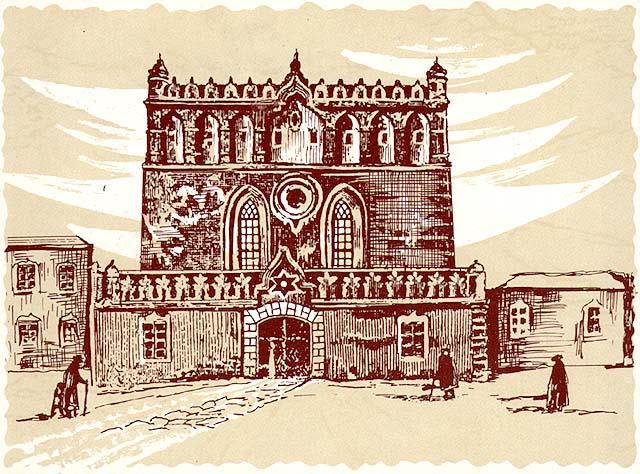
The Jewish Community of Husiatyn
Husiatyn
Gusyatyn
A town in the district of Tarnopol, Ukraine. Until World War II in eastern Galicia, Poland.
Husiatyn received recognition as a town in 1559. In 1594 the town was set on fire by the Cossacks. During the years 1672-1680, the town was occupied several times by the Turks and was under Turkish rule from 1680. In 1699 it was returned to Poland. After the partition of Poland in 1772 the town was divided between Russia and Austria and the Zbrucz river which bisects the town was the border. Only the Austrian sector of Husiatyn was returned to Poland after World War I. In 1914, after world war I broke out, the town was occupied by the Russian army and until June 1919 came under the rule of the western Ukrainian republic. It then became part of the Soviet Union. In 1920 it was once again under Polish jurisdiction. Jews have lived in Husiatyn since 1577. At the end of the 16th century the community had a synagogue. In 1623, as a result of a blood libel, three Jews were burned to death at the stake. At the end of the 17th century the community built a splendid fortress like synagogue.
In 1765 there were 1,200 Jews in the town, some Jews joined the Frankist movement (a messianic movement founded by Jacob Frank). But at the end of the 18th century most of the Jews in Husiatyn were sympathetic to the Hasidic movement. When a Hasidic court was established in 1861 the town became one of the important centers of Galician Hasidism.
After the partition in 1772, the Jewish community was also divided. Most of the Jews remained in the Austrian sector where the community institutions continued their activities. The minority were in the Russian sector on the eastern bank of the Zbrucz river.
In the 19th century a new study-house was built next to the old one, also a synagogue for the cobblers and tailors and an impressive study-house for the admor. There was also a modern public bath, a hospital, an old age home, and charitable and interest-free loan societies.
At the end of the 19th century there were 4,200 Jews in Husiatyn , 66% of the population, but before World War I there were 3,300 Jews, 56% of the population.
When World War I broke out, on August 9, 1914 units of the Russian army entered Husiatyn and rioted against the Jews. About 400 Jewish families succeeded in leaving before the Russians arrived. The others, about 600 people, dispersed in different towns and villages in the area.
In 1915 there was an epidemic of typhoid fever which caused many deaths. On June 13, 1915 the Russian occupying authorities ordered the Jews (about 1,500 souls) to leave within 24 hours. When the Russian army retreated in 1916 the remaining Jews were expelled to the region of Kiev. During the period of the western Ukrainian republic (November 1918 - May 1919) the few remaining Jews in Husiatyn were robbed by bands of peasants. In 1920 the Bolshevik authorities nationalized the property of the Jewish merchants and shopkeepers.
In 1921 368 Jews were left in Husiatyn , this was also their number in 1931.
At the end of the 18th century Husiatyn was the center of trade between Galicia and Russia. Jewish traders came to its fairs from all parts of Galicia, Turkey and Salonica.
The Jews engaged in the trade of grains and lumber, in crafts, in leasing lands and inn-keeping. There were agents, middlemen and money-changers. The Hasidic courts created new means of living like hotels and restaurants.
There were also doctors, lawyers, veterinarians and pharmacists. There was a Jewish-owned printing press and an affiliated publishing house. There were shops for paper and writing materials. The only factory in Galicia that produced pen-points was Jewish owned.
After World War I the means of livelihood in Husiatyn dwindled because of its proximity to the border and the competition from the Ukrainian cooperatives. The Hasidic court also left the town. The law of 1937 regulating ritual slaughter caused a decline in the business of livestock merchants and butchers.
Zionist activity began early in the 20th century. During the years 1901-1903 the "Bnei Zion" and the "Eretz Israel" societies were founded, in 1910 the "Theodor Herzl" society. In 1905 the "Dorshei Sefat Yeshanim" society published the commentary of Saadiah Gaon on Ecclesiastes and other rare manuscripts. During that period a complementary Hebrew school and a private Jewish gymnasium were founded. The leaders of the community were Zionists and two of them even served as chairmen of the municipal council. After World War I there were branches of "Hitahdut", "Ha-Mizrachi", "Ahva" and "Revisionist Zionists". There were also branches of the youth movements "Zionist Youth", "Betar" and "Gordonia". The complementary Hebrew school continued to function.
On the eve of World War II there were 1,800 Jews in Husiatyn .
The Holocaust Period
After World War II broke out (September 1, 1939) and as a result of the pact between Germany and the Soviet Union, Husiatyn , like most of eastern Poland, came under Soviet rule.
Private trading was repressed almost completely. Craftsmen were forced to organize in cooperatives. The Jews worked in the municipal soviet administration and in the marketing networks.
After the German attack on the Soviet Union (June 22, 1941), some Jews escaped with the retreating Soviet army. On July 6, 1941 the town was occupied by the Germans. Local Ukrainians robbed and killed Jews.
In July 1941 the Germans and the Ukrainians killed 200 Jews. The remaining Jews were fined by the German authorities and conscripted to forced-labor. In the winter of 1941-42 many Jews died of disease and starvation.
In March 1942 the surviving Jews of Husiatyn were deported to Kopyczynce and Probuzna where they shared the fate of the local Jews.
Skalat
(Place)Skalat
Скалат
A town in the district of Tarnopol, Ukraine. Until the Second World War, in eastern Galicia, Poland.
Skalat was founded in the 16th century. After the partition of Poland in 1772, it was annexed by Austria, together with the whole of Galicia. Between the two world wars it belonged to an independent Poland.
Jews have lived in Skalat since the beginning of the 17th century. By the end of the century, the town had an organized community with a synagogue and a rabbi.
In 1765, about 700 Jews lived there; in 1890 they numbered about 3250, accounting for 55 percent of the total population. Most of the Jewish inhabitants were Hassidim.
At the end of the 19th century, frightened by unrest and riots following a big fire, many Jewish inhabitants fled overseas. In the United States, an organization of Skalat Jews was established, which helped the Jewish community in Skalat. The synagogue, which had been destroyed during the fire, was rebuilt by the architect Tarnovsky, and decorated with murals by the Jewish painter, Sak.
In addition to the synagogue, there were 10 prayer and study houses in Skalat, among them kloises (a house of torah learning and prayer) of the Ryzyn, Belz and Wiznic Hassidim, and of the artisans' association Yad Haruzim. The community also had a hevra kadisha and a bikur holim society.
The last rabbis officiating in Skalat between the two world wars were Rabbi Itzhak Rosenblatt and Rabbi Binyamin Wolowicz. Both were killed during the Holocaust.
The Skalat Jews took a very active part in the life of the town. At the end of the 19th century 18 Jews were elected to the town council, which had a total of 30 members. The Jewish lawyer, Arnold Ehrlich, was mayor of Skalat at the beginning of the 20th century. In 1933 the 16-man council had six Jewish members.
In the early days of the First World War Skalat was occupied by the Russians, and 4,000 refugees from Husiatyn and Podwoloczyska came to Skalat.
The shortage of housing and food created tension between the Jews of Skalat and the refugees, in connection with the distribution of money from the Kiev Assistance Fund for Jewish refugees.
In the 17th and 18th centuries, the Skalat Jews were leaseholders and merchants. Some of them were innkeepers and bartenders. In the 19th century, they had difficulties in earning a living. Some of them were employed on the estates, some were commission agents and others traded in grains. In 1869, when Suesskind Rozensztok, a rich Jew, bought the local nobleman's estate, many Jews found work there. At the end of the 19th century, there were about 129 Jewish wool, cattle, copper and iron goods, leather and spices. Tailors, tinsmiths, furriers, watchmakers, barbers, bakers and brewers.
At the beginning of the 20th century, a Jewish doctor and two Jewish lawyers lived in Skalat.
Between the two wars, most of the Skalat Jews were retail traders and artisans.
The admorim of Husiatyn, Rabbi Mordechai Shraga Friedmann who died at the end of the 19th century, and after him, his son, Rabbi Israel came to Skalat every year and stayed there from Lag Ba'Omer until after Shavuoth. During the visits of the admorim, hundreds of Hassidim from Galicia and the whole of Poland flocked to Skalat. The visitors increased the income of the hostel owners and temporary restaurants, and of craftsmen.
After the First World War, in independent Poland, the economic situation of the Jews worsenend. A gmiluth hassadim fund and a cooperative bank, supported by the Joint, assisted the needy. At that time, many families left the town. In 1921, the community numbered about 2,900 Jews, that is, 49 percent of the total population.
At the beginning of the 20th century, Zionist groups organized themselves in Skalat. In 1902 the Ahavat Zion Union was established, and in 1904 the Yehuda organization. The Zionist youth movement set up a drama circle which also gave performances in the nearby towns.
Between the two world wars, Zionist activities in Skalat increased and branches of all the Zionist movements were set up. The local Gordonia youth branch created a training group in the vicinity of the town in 1925.
In the same year the Agudat Ezra, and later Hanoar Hazioni, Hanoar Hamizrahi, Ahva, Bnei Akiva and Betar branches, were established.
In 1909 the Zionists opened a Hebrew school which was attended by 70 pupils. After the First World War, this school reopened and about 100 pupils studied there. In 1927 a Jewish kindergarten was set up in Skalat. After 1933, Zionist representatives had a majority on the community committee which had been previously dominated by Hassidim.
In 1939 more than 4,000 Jews lived in Skalat, out of a total population of about 7,000.
The Holocaust Period
In the years 1939 to 1941 following the Molotov-Ribbentrop Agreement of August 1939) Skalat was under Soviet rule. At that time political and social activities were banned and private business activities were prohibited. In the autumn of 1940, under pressure by the authorities, the craftsmen organized in cooperatives. Jews supporting the new regime occupied important positions in the local administration and the state-owned shops. After the outbreak of war between Germany and the USSR on June 22, 1941, the local population began to persecute the Jews. 200 Jews escaped with the retreating Red Army.
The town was occupied by the Germans on July 5, 1941. 20 Jews were murdered by German soldiers. The local administration passed into the hands of Ukrainians, and their nationalist representatives instigated anti-Jewish riots. On July 6, a massacre of local Jews was organized during which 560 persons were murdered.
In the middle of July, a Judenrat (Jewish council) and a Jewish police force were set up. The Judenrat complied with the demands of the Germans, and also took care of the community's needs. A home for the aged and public kitchens were opened.
On July 19, the Skalat Jews were forced to pay a contribution (ransom) amounting to 600,000 rubles within five days. In the summer and autumn of 1941 the Judenrat undertook to deliver about 300 people a day for forced labor. In the autumn of 1942, 200 young people from Skalat were sent to the Burke Wielkie labor camp. Jews from the nearby communities, Grzymalow and Podwoloczyska, were brought to Skalat. That winter Jews from Skalat were sent to labor camps set up in the district.
In February and March 1942, the Jews of the town were transferred to one quarter. In July, a group of young Jewish women were sent to the labor camp in Jagielnice, and in August of the same year the Germans forced the Judenrat - threatening to liquidate the entire Jewish community - to hand over 600 sick and old people. They were taken from the synagogue to Tarnopol, where they joined those selected for deportation to the Belzyc death camp. The cooperation of the Judenrat and the Jewish police in turning over the people, and their murder, caused bitter disputes and recriminations in the community. After this liquidation action, the Jews of Skalat began to hide in bunkers.
On October 21, 1942, a second action took place. SS units and German and Ukrainian policemen surrounded the Jewish quarter and started shooting. 2000 Jews were herded into the synagogue. On the next day they were deported to the Belzyc death camp. 153 were shot in the streets while trying to flee. 50 Jews escaped and returned to Skalat. On November 9, 1942, another action took place, following which 1100 Jews were deported to Belzyc. 100 men were sent to the Hlobcek labor camp. The area of the Jewish quarter was reduced and became a closed ghetto where hunger and illness prevailed.
On November 11, 1942, the Germans broke into the ghetto and herded about 700 Jews into the synagogue. They were taken to pits previously dug outside the town and massacred there. 50 sick people from the Jewish hospital and the medical staff were among them. Some of the victims were buried alive.
After this massacre a group organized itself for armed resistance, under the leadership of Michael Glanc. The members of this group started to acquire arms and searched for Jews who had escaped to the woods. It is assumed that the Germans knew about these preparations for resistance and that is why the liquidation of the ghetto was carried out before the planned date.
On June 9, 1943, the last action took place. 600 Jews were shot and killed by machine-gun fire and thrown into pits outside the town, which was then declared Judenrein. About 400 Jews remained in the town's labor camp. 200 of them were murdered on June 30, 1943, and the rest escaped to the surrounding woods.
A few days later, the Germans declared that the inmates of the labor camp were permitted to return to the town. Owing to the terrible conditions in the woods and the hostile attitude of the local population, about 100 Jews returned and were employed in the nearby quarries. On July 28, 1943, the camp was liquidated, and the inmates were killed. 20 Jews who tried to escape were caught by Ukrainian peasants and handed over to the Germans.
About 300 Skalat Jews survived by hiding in the surrounding forests and the Germans promised a reward for every Jew delivered to them. In the summer of 1943, about 30 Jews joined the Soviet partisan units Kowpak Brigade. Only seven of them survived; most of them fell fighting the Germans.
In March 1944 the town was liberated by the Red Army. About 190 Jewish survivors returned to Skalat, but most of them left again. Some of them emigrated to Eretz Israel, and some to other countries.
According to information received from a former Skalat resident who visited the town in 1967, Skalat was not rebuilt after the war. Most of the Jewish-owned houses were destroyed and the big synagogue, the Shul, now houses a workshop. A stadium was built on the Jewish cemetery. Some of the tombstones were used to build the wall and pave sidewalks. A wood is growing on the communal graves outside the town.
In 1967 only about 1500 people lived in Skalat.
Ukraine
(Place)Ukraine
Україна / Ukrayina
A country in eastern Europe, until 1991 part of the Soviet Union.
21st Century
Estimated Jewish population in 2018: 50,000 out of 42,000,000 (0.1%). Main Jewish organizations:
Єврейська Конфедерація України - Jewish Confederation of Ukraine
Phone: 044 584 49 53
Email: jcu.org.ua@gmail.com
Website: http://jcu.org.ua/en
Ваад (Ассоциация еврейских организаций и общин) Украины (VAAD – Asssociation of Jewish Organizations & Communities of Ukraine)
Voloska St, 8/5
Kyiv, Kyivs’ka
Ukraine 04070
Phone/Fax: 38 (044) 248-36-70, 38 (044) 425-97-57/-58/-59/-60
Email: vaadua.office@gmail.com
Website: http://www.vaadua.org/