דלג לתוכן האתר >
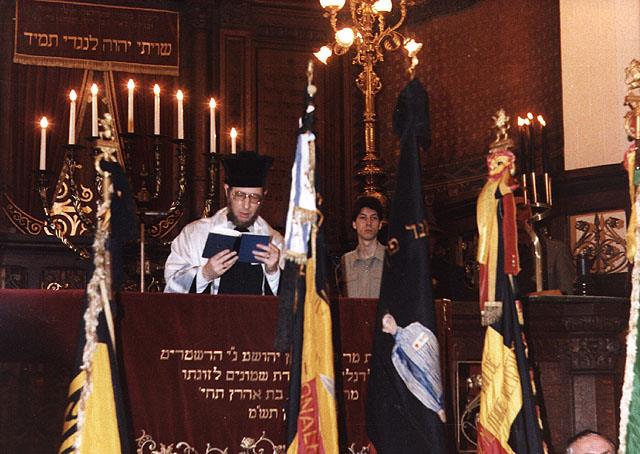
טקס לציון 41 שנה למרד גיטו וארשה בבית הכנסת הגדול. בריסל, בלגיה, 1984

קהילת יהודי בריסל

בריסל

בירת בלגיה.

מספר תושביה 168,600 (1967). ב-1976 נאמד מספר תושביה היהודיים ב-24,500, הגדולה בקהילות בלגיה, עם שלוש עדות אשכנזיות ואחת ספרדית ושלושה מרכזים קהילתיים.

בבריסל רשת מסועפת לחינוך יהודי הכוללת שני בתי-ספר יומיים, אחד מסורתי-דתי ואחד ("גננו") בעל צביון ציוני, ותיכון דתי - כולם בתמיכת הקהילה; בתי-ספר של יום א', בית-ספר ללשון ולספרות אידית וחוגים ללשון עברית. "איחוד ליבראלי", בשיתוף יהודים מקומיים ואזרחי ארצות-הברית תושבי בלגיה, קיים מ-1966. ליד אוניברסיטת בריסל פועל בתמיכת הממשלה מרכז ללימודי היהדות בת- זמננו, שתרם רבות להעלאת קרנה התרבותי של הקהילה. יישוב יהודי נכבד באמצע המאה ה-13, שהוכחד בשנות "המגיפה השחורה" (1349-1348). המעטים שחזרו נרצחו כעבור עשרים שנה באשמת חילול "לחם הקודש" ומאז ועד קץ השלטון הספרדי בבלגיה (1713) נאסר על היהודים להתיישב בבריסל. מפעם לפעם נקלעו לעיר אנוסים מיוצאי ספרד ואחדים מהם, ביניהם המשורר דניאל לוי (מיגואל) באריוס, אף שירתו במאה ה-17 בחיל-המצב הספרדי. היישוב התחדש עם השלטון האוסטרי, על אף האיסור הרשמי, ובתחילת המאה ה-18 ובאמצע המאה מנה 21 גברים, 19 נשים ו-26 ילדים, רובם יוצאי הולאנד. עם הסיפוח לצרפת, ב-1794, הוסרו ההגבלות על מגורי היהודים בעיר וחופש דתי לכל הונהג בבלגיה העצמאית, ב- 1831. בבריסל שכן מרכז
הקונסיסטוריות הבלגיות ואליקים כרמולי נתמנה ב-1832 רב ראשי של יהודי בלגיה. על יוצאי גרמניה והולאנד הוותיקים נוספו מהגרים מפולין ומרוסיה והחל ב-1933 פליטים מגרמניה הנאצית. ערב מלחמת-העולם השנייה מנתה קהילת בריסל כ-30,000 נפש, השנייה בגודלה בבלגיה אחרי אנטוורפן. הגרמנים כבשו את בריסל במאי 1940, הקימו "איגוד יהודי", כביכול לצורכי עזרה הדדית, וכעבור זמן גירשו את יהודי העיר למחנה מקלן (מאלין) ומשם למחנות-ההשמדה במזרח.

בשנים 1950-1945 התרכזו בבריסל פליטים לרבבות; אחרי גלי ההגירה לאמריקה, לאוסטראליה ולישראל נותרו בריסל בשנות ה-50 קצת יותר מ-18,000 יהודים. שיקום היישוב היהודי התעכב בגלל המצב הכלכלי בבלגיה ומיעוט היתרי-העבודה שהוקצבו ליהודים, רובם נתיני-חוץ או חסרי נתינות (ב-1946 נתמכו מקרנות בין- לאומיות כ-4,500 איש בממוצע לחודש, ואילו ב-1970 נותרו רק מאות אחדות של יהודים נזקקי-סעד בעיר). עזרת הג'וינט ו"ועידת התביעות החומריות מגרמניה" ניתנה במשך 20 שנה לערך, בעיקר באמצעות מרכז הסיוע היהודי בבריסל שהוקם ב-1952.

לזר לוי (1882- 1964), פסנתרן. נולד בבריסל, בלגיה, ולמד בקונסרבטוריון בפריס. ניגן עם התזמורות הסימפוניות החשובות באירופה והופיע איתן ברחבי העולם. ב-1920 ירש את מקומו של אלפרד קורטו (Cortot) כפרופסור לפסנתר בקונסרבטוריון של פריס וכמורה מעולה. הלחין קטעים רבים לפסנתר ומוסיקה קאמרית.

Claude Levi-Strauss (1908-2009), anthropologist and ethnologist considered by many to be the father of modern anthropology, born in Brussels, Belgium, to French parents who were at the time living in Brussels, he was brought up in Paris, France. His father was a painter, his maternal grandfather was the rabbi of Versailles, France. He studied law and philosophy at the Sorbonne in Paris. In 1935 he joined a French cultural mission to Brazil and was appointed visiting professor of sociology at the University of Sao Paulo. His wife became visiting professor of ethnology at the same institution.

From 1935-1939 the couple undertook field work together and studied ethnic groups in the Mato Grosso and Amazon Rain Forest areas. In 1938 Levi-Strauss’ wife suffered an injury which prevented her from completing some research so he proceeded to do so alone. It was this experience that confirmed his career as an anthropologist. In 1939 he returned to France and served in the French army until the capitulation in 1940. He then became a school teacher until he was dismissed under the Vichy racial laws and stripped of his French citizenship. He managed to leave France and spent most of World War II in New York, USA, as Professor at the New School for Social Research. After the end of World War II, he received a doctorate from the Sorbonne in anthropology.

In 1949 Levi-Strauss published his "Elementary Structures of Kinship" which was soon recognized as one of the most important anthropological works on the subject and in particularly regarding the position of women in non-western cultures. He argued that families acquire definite identities through their members’ relationships with one another. Thus it is not only the central individuals (husband, wife, children) who are important. He was involved with the French National Center for Scientific Research (CNRS) and the Musee de l’Homme in Paris. By 1955 he was known as one of France’s best known intellectuals when he published Tristes Tropiques, which combined philosophical meditation with ethnographic analyses of the Amazonian peoples. Four years later he published "Structural Anthropology", a collection of essays which gave examples and pragmatic statements about what he called ‘Structuralism’. “Structuralism was”, he said, “the search for unsuspecting harmonies”. At the same time he began to organize the establishment of several institutions in France for the study of anthropology including a Laboratory for Social Anthropology where new students could learn the discipline and a journal where research could be published.

In 1962 he published what was considered his most important work La Pensee Sauvage ["The Savage Mind"], which is about primate thought. The book sets out his theory of culture and mind and also a theory of history and social change. In this he rejected the notion that Western civilization is privileged and unique. With his emphasis on form over content he insisted that the savage mind is equal to the civilized mind. He believed that the characteristics of man are everywhere identical and this belief was the result of his many travels to Brazil and his meetings with the Indian tribes there. He derived this view from a school of linguistics whose focus was not on the meaning of words, but rather on the patterns which the words form. As a result he produced a theory of how the mind works.

In1973 Levi-Strauss was elected to the Academie Francaise. He received a number of international prizes and received honorary doctors from Oxford, Harvard and Columbia Universities. He was a member of the National Academy of Sciences, the American Academy and Institute of Arts and Letters and the American Philosophical Society. He received many other honors both in France and elsewhere. After his death he was described as having been “one of the dominant postwar influences in French intellectual life and the leading exponent of Structualism in the social sciences.”

Statesman

Born in Brussels, Belgium, he qualified as a lawyer and joined the Liberal party. After World War I he was secretary-general to the Belgian delegation to the Reparations Commission and from 1920 to 1924, chief secretary to the Ministry of Finance. Gutt served as Minister of Finance, 1934-35 and 1939-40, and then during World War II in the Belgian government-in-exile in England until February 1945. From 1946-51, he was the first managing director of the International Monetary Fund (IMF).

Clement Ariel Eder (b. 1937), Holocaust survivor, born in Brussels, Belgium. In August 1942, when the Nazis began to deport the Jews of Belgium to Auschwitz, his parents, Mordechai and Cilly Shaul, decided to seek safety by trying to flee to Switzerland. Being aware of the dangers of such a difficult journey, they decided to make the trip without their four-and-a-half year old son. This in order to safeguard their son's life. The couple decided to leave their son Ariel in the good hands of their non-Jewish neighbours Hugo and Elza Buyens-Mortelmans. Cilly reached Switzerland hidden in one of the water tankers of a steam locomotive. Her husband Mordechai made the journey on foot. Once safely in Switzerland, they took refuge there until the end of the war.

A few days later the Gestapo conducted a house-by-house search for Jews in the street in Antwerp where they had lived. Terrified, neighbour Hugo Mortelmans quickly grabbed the child and hid him in the loft of the house. After a few days the Mortelamans decided that Ariel would be safer in France so they entrusted him to a truck driver who was paid to take him to Marseilles under the assumed name of Henri Reder in the hope that he would then be able to join his parents in Switzerland. For some unknown reason the child ended up in Paris where a certain Lucien Sigust, the owner of a bar named "Le Rancho" at 58, Avenue de Wagram, was asked him to take care of him 'for two or three days.' Sigust, not knowing what to do with a young child, took him to a friend of his, Emilienne Lefrançois. When after a few days the driver did not reappear, Emilienne suggested to Lucien that the child would be safer with her brother René, who lived in the village of St. Martin de Bienfaite (Bienfaite) in Normandy. Her reasoning was that in wartime, life in the countryside was, at least to some extent, easier than in town.

A few days after Ariel's (Henri) arrival in Bienfaite village, René's brother Pierre appeared. Pierre, his wife Georgette and their daughter Pierrette, took child to join their family. They treated him like their own. When he arrived at the Lefrançois home, Henri neither spoke nor understood French, his presence in France was illegal, he had no identification papers and therefore had no food or clothing coupons. It was crucial to conceal his Jewish origins at all costs. One of Pierre's brothers, priest Father Paul Lefrançois, had been in the Resistance from the beginning. He had written many articles for the "Patriote de l'Eure", a clandestine journal published by the local National Front for Liberty in the Eure region. Father Paul forged a certificate which claimed that Pierre Lefrançois, on marrying Georgette Suzanne, had agreed also to adopt her son Henri, who had been born out of wedlock. This document legitimised a "bastard". In order to complete the disguise Georgette and Pierre decided to teach Henri some prayers and basic religious practices so that he would not stand out from other children of his age during Sunday mass at church, but they made attempt to influence the Jewish child in favour of Catholicism.

In May 1944 Georgette gave birth to a son of her own, but the baby died within a week. A few weeks later her husband, who was a member of an underground network, was seriously wounded and died. Within less than a month, Georgette had therefore lost both her baby and her husband, but she continued to take care of her two children: daughter Pierrette, now aged four, and Henri-Ariel, now six years old.

The Liberation made it possible to resume correspondence with Henri's family who were still in Switzerland. It was not simple since the only name they knew was Henri Reder. Finally the French Red Cross and the Swiss Red Cross concluded that Henri Reder and Ariel Clement Eder were one and the same so contact was finally made. In February 1945, Eli Sternbuch of St. Galles in Switzerland arrived in Bienfaite with a proxy signed by Henri's parents and entitling him to deliver the child to them.

Ariel Eder, left his adoptive mother and his home in Normandy to return to his real parents.

In 1961 Ariel immigrated to Israel. Georgette died in 1998. In 2006 Georgette and Pierre Lefrancois were posthumously recognized as Righteous among the Nations.

Moise Meir Levi (1915-2003), Chief Rabbi of Belgian Congo (also known as Zaire, now The Democratic Republic of Congo), born in Antalya, Turkey, where his grandfather had been a rabbi. In the aftermath of World War I, after the somewhat chaotic conditions of the collapse of the Ottoman Empire and the establishment of the new Turkish republic, the family, together with many other Turkish Jews, decided to move to the Greek island of Rhodes, which had been seized by Italy in 1912. Economic conditions were difficult, Moises’ father Meir could not find suitable work and finally in 1932 sailed for Palestine where one of his brothers found him a job. Moise did not accompany his parents.

Moise received his secondary school education at the Alliance Israelite Universelle school in Rhodes. A conscientious and diligent student, was awarded a scholarship which enabled him in 1930 to enroll at the Rhodes rabbinical seminary which had been established three years earlier. In 1936 the young rabbi was offered a position in New York, but was persuaded by the president of the Yeshiva to accept a call to become instead the rabbi of Élisabethville (now Lubumbashi) in the Congolese province of Katanga, then under Belgian colonial rule. There he was to become rabbi, teacher, cantor, shochet and mohel for a community of some 2,500 Jews who had moved to the Congo from all over Europe during the 1920s. A majority of these Jews had however come from Rhodes attracted by the opportunities being opened up by the natural resources of the Congo. Many of the Jews from Rhodes became traders, settling in several of the new towns and villages, and making good livings for their families. In 1950, on the recommendation of Rabbi Uziel, chief rabbi of Israel, he was given the title of Chief Rabbi of all the Congo and Rwanda-Urundi.

Rabbi Levi continued to provide religious services to the scattered small communities throughout this vast land, he helped to resolve disputes between them and the authorities and he represented the Jews in relations with the different churches. His Friday night services were broadcast throughout the country. Many of his listeners were non-Jewish. In 1955 he was awarded the "Gold Medal" by King Baudouin I of Belgium and then in 1962 the Italian "Medal of Merit".

He became a personal friend of Moshe Tshombe, leader of Katanga which in 1960 broke away from the remainder of independent Congo for some 5 years. Unrest and rebellion plagued the country for most of the first 15 years of its life resulting in the departure of most of the Jews for South Africa, Israel or Belgium. In 1962, he spent the day before Yom Kippur visiting the wounded and sick at the hospitals. Then, to reach the synagogue he had to crawl on hands and knees for 800 metres. He spent the day entirely alone in the synagogue while battles were fought all around. Under the programme of "Zairization" in the early 1970s much of the property of the remaining Jews was confiscated, but in so far as circumstances permitted he continued to work for the welfare of the Jews who remained in Zaire. In 1966 he was awarded the "National Order of the Leopard" for his services to the country. The award was presented to Rabbi Levi by the President of Congo, General Mobutu Sese Seko.

Rabbi Levi was forced to leave Katanga in 1991 but remained the Chief Rabbi, assisting community members from his seat of exile in Belgium. He died in Brussels. King Baudouin I of Belgium called him “my rabbi”.

קלרה הסקיל (1895-1960) פסנתרנית. נולדה בבוקרשט, רומניה, למשפחה ממוצא ספרדי. למדה אצל ריצ'רד רוברט ואלפרד קורטו (בקונסרבטוריון של פריס). הופעת הבכורה שלה נערכה בווינה, ב-1902. בשנים 1940-1927 התגוררה בפריס. מצרפת הכבושה עברה לשווייץ וקיבלה אזרחות שווייצרית ב-1949. לאורך כל הקריירה שלה סבלה ממחלת שרירים. במהלך השנים הופיעה רבות עם הכנרים אז'ן ייסאי (Eugen Ysaye), ז'ורז' אנסקו וארתור גרומיו (Arthur Grumiaux), ועם פבלו קזאלס (Pablo Casals). הסקיל נחשבה למבצעת מצוינת של יצירותיהם של מוצרט, שוברט ושומאן. נפטרה בבריסל, בלגיה.

יוסף ויניאבסקי (1837- 1912), פסנתרן ומלחין. נולד בלובלין, פולין. בשנים 1855-1850 ערך מסעות קונצרטים ברחבי אירופה עם הנריק אחיו. למד בפריס ואחר כך, ב-1855/56, למד אצל פרנץ ליסט בויימר, גרמניה. בשנים 1869-1865 לימד בקונסרבטוריון במוסקבה ולימים ניהל במוסקבה בית ספר למוסיקה משלו. ב-1876 עבר לבריסל והיה פרופסור בקונסרבטוריון.
הלחין יצירות לתזמורת (כולל קונצ'רטו לפסנתר), מוסיקה קאמרית ומספר קטעים של מוסיקה לפסנתר (ולסים, מזורקה ואטיודים). נפטר בבריסל, בלגיה.

טקס לציון 41 שנה למרד גיטו וארשה בבית הכנסת הגדול
בבריסל, בלגיה, 1984.
צילום: מ. דרייגור-שלוסברג, בלגיה.
(המרכז לתיעוד חזותי ע"ש אוסטר, בית התפוצות,
באדיבות מ. דרייגור-שלוסברג, בלגיה)
מצעד של חברי המחתרת היהודית (בריגדה 9)
לזכר חבריהם שנפלו, בריסל, בלגיה, 1946
(המרכז לתיעוד חזותי ע"ש אוסטר, בית התפוצות,
באדיבות רוז טבקמן, ישראל)

המחתרת הבלגית הייתה מורכבת בתקופת מלחמת העולם השנייה
מיהודים ולא-יהודים שעסקו בהצלת יהודים, בעיקר ילדים, הפצת
עלונים, זיוף מסמכים והעברת נשק
ארוחה שנערכה לחיילים היהודים בצבא גרמניה
לרגל ראש השנה בארמון בודואן, בריסל, בלגיה, 1917
צילום שנעשה בידי הצבא הגרמני במלחמת העולם הראשונה
(המרכז לתיעוד חזותי ע"ש אוסטר, בית התפוצות,
באדיבות האקדמיה הפולנית למדעים)
מאגרי המידע של אנו
גנאלוגיה יהודית
שמות משפחה
קהילות יהודיות
תיעוד חזותי
מרכז המוזיקה היהודית
מקום
אA
אA
אA
קהילת יהודי בריסל
בריסל

בירת בלגיה.

מספר תושביה 168,600 (1967). ב-1976 נאמד מספר תושביה היהודיים ב-24,500, הגדולה בקהילות בלגיה, עם שלוש עדות אשכנזיות ואחת ספרדית ושלושה מרכזים קהילתיים.

בבריסל רשת מסועפת לחינוך יהודי הכוללת שני בתי-ספר יומיים, אחד מסורתי-דתי ואחד ("גננו") בעל צביון ציוני, ותיכון דתי - כולם בתמיכת הקהילה; בתי-ספר של יום א', בית-ספר ללשון ולספרות אידית וחוגים ללשון עברית. "איחוד ליבראלי", בשיתוף יהודים מקומיים ואזרחי ארצות-הברית תושבי בלגיה, קיים מ-1966. ליד אוניברסיטת בריסל פועל בתמיכת הממשלה מרכז ללימודי היהדות בת- זמננו, שתרם רבות להעלאת קרנה התרבותי של הקהילה. יישוב יהודי נכבד באמצע המאה ה-13, שהוכחד בשנות "המגיפה השחורה" (1349-1348). המעטים שחזרו נרצחו כעבור עשרים שנה באשמת חילול "לחם הקודש" ומאז ועד קץ השלטון הספרדי בבלגיה (1713) נאסר על היהודים להתיישב בבריסל. מפעם לפעם נקלעו לעיר אנוסים מיוצאי ספרד ואחדים מהם, ביניהם המשורר דניאל לוי (מיגואל) באריוס, אף שירתו במאה ה-17 בחיל-המצב הספרדי. היישוב התחדש עם השלטון האוסטרי, על אף האיסור הרשמי, ובתחילת המאה ה-18 ובאמצע המאה מנה 21 גברים, 19 נשים ו-26 ילדים, רובם יוצאי הולאנד. עם הסיפוח לצרפת, ב-1794, הוסרו ההגבלות על מגורי היהודים בעיר וחופש דתי לכל הונהג בבלגיה העצמאית, ב- 1831. בבריסל שכן מרכז
הקונסיסטוריות הבלגיות ואליקים כרמולי נתמנה ב-1832 רב ראשי של יהודי בלגיה. על יוצאי גרמניה והולאנד הוותיקים נוספו מהגרים מפולין ומרוסיה והחל ב-1933 פליטים מגרמניה הנאצית. ערב מלחמת-העולם השנייה מנתה קהילת בריסל כ-30,000 נפש, השנייה בגודלה בבלגיה אחרי אנטוורפן. הגרמנים כבשו את בריסל במאי 1940, הקימו "איגוד יהודי", כביכול לצורכי עזרה הדדית, וכעבור זמן גירשו את יהודי העיר למחנה מקלן (מאלין) ומשם למחנות-ההשמדה במזרח.

בשנים 1950-1945 התרכזו בבריסל פליטים לרבבות; אחרי גלי ההגירה לאמריקה, לאוסטראליה ולישראל נותרו בריסל בשנות ה-50 קצת יותר מ-18,000 יהודים. שיקום היישוב היהודי התעכב בגלל המצב הכלכלי בבלגיה ומיעוט היתרי-העבודה שהוקצבו ליהודים, רובם נתיני-חוץ או חסרי נתינות (ב-1946 נתמכו מקרנות בין- לאומיות כ-4,500 איש בממוצע לחודש, ואילו ב-1970 נותרו רק מאות אחדות של יהודים נזקקי-סעד בעיר). עזרת הג'וינט ו"ועידת התביעות החומריות מגרמניה" ניתנה במשך 20 שנה לערך, בעיקר באמצעות מרכז הסיוע היהודי בבריסל שהוקם ב-1952.
חובר ע"י חוקרים של אנו מוזיאון העם היהודי
לזר לוי

לזר לוי (1882- 1964), פסנתרן. נולד בבריסל, בלגיה, ולמד בקונסרבטוריון בפריס. ניגן עם התזמורות הסימפוניות החשובות באירופה והופיע איתן ברחבי העולם. ב-1920 ירש את מקומו של אלפרד קורטו (Cortot) כפרופסור לפסנתר בקונסרבטוריון של פריס וכמורה מעולה. הלחין קטעים רבים לפסנתר ומוסיקה קאמרית.

קלוד לוי-שטראוס

Claude Levi-Strauss (1908-2009), anthropologist and ethnologist considered by many to be the father of modern anthropology, born in Brussels, Belgium, to French parents who were at the time living in Brussels, he was brought up in Paris, France. His father was a painter, his maternal grandfather was the rabbi of Versailles, France. He studied law and philosophy at the Sorbonne in Paris. In 1935 he joined a French cultural mission to Brazil and was appointed visiting professor of sociology at the University of Sao Paulo. His wife became visiting professor of ethnology at the same institution.

From 1935-1939 the couple undertook field work together and studied ethnic groups in the Mato Grosso and Amazon Rain Forest areas. In 1938 Levi-Strauss’ wife suffered an injury which prevented her from completing some research so he proceeded to do so alone. It was this experience that confirmed his career as an anthropologist. In 1939 he returned to France and served in the French army until the capitulation in 1940. He then became a school teacher until he was dismissed under the Vichy racial laws and stripped of his French citizenship. He managed to leave France and spent most of World War II in New York, USA, as Professor at the New School for Social Research. After the end of World War II, he received a doctorate from the Sorbonne in anthropology.

In 1949 Levi-Strauss published his "Elementary Structures of Kinship" which was soon recognized as one of the most important anthropological works on the subject and in particularly regarding the position of women in non-western cultures. He argued that families acquire definite identities through their members’ relationships with one another. Thus it is not only the central individuals (husband, wife, children) who are important. He was involved with the French National Center for Scientific Research (CNRS) and the Musee de l’Homme in Paris. By 1955 he was known as one of France’s best known intellectuals when he published Tristes Tropiques, which combined philosophical meditation with ethnographic analyses of the Amazonian peoples. Four years later he published "Structural Anthropology", a collection of essays which gave examples and pragmatic statements about what he called ‘Structuralism’. “Structuralism was”, he said, “the search for unsuspecting harmonies”. At the same time he began to organize the establishment of several institutions in France for the study of anthropology including a Laboratory for Social Anthropology where new students could learn the discipline and a journal where research could be published.

In 1962 he published what was considered his most important work La Pensee Sauvage ["The Savage Mind"], which is about primate thought. The book sets out his theory of culture and mind and also a theory of history and social change. In this he rejected the notion that Western civilization is privileged and unique. With his emphasis on form over content he insisted that the savage mind is equal to the civilized mind. He believed that the characteristics of man are everywhere identical and this belief was the result of his many travels to Brazil and his meetings with the Indian tribes there. He derived this view from a school of linguistics whose focus was not on the meaning of words, but rather on the patterns which the words form. As a result he produced a theory of how the mind works.

In1973 Levi-Strauss was elected to the Academie Francaise. He received a number of international prizes and received honorary doctors from Oxford, Harvard and Columbia Universities. He was a member of the National Academy of Sciences, the American Academy and Institute of Arts and Letters and the American Philosophical Society. He received many other honors both in France and elsewhere. After his death he was described as having been “one of the dominant postwar influences in French intellectual life and the leading exponent of Structualism in the social sciences.”

Gutt, Camille Adolphe
Statesman

Born in Brussels, Belgium, he qualified as a lawyer and joined the Liberal party. After World War I he was secretary-general to the Belgian delegation to the Reparations Commission and from 1920 to 1924, chief secretary to the Ministry of Finance. Gutt served as Minister of Finance, 1934-35 and 1939-40, and then during World War II in the Belgian government-in-exile in England until February 1945. From 1946-51, he was the first managing director of the International Monetary Fund (IMF).
קלמנט איראל אדר

Clement Ariel Eder (b. 1937), Holocaust survivor, born in Brussels, Belgium. In August 1942, when the Nazis began to deport the Jews of Belgium to Auschwitz, his parents, Mordechai and Cilly Shaul, decided to seek safety by trying to flee to Switzerland. Being aware of the dangers of such a difficult journey, they decided to make the trip without their four-and-a-half year old son. This in order to safeguard their son's life. The couple decided to leave their son Ariel in the good hands of their non-Jewish neighbours Hugo and Elza Buyens-Mortelmans. Cilly reached Switzerland hidden in one of the water tankers of a steam locomotive. Her husband Mordechai made the journey on foot. Once safely in Switzerland, they took refuge there until the end of the war.

A few days later the Gestapo conducted a house-by-house search for Jews in the street in Antwerp where they had lived. Terrified, neighbour Hugo Mortelmans quickly grabbed the child and hid him in the loft of the house. After a few days the Mortelamans decided that Ariel would be safer in France so they entrusted him to a truck driver who was paid to take him to Marseilles under the assumed name of Henri Reder in the hope that he would then be able to join his parents in Switzerland. For some unknown reason the child ended up in Paris where a certain Lucien Sigust, the owner of a bar named "Le Rancho" at 58, Avenue de Wagram, was asked him to take care of him 'for two or three days.' Sigust, not knowing what to do with a young child, took him to a friend of his, Emilienne Lefrançois. When after a few days the driver did not reappear, Emilienne suggested to Lucien that the child would be safer with her brother René, who lived in the village of St. Martin de Bienfaite (Bienfaite) in Normandy. Her reasoning was that in wartime, life in the countryside was, at least to some extent, easier than in town.

A few days after Ariel's (Henri) arrival in Bienfaite village, René's brother Pierre appeared. Pierre, his wife Georgette and their daughter Pierrette, took child to join their family. They treated him like their own. When he arrived at the Lefrançois home, Henri neither spoke nor understood French, his presence in France was illegal, he had no identification papers and therefore had no food or clothing coupons. It was crucial to conceal his Jewish origins at all costs. One of Pierre's brothers, priest Father Paul Lefrançois, had been in the Resistance from the beginning. He had written many articles for the "Patriote de l'Eure", a clandestine journal published by the local National Front for Liberty in the Eure region. Father Paul forged a certificate which claimed that Pierre Lefrançois, on marrying Georgette Suzanne, had agreed also to adopt her son Henri, who had been born out of wedlock. This document legitimised a "bastard". In order to complete the disguise Georgette and Pierre decided to teach Henri some prayers and basic religious practices so that he would not stand out from other children of his age during Sunday mass at church, but they made attempt to influence the Jewish child in favour of Catholicism.

In May 1944 Georgette gave birth to a son of her own, but the baby died within a week. A few weeks later her husband, who was a member of an underground network, was seriously wounded and died. Within less than a month, Georgette had therefore lost both her baby and her husband, but she continued to take care of her two children: daughter Pierrette, now aged four, and Henri-Ariel, now six years old.

The Liberation made it possible to resume correspondence with Henri's family who were still in Switzerland. It was not simple since the only name they knew was Henri Reder. Finally the French Red Cross and the Swiss Red Cross concluded that Henri Reder and Ariel Clement Eder were one and the same so contact was finally made. In February 1945, Eli Sternbuch of St. Galles in Switzerland arrived in Bienfaite with a proxy signed by Henri's parents and entitling him to deliver the child to them.

Ariel Eder, left his adoptive mother and his home in Normandy to return to his real parents.

In 1961 Ariel immigrated to Israel. Georgette died in 1998. In 2006 Georgette and Pierre Lefrancois were posthumously recognized as Righteous among the Nations.

מושה מאיר לוי

Moise Meir Levi (1915-2003), Chief Rabbi of Belgian Congo (also known as Zaire, now The Democratic Republic of Congo), born in Antalya, Turkey, where his grandfather had been a rabbi. In the aftermath of World War I, after the somewhat chaotic conditions of the collapse of the Ottoman Empire and the establishment of the new Turkish republic, the family, together with many other Turkish Jews, decided to move to the Greek island of Rhodes, which had been seized by Italy in 1912. Economic conditions were difficult, Moises’ father Meir could not find suitable work and finally in 1932 sailed for Palestine where one of his brothers found him a job. Moise did not accompany his parents.

Moise received his secondary school education at the Alliance Israelite Universelle school in Rhodes. A conscientious and diligent student, was awarded a scholarship which enabled him in 1930 to enroll at the Rhodes rabbinical seminary which had been established three years earlier. In 1936 the young rabbi was offered a position in New York, but was persuaded by the president of the Yeshiva to accept a call to become instead the rabbi of Élisabethville (now Lubumbashi) in the Congolese province of Katanga, then under Belgian colonial rule. There he was to become rabbi, teacher, cantor, shochet and mohel for a community of some 2,500 Jews who had moved to the Congo from all over Europe during the 1920s. A majority of these Jews had however come from Rhodes attracted by the opportunities being opened up by the natural resources of the Congo. Many of the Jews from Rhodes became traders, settling in several of the new towns and villages, and making good livings for their families. In 1950, on the recommendation of Rabbi Uziel, chief rabbi of Israel, he was given the title of Chief Rabbi of all the Congo and Rwanda-Urundi.

Rabbi Levi continued to provide religious services to the scattered small communities throughout this vast land, he helped to resolve disputes between them and the authorities and he represented the Jews in relations with the different churches. His Friday night services were broadcast throughout the country. Many of his listeners were non-Jewish. In 1955 he was awarded the "Gold Medal" by King Baudouin I of Belgium and then in 1962 the Italian "Medal of Merit".

He became a personal friend of Moshe Tshombe, leader of Katanga which in 1960 broke away from the remainder of independent Congo for some 5 years. Unrest and rebellion plagued the country for most of the first 15 years of its life resulting in the departure of most of the Jews for South Africa, Israel or Belgium. In 1962, he spent the day before Yom Kippur visiting the wounded and sick at the hospitals. Then, to reach the synagogue he had to crawl on hands and knees for 800 metres. He spent the day entirely alone in the synagogue while battles were fought all around. Under the programme of "Zairization" in the early 1970s much of the property of the remaining Jews was confiscated, but in so far as circumstances permitted he continued to work for the welfare of the Jews who remained in Zaire. In 1966 he was awarded the "National Order of the Leopard" for his services to the country. The award was presented to Rabbi Levi by the President of Congo, General Mobutu Sese Seko.

Rabbi Levi was forced to leave Katanga in 1991 but remained the Chief Rabbi, assisting community members from his seat of exile in Belgium. He died in Brussels. King Baudouin I of Belgium called him “my rabbi”.

קלרה הסקיל

קלרה הסקיל (1895-1960) פסנתרנית. נולדה בבוקרשט, רומניה, למשפחה ממוצא ספרדי. למדה אצל ריצ'רד רוברט ואלפרד קורטו (בקונסרבטוריון של פריס). הופעת הבכורה שלה נערכה בווינה, ב-1902. בשנים 1940-1927 התגוררה בפריס. מצרפת הכבושה עברה לשווייץ וקיבלה אזרחות שווייצרית ב-1949. לאורך כל הקריירה שלה סבלה ממחלת שרירים. במהלך השנים הופיעה רבות עם הכנרים אז'ן ייסאי (Eugen Ysaye), ז'ורז' אנסקו וארתור גרומיו (Arthur Grumiaux), ועם פבלו קזאלס (Pablo Casals). הסקיל נחשבה למבצעת מצוינת של יצירותיהם של מוצרט, שוברט ושומאן. נפטרה בבריסל, בלגיה.

יוסף ויניאבסקי

יוסף ויניאבסקי (1837- 1912), פסנתרן ומלחין. נולד בלובלין, פולין. בשנים 1855-1850 ערך מסעות קונצרטים ברחבי אירופה עם הנריק אחיו. למד בפריס ואחר כך, ב-1855/56, למד אצל פרנץ ליסט בויימר, גרמניה. בשנים 1869-1865 לימד בקונסרבטוריון במוסקבה ולימים ניהל במוסקבה בית ספר למוסיקה משלו. ב-1876 עבר לבריסל והיה פרופסור בקונסרבטוריון.
הלחין יצירות לתזמורת (כולל קונצ'רטו לפסנתר), מוסיקה קאמרית ומספר קטעים של מוסיקה לפסנתר (ולסים, מזורקה ואטיודים). נפטר בבריסל, בלגיה.

טקס לציון 41 שנה למרד גיטו וארשה בבית הכנסת הגדול. בריסל, בלגיה, 1984
טקס לציון 41 שנה למרד גיטו וארשה בבית הכנסת הגדול
בבריסל, בלגיה, 1984.
צילום: מ. דרייגור-שלוסברג, בלגיה.
(המרכז לתיעוד חזותי ע"ש אוסטר, בית התפוצות,
באדיבות מ. דרייגור-שלוסברג, בלגיה)
מצעד של חברי המחתרת היהודית לזכר חבריהם שנפלו, בריסל, בלגיה, 1946
מצעד של חברי המחתרת היהודית (בריגדה 9)
לזכר חבריהם שנפלו, בריסל, בלגיה, 1946
(המרכז לתיעוד חזותי ע"ש אוסטר, בית התפוצות,
באדיבות רוז טבקמן, ישראל)

המחתרת הבלגית הייתה מורכבת בתקופת מלחמת העולם השנייה
מיהודים ולא-יהודים שעסקו בהצלת יהודים, בעיקר ילדים, הפצת
עלונים, זיוף מסמכים והעברת נשק
ארוחה שנערכה לחיילים היהודים בצבא גרמניה לרגל ראש השנה, בריסל, בלגיה, 1917
ארוחה שנערכה לחיילים היהודים בצבא גרמניה
לרגל ראש השנה בארמון בודואן, בריסל, בלגיה, 1917
צילום שנעשה בידי הצבא הגרמני במלחמת העולם הראשונה
(המרכז לתיעוד חזותי ע"ש אוסטר, בית התפוצות,
באדיבות האקדמיה הפולנית למדעים)