Skip to website content >
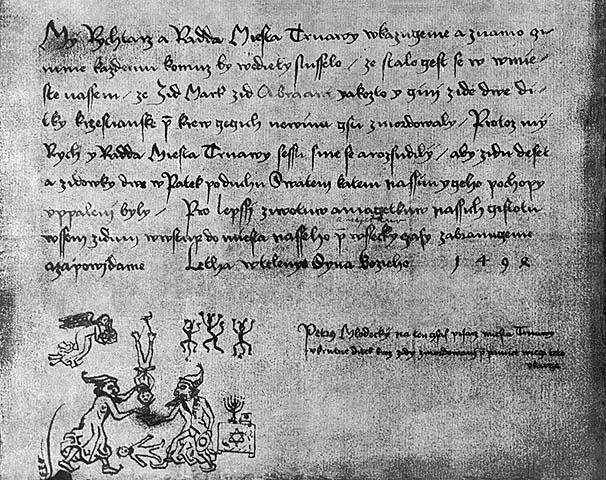
Document on the expulsion of the Jews from Trnava (Nagyszombat), 1498.

The Jewish Community of Trnava

Trnava

Yiddish: טאַרנע, Tarne; Hungarian; Nagyszombat; German: Tyrnau

A city in Slovakia

Until 1918 Trnava was part of Austria-Hungary. Between 1918 and 1993 it was part of Czechoslovakia. Since 1993 it has been part of Slovakia.


21ST CENTURY

The building that once housed the Status Quo Ante synagogue is used as a gallery for the Center for Contemporary Art of Jan Koniarek. There is a Holocaust memorial located at the entrance. 

The former Orthodox synagogue is now the Synagoga Café.


HISTORY

Records of Jews in Trnava date from 1373; a tombstone dating from 1340 indicates that the community was one of the oldest in Hungary. One of the most prominent rabbis to serve the community was Isaac Tyrna (c. 1400), the codifier of Minhagim LeKol HaShanah.

Life was not always easy for the Jews of Trnava. In 1494 a blood libel led to the the deaths of 16 Jewish men and women. An additional blood libel was levied against the Jewish community in 1536-37; a trial was held, and the accused were executed. Ferdinand I, the king of Bohemia and Hungary, ordered the expulsion of the Jews from Trnava on February 19, 1539, in accordance with a request by the city authorities.

After the expulsion, only the few Jewish students studying at the local Catholic university (the Jesuit Trnava University, 1635-1777. At the time, it was the only university in the Kingdom of Hungary) had the right to stay in the town, due to the fact that the university was considered to be extraterritorial. Additionally in 1717 Simon Michael, a negotiator for the Jewish community of Bratislava, worked with the city authorities to reach an agreement allowing Jews to pass through the city for a fixed fee.

Jewish settlement was renewed under Joseph II, though after his death in 1790 the municipality attempted, though unsuccessfully, to expel the Jews. Meanwhile, however, the community continued to grow. A chevra kaddisha was founded in 1800. The community hired a rabbi, and a synagogue was built shortly thereafter.

Anti-Jewish riots broke out during the Hungarian Revolution of 1848 revolution. A tailor named Schwarz, who organized local Jewish self-defense, was expelled from the city.

In 1850 the community established a Status Quo Ante school. A large Status Quo Ante synagogue was built in 1892; a smaller Orthodox synagogue was built in 1914. Trnava was also home to a prominent yeshiva.

A number of Zionist organizations were established in 1898, making them among the first in upper Hungary.

The community, which included 14 affiliated villages, numbered 2,728 in 1930.


THE HOLOCAUST

After the Munich Agreement was signed in September 1938, Slovakia became an autonomous, pro-Nazi state. Jews were subject to increasing discrimination. In early December 1939 the Status Quo Ante synagogue was set on fire by a mob.  

About 2,500 Jews were deported to Auschwitz during the last stages of World War II (1939-1945); some managed to evade deportation through fictitious baptism.


POSTWAR

A new united community was founded in 1945 by survivors who returned to the city. The Status Quo Ante synagogue was restored, but was so much larger than the space needed for services that it was turned into a memorial. In the mid-1960s services for the approximately 100 members of the community were held in the renovated Orthodox synagogue.

The Status Quo Ante synagogue was partly restored in the 1990s.


Document on the expulsion of the Jews from Trnava (Nagyszombat), 1498.
The date of the expulsion is uncertain, therefore the authenticity of this document is in doubt.
(From the Beit Hatfutsot Photo Exhibition: "The Story of the Jews of Hungary", 1984)
"The Trnava persecution lamenation" in memory of the twleve Jews burned at the stake, following a blood libel which accused them of murdering a Christian boy.
Trnava (Nogyszombat), 1494.
(From the Beit Hatfutsot Photo Exhibition: "The Story of the Jews of Hungary", 1984)

Ludwig Schlesinger (1864-1933), mathematician, known for his contributions in field of linear differential equation and also as a historian of science, born in Trnava, Slovakia (then part of the Austrian Empire). He attended high school in Bratislava (Pressburg) and then studied at the universities of Heidelberg and Berlin earning a doctorate in 1887. He was an associate professor at the University of Berlin from 1889 to 1896, followed by work at the University of in Bonn, Germany, in 1897, and as a full professor at the University of Cluj (now in Romania). In 1910 he lectured at the University of Frankfurt am Main and then in 19111, for a short period of time at the University of Budapest. In 1911 he became a professor at the University of Giessen until his dismission in 1933 following the rise to power of the Nazis.

His works include Handbuch der Theorie der linearen Differentialgleichungen (“Handbook of the theory of linear differential equations”, 1894-1896), an encyclopedic work of nearly 1,500 pages summarizing the classic research of Leonhard Euler, Johann Carl Friedrich Gauss, Augustin-Louis Cauch, Carl Gustav Jacob Jacobi, Bernhard Riemann and others as well as the new findings of Christian Felix Klein, Jules Henri Poincaré, Lazarus Immanuel Fuchs, and Schlesinger himself, as well as Vorlesungen euber lineare Differentialgleichungen ("Lectures on linear differential equations", 1908), and Automorphe Funktionen ("Automorphic functions", 1924). Schlesinger was instrumental in disseminating Albert Einstein’s theory.

Hlohovec

In Hungarian: Galgoc or Liptovar

A town in the district of Nitra, west Slovakia.

Hlohovec is situated in an agricultural region, on the river Vah and a railway junction. The place was settled already in Roman times. In 1400, then Galgoc, it was a free royal town not subject to the central administration and developed into a commercial centre. At first it belonged to the Hungarian Kingdom and later to the Austro-Hungarian Empire. From 1918 it was part of the Czechoslovak Republic, except during the years 1939-1945, when it was part of independent Slovakia.

Jews lived in west Slovakia already during the Roman period. The Jews who lived in the area at the time of Great Moravia, in the 9th century, were joined by others who came with the invading Hungarian tribes. At first the Jews enjoyed the same rights as the other inhabitants and were also similarly occupied. The hatred of the local inhabitants, especially the German merchants, started when the Jews began to engage in lending money. The hatred grew when Christianity became more established in Europe. Already at the end of the 11th century laws restricting the Jews were enacted and the persecutions aggravated with the crusaders. At the end of the 13th century the Jews were ordered to wear on their clothes a red patch, for identification. In the second half to the 14th century the Hungarian authorities aimed to baptize all the Jews and those who refused to convert were expelled from the land in 1360. However, as a result of a setback in the economy, they were allowed to return to
Hungary a few years later.

Before the expulsion the Jews lived in all parts of the town, but when they returned to Hlohovec they were limited to one street only.

In 1494, as a result of a blood libel, Jews were tortured and burnt at the stake in the district town of Trnava. At that time the Jews of Hlohovec, too, were living in fear and some fled to other places. They returned to their homes when the danger was over. The Jews of Hlohovec were persecuted also following the uprising of the farmers of Hungary in 1514.

An organized community in the town was established in the 18th century, apparently by Jews who had come from Moravia and Austria. They were under the patronage of the noblemen of the house of Erdoedy and already in 1750 built a synagogue. The first rabbi was Mordechai Deutsch, who was appointed in 1740. He founded a yeshiva and held his office until his death in 1772. The oldest known register of the community is of the year 1797. Some of the tombstones in the Jewish cemetery are also of approximately that time.

At the end of the 18th century 42 Jews at Hlohovec paid the tolerance tax imposed by Queen Maria Theresa. 36 Jews paid the community tax.

In the first half of the 19th century there were a number of private schools at Hlohovec. The Tolerance Patent (Edict of Tolerance, 1782) of the Emperor Joseph II, whose aim was to make the Jews useful to society through education and attract the minorities to the German culture, enabled the opening of Jewish schools. Joseph M. Eisler, the head of the community, founded in 1828 a Talmud torah school, and in 1858 an elementary school with 130 pupils was opened. German was the teaching language and an emphasis was laid on religious subjects. The school was closed dowd four years later and its teachers established private schools. A school which won the recognition of the authorities was founded in 1865. The synagogue, which was built in 1830, was renovated and enlarged in 1890.

1n 1868, one year after the emancipation of the Jews in Hungary, the leaders of the communities gathered in Budapest in order to draw up principles for their internal constitution. The delegate of the Nitra district was Emmanuel Eisler, the head of the Hlohovec community. Following the conference, the community identified with the Status Quo group of communities and refrained from taking any part in the struggle between the Neolog (Reform) communities and the Orthodox, who opposed any digression from the established Halakhah. However, some time later Rabbi Eisler with a group of followers withdrew from the community and established a separate Orthodox community. The scrolls of the torah, the hevra kaddisha (burial society) and the cemetery were common to both communities. On the initiative of the head of the community Emmanuel Aharon Rudolfer and the Chief Rabbi Joseph Rosenfeld, the two communities were re-united in 1880 on the basis of the orthodox principles. The schools were also merged together and a new yeshiva was founded. The united community possessed a valuable archive.

In 1900 a new synagogue was built with a contribution by the brothers Wallach. At that time the community was led by a chairman, two deputies, two synagogue managers, a treasurer, and a council of 15 members. Dr. Rosenfeld was the last chairman of the community.

To the community of Hlohovec were attached also Jews from 12 close by villages. It employed a rabbi, 4 teachers, a secretary, a hazzan (cantor), two slaughterers, and a janitor.

Among the community’s institutions were agudat nashim (women’s society), agudat banot (young women’s society), a community kitchen, bikkur holim (care of the sick), malbish arumim (clothing for the poor), a school committee, and others. The last rabbi of the community, Rabbi Moshe Schwartz, founded a boarding school Torah Ve-Avoda” for boys, in which they learned a trade in the morning and torah in the afternoon. Rabbi Schwartz was a Zionist and in 1939 he sent his only son to Eretz Israel.

Some 900 Jews were living in Hlohovec in the 1920’s.

The well-known Jewish orientalist Ede Mahler was born at Hlohovec.

At the end of the 11th century, Saturday was set as the weekly market day at Hlohovec and the Jewish traders regarded this as a restriction. The rulers often decreed a remission of debts of Christians to Jewish money lenders, who were obliged to absorb the loss.

In the Middle Ages the Jews of Hlohovec were entrusted with the collection of customs at the entrance bridge to the town. Jewish merchants from the town took part also in the big Leipzig fairs and some of them were suppliers of the Emperor’s army. Jews leased beer breweries and wine cellars, as well as the retailing of meat. The Jewish artisans were mostly tailors, glaziers and butchers.

Following the emancipation of the Jews in Hungary (1867), the Jews of Hlohovec became more involved in the economic life of the town. Jews owned a malt brewery, a sawmill, a cart factory and a commercial company. Jews were also managers of agricultural farms in the rural neighborhood.

In the period between the two world wars the Jewish community included 5 big merchants, an owner of a workshop, 8 farmers, 75 traders, some 20 clerks, 20 artisans, as well as teachers, lawyers, engineers, physicians, etc. However, there were also some unemployed in the community.

200 Jews of Hlohovec served 8in the army in World War I. 13 of them fell in battle. During the period between the two world wars, at the time of the Czechoslovak Republic, the Jewish community of Hlohovec had a sport club and branches of the Zionist youth movements Ha-Shomer Ha-Zair and Benei Akiva.

When the Jewish party was formed in 1931, Joseph Mueller and Dr. Michael Eisler of Hlohovec were elected to the central committee of the party. Rabbi Schwartz was among the founders of Hamizrachi in Slovakia.

In 1938 840 Jews were living in the town.


The Holocaust Period

Following the Munich Agreement of September 1938, the Sudeten (Sumava) region was annexed to Germany and Slovakia was declared autonomous on October 6, 1938. On the 14th of March 1939 Slovakia became an independent state (a satellite of Germany) and the next day the Czech Republic became a protectorate of the Third Reich. The Fascist authorities of Slovakia took measures designed to gradually exclude the Jews from the social and economic life of the country, culminating in their total dispossession of property and civil rights.

In the spring of 1942 the Slovaks began to expel the Jews and hand them over to the Germans accross the border, in Poland. First to go were the young people, among them also natives of Hlohovec. The next step was to send Jewish families from the town to the labor camp in Sered and from there to the extermination camps in Poland. The third transport of Jews left Hlohovec in September 1942, and there remained only holders of special permits or those who managed to find a hiding place.

At the end of August 1944, when the anti-Nazi uprising broke out in Slovakia, many Jews escaped to the forests and some of them joined the partisans. In September the Germans entered Slovakia in order to suppress the uprising. Jews were then handed over to the Germans by treacherous partisans. Among them were Rabbi Schwartz and other members of the community. They were first sent to the camp at Sered and two weeks later to the extermination camp of Auschwitz. For one week they were put up at the families block and then they were separated and finally shared the fate of all the other inmates.


About 100 Jews of the Hlohovec community survived the war. The authorities turned the synagogue into a store for fabrics. On the upper floor, at the women’s gallery, the survivors fixed a memorial plaque for the victims of the Holocaust. Most of the survivors went to Israel in 1949 and others emigrated to Canada and the U.S.A. Only about a dozen Jews remained in the town.

In 1960 the authorities demolished the synagogue in the course of development work. In 1986 there were a few Jews in the town and they had a small place for praying. The cemetery was at that time well kept.

Vrbove

In Hungarian: Verbo, in German: Werbau

A small town in west Slovakia.

Vrbove is situated in a valley at the foot of the Carpathian Mouintains. Until 1918 the region was part of the Austro-Hungarian Empire, and then, until 1933, part of the Republic of Czechoslovakia. The valleys at the foot of the mountains served as a convenient hiding place for the Jews who were expelled from Moravia. There they found refuge in the estate of the nobles and lived under their protection.

A Jewish community existed at Vrbove already in 1522. In 1670 Jewish refugees from Vienna settled in the place and in 1683 came Jews who escaped from rioters in Ungarisch Brod. Until the beginning of the 18th century the community of Ungarisch Brod was the mother community of Vrbove.

Up to the middle of the 19th century Jewish traders were forbidden to live in the town of Trnava (in Hungarian Nagyszombat) and they settled in the small towns and villages around it, including Vrbove. In 1736, 35 Jewish families were living in the town. In 1773 the number rose to 70 and in 1848 to over 100.

The community of Vrbove was Orthodox and it cultivated scholars of the torah. The great synagogue was dedicated in 1883. The first rabbi of the community, Rabbi Moshe Mandels, was appointed in 1620. Rabbi Moshe Zuckermandel was the rabbi in the years 1770-1790. Rabbi Jacob Altkunstadt was the rabbi in the years 1829-1839 and was the first of a local dynasty. His grandson Rabbi Jacob Kopel Reich, who occupied the rabbinical chair in the years 1872-1889, was eventually appointed the Orthodox rabbi of Budapest and was a member of the upper chamber of the Hungarian house of representatives.

Until the appointment in 1902 of Jacob Kopel Reich’s son, Rabbi Shmuel Reich, the post of rabbi was vacant and some of the rabbi’s functions were performed by the Dayan Kopel Blau. Rabbi Joseph Haim Sonnenfeld (1848-1932), who was born in Vrbove, went to Eretz Israel and became the Orthodox rabbi of Jerusalem. Until World War II, Rabbi Itzhak Weiss served as a dayan in Vrbove.

A hevra kaddisha (burial society) functioned at the place from 1754. An interest free loan fund was founded in 1758, and a women’s society in 1859. In that year an elementary Jewish school was also opened. Rabbi Shmuel Reich founded in 1902, at the beginning of his term, a Jewish general school which in 1918 became a state school, and a few years later a boarding school for Jewish children. In 1936 he founded also a commerce school.

In 1922, 987 Jews were living at Vrbove, over 20% of the total population. At that time the head of the community was Mark Schoenfeld and the secretary Abraham Schwartz. The staff of the community included also a gabai (treasurer), religious judges (dayanim), and ritual slaughterers (shohets).

The writer Avigdor Hameiri was a student at the local yeshiva, and the well-known cantors, the brothers Vigoda (brothers of Joseph Vigoda, the head of the community), were born at Vrbove.

Most of the Jews of the town found their living in the trade in grains, skins, and spirits. Their shops were in the central square. There were among them also craftsmen, lawyers, and doctors. The Jews were involved in the local economic activity and Rabbi Shmuel Reich was among the business people who laid the railway line between Vrbove and Pyestany.

Initially the relations between the Jews and the rest of the local population were good and in 1848, when a band of robbers attacked the Jews of the area, the Jews of Vrbove were saved thanks to the protection of the local inhabitants and the noble Rudolf Ocskai.

At the beginning of the 20th century, a branch of Agudat Israel, headed by Rabbi Reich, was active in the place. After 1920, that branch provided the means for vacations for the children of Jewish refugees.

Zionist activity developed at Vrbove at the time of the Republic of Czechoslovakia, between the two world wars. In 1937, 33 Jews of the community took part in the elections to the 20th Zionist Congress.

On the eve of World War II there were about 600 Jews at Vrbove.


The Holocaust Period

Following the annexation of Austria to the German Reich, in March 1938, more than a year before World War II, there were antisemitic manifestations at Vrbove, which intensified following the Munich Agreement of September 1938, by which the Sudeten region of the Republic was ceded to Nazi Germany. The Republic of Czechoslovakia was broken up and in March 1939 an independent Slovak state, under president Tiso, was formed, a satellite of Germany. Inspired by the government, the Hlinka Guard began harassing the Jews. Laws enacted in 1940 restricted the Jews in the social life and in the economy. Business places and enterprises of Jews were confiscated. Jews of Vrbove began leaving, some went to Eretz Israel, some escaped to Hungary or emigrated to England.

When the expulsion of the Jews from the area of Bratislava, the capital, started, some 30 families came to Vrbove. With the help of the Jewish Office, which the authorities had set up, a people’s kitchen was established for the refugees and the local Jews who had lost their means of livelihood.

On March 26, 1942, young Jewish girls and women were deported to concentration camps in Poland. Whole Jewish families began to be deported in April. Letters from the camps were received only in the first few weeks, mostly from the camp of Opole near Lublin.

In the autumn of 1942 only some 20 families of the 200 Jewish families of Vrbove were still in the town. They were families of Jews whose work was essential to the authorities or some who managed to hide by means of Aryan papers.

In the autumn of 1944, when the war front drew nearer to Slovakia, a revolt against the Fascist regime broke out. Some Jews who were fighting in the ranks of the partisans, joined the revolt. On the 29th of August, 1944 the German army occupied Slovakia in order to suppress the uprising. When the German army entered nearby Pyestany there were still some Jews at Vrbove. They escaped to the small town Kopanice and found shelter at the homes of Evangelists who opposed the regime.

Jewish fighters who were caught by the Germans were shot on the spot. Among them were Laszlo Schoenfeld of Vrbove. Others who were hunted down by the Germans were interned at the camp in Sered, and when the deportations were renewed on September 30,1944, after the lull since the autumn of 1942, they were all sent to extermination camps. In the course of the war the equipment of the synagogue was looted and the benches were used as fire wood.

In 1945, when the war ended, survivors of the town began returning to it. But the local inhabitants were hostile, window panes were shattered, antisemitic slogans were inscribed on walls and tombstones at the cemetery were removed or destroyed.

Following the establishment of the State of Israel in 1948, most of the survivors of Vrbove, including Rabbi Reich and his wife, went to Israel. Some others emigrated to the U.S.A., Canada, Western Europe, and Australia.

Slovakia

Slovenská republika - Slovak Republic
A country in central Europe, until 1993 part of Czechoslovakia, member of the European Union (EU).

21st Century

Estimated Jewish population in 2018: 2,600 out of 5,450,000. Main Jewish organization:

Ústredný zväz židovských náboženských obcí v Slovenskej republike - Federation of Jewish Communities in Slovakia
Panenská 4
811 03 Bratislava
Slovakia
Phone: 02-5441 2167
Fax: 02-5441 1106
Email: office@uzzno.sk
Website: http://www.uzzno.sk/

ציפר

Cifer

עיירה בדרום מערב סלובקיה.


ציפר שוכנת באזור פורה, בין הבירה בראטיסלאווה לבין העיר טרנאווה. עד 1918 השתייך האזור לקיסרות אוסטריה-הונגריה ומאז עד 1993 לרפובליקה הצ'כוסלובקית.

היהודים הראשונים שהתיישבו בציפר היו ככל הנראה אלה שגורשו מטרנאווה ב- 1539. במאה ה- 18, בעיקר במחציתה השנייה, היו בציפר חיים יהודיים ערים; לרבנות הקהילה ולמוסדותיה השתייכו בין השנים 1783 - 1855 גם יהודי טרנאווה.

בין רבני הקהילה היו: הרב חיים האס שמיירה SCHMEYRA, שכיהן בין השנים 1803 - 1823, הרב יחיאל מיכאל מ- 1823 עד 1844 , ומ- 1845 עד 1855 כיהן הרב שמעון סידון SIDON. במרוצת השנים נדלדלה קהילת ציפר, ובשנת 1855 בוטלה בה כהונת הרב. באותה השנה התארגנה קהילה בטרנאווה, וקהילת ציפר נסתפחה אליה.

בית ספר יסודי יהודי פעל בעיירה. בית הכנסת הוקם על אדמת בית האצילים המקומי, בסמוך לכניסה אל הטירה.

ב- 1851 חיו בציפר כ- 260 יהודים. עד 1880 ירד מספרם מתחת ל- 100.

אחרי קונגרס יהודי הונגריה, שהתכנס בסוף שנת 1868, הצטרפה קהילת ציפר לקהילות "סטאטוס קוו אנטה" STATUS QUO ANTE, אלה שלא נקטו עמדה בחילוקי הדעות בין המשכילים לאורתודוקסים ונשארו במתכונתם שלפני הקונגרס.

בבית העלמין הישן על שפת הנחל, כמה מאות מטר מהעיירה, היו רוב המצבות עשויות אבן סיד ואבן חול, מעוגלות בפינות וכתובות בעברית ובגרמנית. בית העלמין החדש קודש מרחק כ- 150 מטר מהישן. נקברו בו נשים וגברים בשורות נפרדות, ורוב המצבות נעשו בשייש.

יהודי ציפר התפרנסו כסוחרים, כבעלי חנויות מכולת, כרוכלים וכבעלי מלאכה, כמו חייטים, סנדלרים, אופים וקצבים. היו בין יהודי העיירה גם כמה חקלאים וחוכרי ארינדות (משק אחוזות של האצילים).

ההיסטוריון המזרחן אדוארד מאהלר MAHLER, שפעל בווינה ובבודאפשט ומחקריו נודעו בעולם היהודי, נולד בציפר ב- 1857.

ב- 1940 ישבו 51 יהודים בציפר.


תקופת השואה

בעקבות הסכם מינכן שנחתם בספטמבר 1938, כשנה לפני פרוץ מלחמת העולם השנייה, התפרקה הרפובליקה הצ'כוסלובקית. ב6- באוקטובר 1938 הכריזה סלובקיה על אוטונומיה ובמרס 1939 נעשתה מדינה עצמאית גרורת גרמניה הנאצית. על-ידי חקיקה גזענית הורחקו היהודים ממוסדות החינוך וממקורות הפרנסה. עסקיהם וקניינם הועברו לידי סלובקים "בני הגזע הארי". באביב 1942 החל גירוש יהודי סלובקיה למחנות ריכוז והשמדה. אחרי הפוגה של כשנתיים בגירושים נשלחו לבסוף רוב יהודי סלובקיה למחנות וניספו שם.


אחרי המלחמה לא חודשו החיים היהודיים בציפר. בניין בית הכנסת נהרס (לא ידוע מתי) ואותות המלחמה ניכרו גם בשני בתי העלמין. הגדרות התמוטטו והשערים נעקרו. רוב המצבות נמצאו שקועות באדמה או שבורות, מכוסות אזוב ואינן ניתנות לזיהוי.

Sered

A town in west Slovakia.

Until 1918 Sered belonged to the Austro-Hungarian Empire and later, until 1993, to the Republic of Czechoslovakia.

Jews lived at Sered already in the 17th century and possibly also in the 16th century. An organized community, with the regular institutions, was formed at Sered in 1860.

The Jews of Sered were orthodox and following the General Congress of the Jews of Hungary (1868/9) they registered as an orthodox community. A yeshiva was founded at Sered and among its graduates were well known rabbis.

The community of Sered built a synagogue and two batei midrash and dedicated a cemetery. Among its institutions were a hevra kaddisha (burial society), a charity society and a women’s society, a Talmud torah school and also a Jewish elementary school which employed 3 teachers. In 1922 about 1200 Jews were registered in the community of Sered, including the Jews of the affiliated neighboring settlements Surovce, Soporna, and Abraham.

Among the rabbis of Sered were Rabbi Haim Benjamin Polack, in the first half of the 19th century, and Rabbi Benjamin Ze’ev Fuchs, in the second half of the century, who died in 1877. Rabbi Moshe Asher Eckstein was appointed in 1920. He developed and enlarged the local yeshiva and served as the town’s rabbi until 1942, when he was deported to the extermination camp of Maidanek, where he perished.

Most of the Jews of Sered made their living in trade but there were among them also craftsmen, owners of agricultural land and members of the liberal professions.

When the Jews of Hungary were granted full civil rights (1867) they became involved in public life and also volunteered to serve in the army of Austro-Hungary. In the battles of World War I, 15 Jews of Sered lost their lives.

During the time of the Republic of Czechoslovakia, between the two world wars, a lively politic and Zionist activity developed among the Jews of Sered. A Jewish sport club and the youth movement Maccabi were popular. Prior to the 15th Zionist Congress in 1927 the Jews of Sered acquired 50 Shekels membership in the Zionist organization and a voting right, and in 1937, 21 Jews of the town voted in the elections to the forthcoming 20th Zionist Congress. In 1931, M. Selzer of Sered was elected to the central committee of the Jewish party in Czechoslovakia.

In 1930 853 Jews were living in Sered, forming about 15% of the total population of the town.


The Holocaust Period

The Munich Agreement of September 1938, about a year before the outbreak of World War II, caused the disintegration of the Republic of Czechoslovakia. In March 1939 Slovakia became an independent state. The Fascist regime which ensued under the protection of the German Third Reich treated the Jews according to the Nazi racial laws.

At the end of 1940, 726 Jews were living in Sered. Under anti-Jewish enactments all the Jewish places of business and their property were transferred to Aryan hands and many were left without any means of livelihood. One of the five labor camps that were set up by the government Center of Jews, was in Sered. In the summer of 1942, when most of the Jews of Slovakia were deported to concentration and extermination camps, the Jews who were employed in the labor camps and their families were exempt from deportation. Nevertheless, when the quota of 1000 Jews for a deportation was not filled the number was made up with Jews from the camps. At the beginning of 1943 there were still 1,095 Jews in the labor camp of Sered and the Zionist youth movement Hashomer Hazair and Maccabi Hazair endeavored to maintain some activity.

In the summer of 1944 a revolt broke out in Slovakia against the Fascist regime. On August 29, 1944, the German army entered the country in order to suppress the insurrection. On the following day, Jews in the camp who organized themselves clandestinely, liberated all the inmates of the camp, secured weapons from the commander of the camp and joined the insurrection. For a short time the camp served as a place for keeping German prisoners. When the revolt was suppressed, all the exemptions from deportation were annulled. The remaining Jews, together with Jews who had fought in the insurrection and had been caught, were concentrated in the camp of Sered. Thus the deportations were resumed after a lull of two years. 12, 306 Jews were deported to the death camps from Sered in 11 transports, beginning on September 30, 1944. In the first transports 7,936 Jews were taken from Sered directly to the gas chambers at Auschwitz. In the first group, which reached Auschwitz on October 17, 1944, were two of the leaders of the clandestine Work Group which operated in the Center of Jews with the object of saving the Jews of Slovakia, Rabbi Michael Dov Weissmandel, who managed to escape on the way, and Gizi Fleischman, who was taken directly to the gas chambers. After that another 2,732 Jews were deported from Sered to camps in Germany - Sachsenhousen, Ravensbruek, and Bergen Belzen. The last group from Sered was deported to Terezin (Theresienstadt). When all the Jews of Sered had been deported, the authorities turned the synagogue building into a warehouse.

In 1945, at the end of the war, some 50 Jewish survivors of Sered returned to the town. Some of them went to Israel. A monument in memory of the victims of the Holocaust was set up in a public garden. Visitors to Sered in 1986 found the Jewish cemetery well kept.

Slovakian: Boleráz

A municipality in the Trnava region, Slovakia


Until 1918 Boleraz was part of the Austro-Hungarian Empire. Between 1918 to 1993 it was part of the Republic of Czechoslovakia. Since 1993, Boleraz has been part of Slovakia.


HISTORY

Evidence suggests that the first Jews who came to Boleraz had been expelled from Trnava in the 16th century. However, it was only during the 19th century a community was established. The community was not large; in 1851 there were 40 Jews living in Boleraz.

Community institutions included a synagogue, and a small cemetery that was located north of the village.

The Jews of Boleraz worked as merchants or farmers cultivating 7-10-acre plots of land. Jews also had horses, and some engaged in carting. There were also Jewish butchers and cattle merchants.

In 1930 there were 15 Jews living in Boleraz.


THE HOLOCAUST

Following the Munich Agreement (September 1938), Slovakia declared its independence. On March 14, 1939 it became an autonomous state under the protection of Nazi Germany. The Slovakian regime then proceeded to discriminate against Jews socially and economically.

Between the spring and autumn of 1942 the Slovakians deported most of the Jews to concentration and death camps in Poland.


POSTWAR

The Jewish community was not renewed after the war. By the 1980s only the foundation of the synagogue remained. Most of the tombstones at the cemetery had been stolen or ruined, and the fence and the pre-burial purification chamber were destroyed.


ANU Databases
Jewish Genealogy
Family Names
Jewish Communities
Visual Documentation
Jewish Music Center
Place
אA
אA
אA
The Jewish Community of Trnava

Trnava

Yiddish: טאַרנע, Tarne; Hungarian; Nagyszombat; German: Tyrnau

A city in Slovakia

Until 1918 Trnava was part of Austria-Hungary. Between 1918 and 1993 it was part of Czechoslovakia. Since 1993 it has been part of Slovakia.


21ST CENTURY

The building that once housed the Status Quo Ante synagogue is used as a gallery for the Center for Contemporary Art of Jan Koniarek. There is a Holocaust memorial located at the entrance. 

The former Orthodox synagogue is now the Synagoga Café.


HISTORY

Records of Jews in Trnava date from 1373; a tombstone dating from 1340 indicates that the community was one of the oldest in Hungary. One of the most prominent rabbis to serve the community was Isaac Tyrna (c. 1400), the codifier of Minhagim LeKol HaShanah.

Life was not always easy for the Jews of Trnava. In 1494 a blood libel led to the the deaths of 16 Jewish men and women. An additional blood libel was levied against the Jewish community in 1536-37; a trial was held, and the accused were executed. Ferdinand I, the king of Bohemia and Hungary, ordered the expulsion of the Jews from Trnava on February 19, 1539, in accordance with a request by the city authorities.

After the expulsion, only the few Jewish students studying at the local Catholic university (the Jesuit Trnava University, 1635-1777. At the time, it was the only university in the Kingdom of Hungary) had the right to stay in the town, due to the fact that the university was considered to be extraterritorial. Additionally in 1717 Simon Michael, a negotiator for the Jewish community of Bratislava, worked with the city authorities to reach an agreement allowing Jews to pass through the city for a fixed fee.

Jewish settlement was renewed under Joseph II, though after his death in 1790 the municipality attempted, though unsuccessfully, to expel the Jews. Meanwhile, however, the community continued to grow. A chevra kaddisha was founded in 1800. The community hired a rabbi, and a synagogue was built shortly thereafter.

Anti-Jewish riots broke out during the Hungarian Revolution of 1848 revolution. A tailor named Schwarz, who organized local Jewish self-defense, was expelled from the city.

In 1850 the community established a Status Quo Ante school. A large Status Quo Ante synagogue was built in 1892; a smaller Orthodox synagogue was built in 1914. Trnava was also home to a prominent yeshiva.

A number of Zionist organizations were established in 1898, making them among the first in upper Hungary.

The community, which included 14 affiliated villages, numbered 2,728 in 1930.


THE HOLOCAUST

After the Munich Agreement was signed in September 1938, Slovakia became an autonomous, pro-Nazi state. Jews were subject to increasing discrimination. In early December 1939 the Status Quo Ante synagogue was set on fire by a mob.  

About 2,500 Jews were deported to Auschwitz during the last stages of World War II (1939-1945); some managed to evade deportation through fictitious baptism.


POSTWAR

A new united community was founded in 1945 by survivors who returned to the city. The Status Quo Ante synagogue was restored, but was so much larger than the space needed for services that it was turned into a memorial. In the mid-1960s services for the approximately 100 members of the community were held in the renovated Orthodox synagogue.

The Status Quo Ante synagogue was partly restored in the 1990s.


Written by researchers of ANU Museum of the Jewish People
Document on the expulsion of the Jews from Trnava (Nagyszombat), 1498.
The date of the expulsion is uncertain, therefore the authenticity of this document is in doubt.
(From the Beit Hatfutsot Photo Exhibition: "The Story of the Jews of Hungary", 1984)
"The Trnava persecution lamenation" in memory of the twleve Jews burned at the stake. Trnava, 1494.
"The Trnava persecution lamenation" in memory of the twleve Jews burned at the stake, following a blood libel which accused them of murdering a Christian boy.
Trnava (Nogyszombat), 1494.
(From the Beit Hatfutsot Photo Exhibition: "The Story of the Jews of Hungary", 1984)
Ludwig Schlesinger

Ludwig Schlesinger (1864-1933), mathematician, known for his contributions in field of linear differential equation and also as a historian of science, born in Trnava, Slovakia (then part of the Austrian Empire). He attended high school in Bratislava (Pressburg) and then studied at the universities of Heidelberg and Berlin earning a doctorate in 1887. He was an associate professor at the University of Berlin from 1889 to 1896, followed by work at the University of in Bonn, Germany, in 1897, and as a full professor at the University of Cluj (now in Romania). In 1910 he lectured at the University of Frankfurt am Main and then in 19111, for a short period of time at the University of Budapest. In 1911 he became a professor at the University of Giessen until his dismission in 1933 following the rise to power of the Nazis.

His works include Handbuch der Theorie der linearen Differentialgleichungen (“Handbook of the theory of linear differential equations”, 1894-1896), an encyclopedic work of nearly 1,500 pages summarizing the classic research of Leonhard Euler, Johann Carl Friedrich Gauss, Augustin-Louis Cauch, Carl Gustav Jacob Jacobi, Bernhard Riemann and others as well as the new findings of Christian Felix Klein, Jules Henri Poincaré, Lazarus Immanuel Fuchs, and Schlesinger himself, as well as Vorlesungen euber lineare Differentialgleichungen ("Lectures on linear differential equations", 1908), and Automorphe Funktionen ("Automorphic functions", 1924). Schlesinger was instrumental in disseminating Albert Einstein’s theory.

Hlohovec

Hlohovec

In Hungarian: Galgoc or Liptovar

A town in the district of Nitra, west Slovakia.

Hlohovec is situated in an agricultural region, on the river Vah and a railway junction. The place was settled already in Roman times. In 1400, then Galgoc, it was a free royal town not subject to the central administration and developed into a commercial centre. At first it belonged to the Hungarian Kingdom and later to the Austro-Hungarian Empire. From 1918 it was part of the Czechoslovak Republic, except during the years 1939-1945, when it was part of independent Slovakia.

Jews lived in west Slovakia already during the Roman period. The Jews who lived in the area at the time of Great Moravia, in the 9th century, were joined by others who came with the invading Hungarian tribes. At first the Jews enjoyed the same rights as the other inhabitants and were also similarly occupied. The hatred of the local inhabitants, especially the German merchants, started when the Jews began to engage in lending money. The hatred grew when Christianity became more established in Europe. Already at the end of the 11th century laws restricting the Jews were enacted and the persecutions aggravated with the crusaders. At the end of the 13th century the Jews were ordered to wear on their clothes a red patch, for identification. In the second half to the 14th century the Hungarian authorities aimed to baptize all the Jews and those who refused to convert were expelled from the land in 1360. However, as a result of a setback in the economy, they were allowed to return to
Hungary a few years later.

Before the expulsion the Jews lived in all parts of the town, but when they returned to Hlohovec they were limited to one street only.

In 1494, as a result of a blood libel, Jews were tortured and burnt at the stake in the district town of Trnava. At that time the Jews of Hlohovec, too, were living in fear and some fled to other places. They returned to their homes when the danger was over. The Jews of Hlohovec were persecuted also following the uprising of the farmers of Hungary in 1514.

An organized community in the town was established in the 18th century, apparently by Jews who had come from Moravia and Austria. They were under the patronage of the noblemen of the house of Erdoedy and already in 1750 built a synagogue. The first rabbi was Mordechai Deutsch, who was appointed in 1740. He founded a yeshiva and held his office until his death in 1772. The oldest known register of the community is of the year 1797. Some of the tombstones in the Jewish cemetery are also of approximately that time.

At the end of the 18th century 42 Jews at Hlohovec paid the tolerance tax imposed by Queen Maria Theresa. 36 Jews paid the community tax.

In the first half of the 19th century there were a number of private schools at Hlohovec. The Tolerance Patent (Edict of Tolerance, 1782) of the Emperor Joseph II, whose aim was to make the Jews useful to society through education and attract the minorities to the German culture, enabled the opening of Jewish schools. Joseph M. Eisler, the head of the community, founded in 1828 a Talmud torah school, and in 1858 an elementary school with 130 pupils was opened. German was the teaching language and an emphasis was laid on religious subjects. The school was closed dowd four years later and its teachers established private schools. A school which won the recognition of the authorities was founded in 1865. The synagogue, which was built in 1830, was renovated and enlarged in 1890.

1n 1868, one year after the emancipation of the Jews in Hungary, the leaders of the communities gathered in Budapest in order to draw up principles for their internal constitution. The delegate of the Nitra district was Emmanuel Eisler, the head of the Hlohovec community. Following the conference, the community identified with the Status Quo group of communities and refrained from taking any part in the struggle between the Neolog (Reform) communities and the Orthodox, who opposed any digression from the established Halakhah. However, some time later Rabbi Eisler with a group of followers withdrew from the community and established a separate Orthodox community. The scrolls of the torah, the hevra kaddisha (burial society) and the cemetery were common to both communities. On the initiative of the head of the community Emmanuel Aharon Rudolfer and the Chief Rabbi Joseph Rosenfeld, the two communities were re-united in 1880 on the basis of the orthodox principles. The schools were also merged together and a new yeshiva was founded. The united community possessed a valuable archive.

In 1900 a new synagogue was built with a contribution by the brothers Wallach. At that time the community was led by a chairman, two deputies, two synagogue managers, a treasurer, and a council of 15 members. Dr. Rosenfeld was the last chairman of the community.

To the community of Hlohovec were attached also Jews from 12 close by villages. It employed a rabbi, 4 teachers, a secretary, a hazzan (cantor), two slaughterers, and a janitor.

Among the community’s institutions were agudat nashim (women’s society), agudat banot (young women’s society), a community kitchen, bikkur holim (care of the sick), malbish arumim (clothing for the poor), a school committee, and others. The last rabbi of the community, Rabbi Moshe Schwartz, founded a boarding school Torah Ve-Avoda” for boys, in which they learned a trade in the morning and torah in the afternoon. Rabbi Schwartz was a Zionist and in 1939 he sent his only son to Eretz Israel.

Some 900 Jews were living in Hlohovec in the 1920’s.

The well-known Jewish orientalist Ede Mahler was born at Hlohovec.

At the end of the 11th century, Saturday was set as the weekly market day at Hlohovec and the Jewish traders regarded this as a restriction. The rulers often decreed a remission of debts of Christians to Jewish money lenders, who were obliged to absorb the loss.

In the Middle Ages the Jews of Hlohovec were entrusted with the collection of customs at the entrance bridge to the town. Jewish merchants from the town took part also in the big Leipzig fairs and some of them were suppliers of the Emperor’s army. Jews leased beer breweries and wine cellars, as well as the retailing of meat. The Jewish artisans were mostly tailors, glaziers and butchers.

Following the emancipation of the Jews in Hungary (1867), the Jews of Hlohovec became more involved in the economic life of the town. Jews owned a malt brewery, a sawmill, a cart factory and a commercial company. Jews were also managers of agricultural farms in the rural neighborhood.

In the period between the two world wars the Jewish community included 5 big merchants, an owner of a workshop, 8 farmers, 75 traders, some 20 clerks, 20 artisans, as well as teachers, lawyers, engineers, physicians, etc. However, there were also some unemployed in the community.

200 Jews of Hlohovec served 8in the army in World War I. 13 of them fell in battle. During the period between the two world wars, at the time of the Czechoslovak Republic, the Jewish community of Hlohovec had a sport club and branches of the Zionist youth movements Ha-Shomer Ha-Zair and Benei Akiva.

When the Jewish party was formed in 1931, Joseph Mueller and Dr. Michael Eisler of Hlohovec were elected to the central committee of the party. Rabbi Schwartz was among the founders of Hamizrachi in Slovakia.

In 1938 840 Jews were living in the town.


The Holocaust Period

Following the Munich Agreement of September 1938, the Sudeten (Sumava) region was annexed to Germany and Slovakia was declared autonomous on October 6, 1938. On the 14th of March 1939 Slovakia became an independent state (a satellite of Germany) and the next day the Czech Republic became a protectorate of the Third Reich. The Fascist authorities of Slovakia took measures designed to gradually exclude the Jews from the social and economic life of the country, culminating in their total dispossession of property and civil rights.

In the spring of 1942 the Slovaks began to expel the Jews and hand them over to the Germans accross the border, in Poland. First to go were the young people, among them also natives of Hlohovec. The next step was to send Jewish families from the town to the labor camp in Sered and from there to the extermination camps in Poland. The third transport of Jews left Hlohovec in September 1942, and there remained only holders of special permits or those who managed to find a hiding place.

At the end of August 1944, when the anti-Nazi uprising broke out in Slovakia, many Jews escaped to the forests and some of them joined the partisans. In September the Germans entered Slovakia in order to suppress the uprising. Jews were then handed over to the Germans by treacherous partisans. Among them were Rabbi Schwartz and other members of the community. They were first sent to the camp at Sered and two weeks later to the extermination camp of Auschwitz. For one week they were put up at the families block and then they were separated and finally shared the fate of all the other inmates.


About 100 Jews of the Hlohovec community survived the war. The authorities turned the synagogue into a store for fabrics. On the upper floor, at the women’s gallery, the survivors fixed a memorial plaque for the victims of the Holocaust. Most of the survivors went to Israel in 1949 and others emigrated to Canada and the U.S.A. Only about a dozen Jews remained in the town.

In 1960 the authorities demolished the synagogue in the course of development work. In 1986 there were a few Jews in the town and they had a small place for praying. The cemetery was at that time well kept.

Vrbove

Vrbove

In Hungarian: Verbo, in German: Werbau

A small town in west Slovakia.

Vrbove is situated in a valley at the foot of the Carpathian Mouintains. Until 1918 the region was part of the Austro-Hungarian Empire, and then, until 1933, part of the Republic of Czechoslovakia. The valleys at the foot of the mountains served as a convenient hiding place for the Jews who were expelled from Moravia. There they found refuge in the estate of the nobles and lived under their protection.

A Jewish community existed at Vrbove already in 1522. In 1670 Jewish refugees from Vienna settled in the place and in 1683 came Jews who escaped from rioters in Ungarisch Brod. Until the beginning of the 18th century the community of Ungarisch Brod was the mother community of Vrbove.

Up to the middle of the 19th century Jewish traders were forbidden to live in the town of Trnava (in Hungarian Nagyszombat) and they settled in the small towns and villages around it, including Vrbove. In 1736, 35 Jewish families were living in the town. In 1773 the number rose to 70 and in 1848 to over 100.

The community of Vrbove was Orthodox and it cultivated scholars of the torah. The great synagogue was dedicated in 1883. The first rabbi of the community, Rabbi Moshe Mandels, was appointed in 1620. Rabbi Moshe Zuckermandel was the rabbi in the years 1770-1790. Rabbi Jacob Altkunstadt was the rabbi in the years 1829-1839 and was the first of a local dynasty. His grandson Rabbi Jacob Kopel Reich, who occupied the rabbinical chair in the years 1872-1889, was eventually appointed the Orthodox rabbi of Budapest and was a member of the upper chamber of the Hungarian house of representatives.

Until the appointment in 1902 of Jacob Kopel Reich’s son, Rabbi Shmuel Reich, the post of rabbi was vacant and some of the rabbi’s functions were performed by the Dayan Kopel Blau. Rabbi Joseph Haim Sonnenfeld (1848-1932), who was born in Vrbove, went to Eretz Israel and became the Orthodox rabbi of Jerusalem. Until World War II, Rabbi Itzhak Weiss served as a dayan in Vrbove.

A hevra kaddisha (burial society) functioned at the place from 1754. An interest free loan fund was founded in 1758, and a women’s society in 1859. In that year an elementary Jewish school was also opened. Rabbi Shmuel Reich founded in 1902, at the beginning of his term, a Jewish general school which in 1918 became a state school, and a few years later a boarding school for Jewish children. In 1936 he founded also a commerce school.

In 1922, 987 Jews were living at Vrbove, over 20% of the total population. At that time the head of the community was Mark Schoenfeld and the secretary Abraham Schwartz. The staff of the community included also a gabai (treasurer), religious judges (dayanim), and ritual slaughterers (shohets).

The writer Avigdor Hameiri was a student at the local yeshiva, and the well-known cantors, the brothers Vigoda (brothers of Joseph Vigoda, the head of the community), were born at Vrbove.

Most of the Jews of the town found their living in the trade in grains, skins, and spirits. Their shops were in the central square. There were among them also craftsmen, lawyers, and doctors. The Jews were involved in the local economic activity and Rabbi Shmuel Reich was among the business people who laid the railway line between Vrbove and Pyestany.

Initially the relations between the Jews and the rest of the local population were good and in 1848, when a band of robbers attacked the Jews of the area, the Jews of Vrbove were saved thanks to the protection of the local inhabitants and the noble Rudolf Ocskai.

At the beginning of the 20th century, a branch of Agudat Israel, headed by Rabbi Reich, was active in the place. After 1920, that branch provided the means for vacations for the children of Jewish refugees.

Zionist activity developed at Vrbove at the time of the Republic of Czechoslovakia, between the two world wars. In 1937, 33 Jews of the community took part in the elections to the 20th Zionist Congress.

On the eve of World War II there were about 600 Jews at Vrbove.


The Holocaust Period

Following the annexation of Austria to the German Reich, in March 1938, more than a year before World War II, there were antisemitic manifestations at Vrbove, which intensified following the Munich Agreement of September 1938, by which the Sudeten region of the Republic was ceded to Nazi Germany. The Republic of Czechoslovakia was broken up and in March 1939 an independent Slovak state, under president Tiso, was formed, a satellite of Germany. Inspired by the government, the Hlinka Guard began harassing the Jews. Laws enacted in 1940 restricted the Jews in the social life and in the economy. Business places and enterprises of Jews were confiscated. Jews of Vrbove began leaving, some went to Eretz Israel, some escaped to Hungary or emigrated to England.

When the expulsion of the Jews from the area of Bratislava, the capital, started, some 30 families came to Vrbove. With the help of the Jewish Office, which the authorities had set up, a people’s kitchen was established for the refugees and the local Jews who had lost their means of livelihood.

On March 26, 1942, young Jewish girls and women were deported to concentration camps in Poland. Whole Jewish families began to be deported in April. Letters from the camps were received only in the first few weeks, mostly from the camp of Opole near Lublin.

In the autumn of 1942 only some 20 families of the 200 Jewish families of Vrbove were still in the town. They were families of Jews whose work was essential to the authorities or some who managed to hide by means of Aryan papers.

In the autumn of 1944, when the war front drew nearer to Slovakia, a revolt against the Fascist regime broke out. Some Jews who were fighting in the ranks of the partisans, joined the revolt. On the 29th of August, 1944 the German army occupied Slovakia in order to suppress the uprising. When the German army entered nearby Pyestany there were still some Jews at Vrbove. They escaped to the small town Kopanice and found shelter at the homes of Evangelists who opposed the regime.

Jewish fighters who were caught by the Germans were shot on the spot. Among them were Laszlo Schoenfeld of Vrbove. Others who were hunted down by the Germans were interned at the camp in Sered, and when the deportations were renewed on September 30,1944, after the lull since the autumn of 1942, they were all sent to extermination camps. In the course of the war the equipment of the synagogue was looted and the benches were used as fire wood.

In 1945, when the war ended, survivors of the town began returning to it. But the local inhabitants were hostile, window panes were shattered, antisemitic slogans were inscribed on walls and tombstones at the cemetery were removed or destroyed.

Following the establishment of the State of Israel in 1948, most of the survivors of Vrbove, including Rabbi Reich and his wife, went to Israel. Some others emigrated to the U.S.A., Canada, Western Europe, and Australia.

Slovakia

Slovakia

Slovenská republika - Slovak Republic
A country in central Europe, until 1993 part of Czechoslovakia, member of the European Union (EU).

21st Century

Estimated Jewish population in 2018: 2,600 out of 5,450,000. Main Jewish organization:

Ústredný zväz židovských náboženských obcí v Slovenskej republike - Federation of Jewish Communities in Slovakia
Panenská 4
811 03 Bratislava
Slovakia
Phone: 02-5441 2167
Fax: 02-5441 1106
Email: office@uzzno.sk
Website: http://www.uzzno.sk/

Cifer

ציפר

Cifer

עיירה בדרום מערב סלובקיה.


ציפר שוכנת באזור פורה, בין הבירה בראטיסלאווה לבין העיר טרנאווה. עד 1918 השתייך האזור לקיסרות אוסטריה-הונגריה ומאז עד 1993 לרפובליקה הצ'כוסלובקית.

היהודים הראשונים שהתיישבו בציפר היו ככל הנראה אלה שגורשו מטרנאווה ב- 1539. במאה ה- 18, בעיקר במחציתה השנייה, היו בציפר חיים יהודיים ערים; לרבנות הקהילה ולמוסדותיה השתייכו בין השנים 1783 - 1855 גם יהודי טרנאווה.

בין רבני הקהילה היו: הרב חיים האס שמיירה SCHMEYRA, שכיהן בין השנים 1803 - 1823, הרב יחיאל מיכאל מ- 1823 עד 1844 , ומ- 1845 עד 1855 כיהן הרב שמעון סידון SIDON. במרוצת השנים נדלדלה קהילת ציפר, ובשנת 1855 בוטלה בה כהונת הרב. באותה השנה התארגנה קהילה בטרנאווה, וקהילת ציפר נסתפחה אליה.

בית ספר יסודי יהודי פעל בעיירה. בית הכנסת הוקם על אדמת בית האצילים המקומי, בסמוך לכניסה אל הטירה.

ב- 1851 חיו בציפר כ- 260 יהודים. עד 1880 ירד מספרם מתחת ל- 100.

אחרי קונגרס יהודי הונגריה, שהתכנס בסוף שנת 1868, הצטרפה קהילת ציפר לקהילות "סטאטוס קוו אנטה" STATUS QUO ANTE, אלה שלא נקטו עמדה בחילוקי הדעות בין המשכילים לאורתודוקסים ונשארו במתכונתם שלפני הקונגרס.

בבית העלמין הישן על שפת הנחל, כמה מאות מטר מהעיירה, היו רוב המצבות עשויות אבן סיד ואבן חול, מעוגלות בפינות וכתובות בעברית ובגרמנית. בית העלמין החדש קודש מרחק כ- 150 מטר מהישן. נקברו בו נשים וגברים בשורות נפרדות, ורוב המצבות נעשו בשייש.

יהודי ציפר התפרנסו כסוחרים, כבעלי חנויות מכולת, כרוכלים וכבעלי מלאכה, כמו חייטים, סנדלרים, אופים וקצבים. היו בין יהודי העיירה גם כמה חקלאים וחוכרי ארינדות (משק אחוזות של האצילים).

ההיסטוריון המזרחן אדוארד מאהלר MAHLER, שפעל בווינה ובבודאפשט ומחקריו נודעו בעולם היהודי, נולד בציפר ב- 1857.

ב- 1940 ישבו 51 יהודים בציפר.


תקופת השואה

בעקבות הסכם מינכן שנחתם בספטמבר 1938, כשנה לפני פרוץ מלחמת העולם השנייה, התפרקה הרפובליקה הצ'כוסלובקית. ב6- באוקטובר 1938 הכריזה סלובקיה על אוטונומיה ובמרס 1939 נעשתה מדינה עצמאית גרורת גרמניה הנאצית. על-ידי חקיקה גזענית הורחקו היהודים ממוסדות החינוך וממקורות הפרנסה. עסקיהם וקניינם הועברו לידי סלובקים "בני הגזע הארי". באביב 1942 החל גירוש יהודי סלובקיה למחנות ריכוז והשמדה. אחרי הפוגה של כשנתיים בגירושים נשלחו לבסוף רוב יהודי סלובקיה למחנות וניספו שם.


אחרי המלחמה לא חודשו החיים היהודיים בציפר. בניין בית הכנסת נהרס (לא ידוע מתי) ואותות המלחמה ניכרו גם בשני בתי העלמין. הגדרות התמוטטו והשערים נעקרו. רוב המצבות נמצאו שקועות באדמה או שבורות, מכוסות אזוב ואינן ניתנות לזיהוי.

Sered

Sered

A town in west Slovakia.

Until 1918 Sered belonged to the Austro-Hungarian Empire and later, until 1993, to the Republic of Czechoslovakia.

Jews lived at Sered already in the 17th century and possibly also in the 16th century. An organized community, with the regular institutions, was formed at Sered in 1860.

The Jews of Sered were orthodox and following the General Congress of the Jews of Hungary (1868/9) they registered as an orthodox community. A yeshiva was founded at Sered and among its graduates were well known rabbis.

The community of Sered built a synagogue and two batei midrash and dedicated a cemetery. Among its institutions were a hevra kaddisha (burial society), a charity society and a women’s society, a Talmud torah school and also a Jewish elementary school which employed 3 teachers. In 1922 about 1200 Jews were registered in the community of Sered, including the Jews of the affiliated neighboring settlements Surovce, Soporna, and Abraham.

Among the rabbis of Sered were Rabbi Haim Benjamin Polack, in the first half of the 19th century, and Rabbi Benjamin Ze’ev Fuchs, in the second half of the century, who died in 1877. Rabbi Moshe Asher Eckstein was appointed in 1920. He developed and enlarged the local yeshiva and served as the town’s rabbi until 1942, when he was deported to the extermination camp of Maidanek, where he perished.

Most of the Jews of Sered made their living in trade but there were among them also craftsmen, owners of agricultural land and members of the liberal professions.

When the Jews of Hungary were granted full civil rights (1867) they became involved in public life and also volunteered to serve in the army of Austro-Hungary. In the battles of World War I, 15 Jews of Sered lost their lives.

During the time of the Republic of Czechoslovakia, between the two world wars, a lively politic and Zionist activity developed among the Jews of Sered. A Jewish sport club and the youth movement Maccabi were popular. Prior to the 15th Zionist Congress in 1927 the Jews of Sered acquired 50 Shekels membership in the Zionist organization and a voting right, and in 1937, 21 Jews of the town voted in the elections to the forthcoming 20th Zionist Congress. In 1931, M. Selzer of Sered was elected to the central committee of the Jewish party in Czechoslovakia.

In 1930 853 Jews were living in Sered, forming about 15% of the total population of the town.


The Holocaust Period

The Munich Agreement of September 1938, about a year before the outbreak of World War II, caused the disintegration of the Republic of Czechoslovakia. In March 1939 Slovakia became an independent state. The Fascist regime which ensued under the protection of the German Third Reich treated the Jews according to the Nazi racial laws.

At the end of 1940, 726 Jews were living in Sered. Under anti-Jewish enactments all the Jewish places of business and their property were transferred to Aryan hands and many were left without any means of livelihood. One of the five labor camps that were set up by the government Center of Jews, was in Sered. In the summer of 1942, when most of the Jews of Slovakia were deported to concentration and extermination camps, the Jews who were employed in the labor camps and their families were exempt from deportation. Nevertheless, when the quota of 1000 Jews for a deportation was not filled the number was made up with Jews from the camps. At the beginning of 1943 there were still 1,095 Jews in the labor camp of Sered and the Zionist youth movement Hashomer Hazair and Maccabi Hazair endeavored to maintain some activity.

In the summer of 1944 a revolt broke out in Slovakia against the Fascist regime. On August 29, 1944, the German army entered the country in order to suppress the insurrection. On the following day, Jews in the camp who organized themselves clandestinely, liberated all the inmates of the camp, secured weapons from the commander of the camp and joined the insurrection. For a short time the camp served as a place for keeping German prisoners. When the revolt was suppressed, all the exemptions from deportation were annulled. The remaining Jews, together with Jews who had fought in the insurrection and had been caught, were concentrated in the camp of Sered. Thus the deportations were resumed after a lull of two years. 12, 306 Jews were deported to the death camps from Sered in 11 transports, beginning on September 30, 1944. In the first transports 7,936 Jews were taken from Sered directly to the gas chambers at Auschwitz. In the first group, which reached Auschwitz on October 17, 1944, were two of the leaders of the clandestine Work Group which operated in the Center of Jews with the object of saving the Jews of Slovakia, Rabbi Michael Dov Weissmandel, who managed to escape on the way, and Gizi Fleischman, who was taken directly to the gas chambers. After that another 2,732 Jews were deported from Sered to camps in Germany - Sachsenhousen, Ravensbruek, and Bergen Belzen. The last group from Sered was deported to Terezin (Theresienstadt). When all the Jews of Sered had been deported, the authorities turned the synagogue building into a warehouse.

In 1945, at the end of the war, some 50 Jewish survivors of Sered returned to the town. Some of them went to Israel. A monument in memory of the victims of the Holocaust was set up in a public garden. Visitors to Sered in 1986 found the Jewish cemetery well kept.

Boleraz

Slovakian: Boleráz

A municipality in the Trnava region, Slovakia


Until 1918 Boleraz was part of the Austro-Hungarian Empire. Between 1918 to 1993 it was part of the Republic of Czechoslovakia. Since 1993, Boleraz has been part of Slovakia.


HISTORY

Evidence suggests that the first Jews who came to Boleraz had been expelled from Trnava in the 16th century. However, it was only during the 19th century a community was established. The community was not large; in 1851 there were 40 Jews living in Boleraz.

Community institutions included a synagogue, and a small cemetery that was located north of the village.

The Jews of Boleraz worked as merchants or farmers cultivating 7-10-acre plots of land. Jews also had horses, and some engaged in carting. There were also Jewish butchers and cattle merchants.

In 1930 there were 15 Jews living in Boleraz.


THE HOLOCAUST

Following the Munich Agreement (September 1938), Slovakia declared its independence. On March 14, 1939 it became an autonomous state under the protection of Nazi Germany. The Slovakian regime then proceeded to discriminate against Jews socially and economically.

Between the spring and autumn of 1942 the Slovakians deported most of the Jews to concentration and death camps in Poland.


POSTWAR

The Jewish community was not renewed after the war. By the 1980s only the foundation of the synagogue remained. Most of the tombstones at the cemetery had been stolen or ruined, and the fence and the pre-burial purification chamber were destroyed.