Skip to website content >
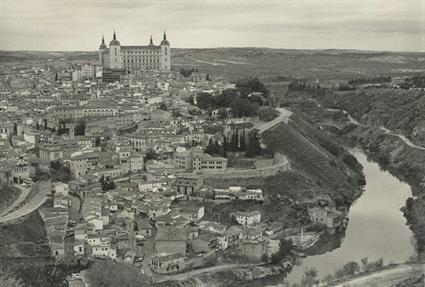
View of Toledo, Spain 1980s

The Jewish Community of Toledo, Spain

Toledo

City in Castila La Mancha, central Spain; capital of Spain until 1561.

According to a Jewish tradition dating from the period of Muslim rule, the Jewish settlement in Toledo was the most ancient in the Iberian Peninsula. This tradition was accepted by Isaac Abrabanel who states (in his commentary to the book of Kings, at the end, and to Obadiah, 20) that the first settlers in Toledo were exiles from the tribes of Judah and Benjamin. Jews probably established themselves there when the town became the capital of the Visigoths, or during the fourth to fifth centuries c.e.

Toledo is one of the few towns of Spain where remnants of Jewish edifices have been preserved. Toward the close of the 15th century the sources mention ten synagogues and a further five battei midrash. Toledo also has many remnants of Jewish tombstones, some of which are preserved in the archaeological museum of the town.

During the 11th century, when Toledo was ruled by the Muslims, it had a large Jewish population of about 4,000, divided into separate communities generally according to place of origin and a group who were of Khazar descent.
Toledo was also the center of the Karaites in Spain. Jewish occupations included textile manufacture, tanning, and dyeing, military professions and commerce. Toledo became a center of Jewish scholarship, translation, and science; the astronomer Zarkal (Abu Ishaq Ibrahim Ben Yachya) lived there for a time in the mid-11th century, and the biblical commentator Judah Ben Samuel Ibn Bal'am was born and educated in Toledo in this period. The situation of the Jews in Toledo remained unchanged after the town was conquered by Alfonso VI in 1085. During the 12th century it continued a center of learning and Jews and apostates were among those who translated works of mathematics, astronomy, and other subjects from Arabic into the spoken vernacular and from that language into Latin. From then on, the community developed until it became the most prominent in the kingdom of Castile and one of the most important in Spain. During this period some of the most distinguished who apparently left the town in 1119; Moses Ibn Ezra who stayed there; and Joseph Ibn Kamaniel, the physician, one of the wealthiest members of the community who was entrusted with an important diplomatic mission to the king of Portugal. The language spoken by the Jews of Toledo and employed in their documents during the 11th to 13th centuries was partly Arabic; they customarily wrote their documents in Arabic with Hebrew characters. These sources reveal a well-developed economic life. Jews of Toledo are recorded as having sold or purchased land, as lenders and borrowers, and are also found in partnerships with Christians in real estate transactions and in commerce.

The administrative organization of the community does not appear to have changed throughout its existence. There is no information on the administrative organization during Muslim rule, but a responsum, attributed to rabbi Joseph Ibn Mega, mentions the existence, in the early 12th century, of an organization headed by seven notables and elders and a bet din. The procedure for solving problems was to be taken by decision of four elders, Muqaddimun of the community, and two Jews chosen by the archbishop.

A period of crisis occurred at the time of the revolt of crown prince Sancho against his father (1280-81). A contemporary author relates that the community of Toledo was shaken "as Sodom and Gomorrah". Alfonso X ordered the imprisonment of the Jews in their synagogues, from which they were not to be released until the community paid him a special tax. Notables of the community remained in prison for many months. Attempts were even made there to convert them and several were executed.

During his own lifetime, Maimonides was challenged in Toledo by a notable adversary, Meir rabbi Todros Ha-Levi Abulafia, whose opinions were shared by the physician Judah B. Joseph Al-Fakhar, and Joseph Ben Todros Ha-Levi. They regarded the writings of Maimonides to be dangerous in that they could undermine faith. The controversy over the study of the writings of Maimonides received particular impetus in Toledo in 1304-05, at the time of the publication of the correspondence between Solomon Ben Adret and Abba Mari Astruc on the subject of the cherem issued against the study of the guide of the perplexed.

At the beginning of the 14th century, an attempt was made by the clergy in Toledo to compel the Jews to cease from engaging in moneylending; they also compelled the Jews to return the interest which they had taken and to cancel the obligations of payment which Christians had undersigned.
Ferdinand IV notified the clergy that he would bring them to account if they continued to impose a boycott on the Jews or sought to persecute them before the church tribunals. Nevertheless in a number of cases the king accepted the arguments of the clergy, and Jewish moneylenders of Toledo were arrested, tried before Christian judges, and condemned to lengthy terms of imprisonment.

The Black Death (1348) took a heavy toll among the community of Toledo. During the reign of Pedro the Cruel (1350-60), Don Samuel Ben Meir Ha-Levi Abulafia acted as chief agent and treasurer of the king. In 1358 he left for Portugal to negotiate a political agreement, and he was signatory to several royal edicts. He was suddenly arrested in 1360 upon the order of king Pedro, and removed to Seville, where he died at the hands of his torturers. Other Jews after him were lessees and courtiers, more particularly members of the Ha-Levi and Beneveniste families of Burgos.

In 1355, when the king entered Toledo, Christians and Muslims attacked the Jewish quarters. The town changed hands several times; when Pedro once more besieged the city, in 1368-69, 8,000 Jews perished. While the Toledo community was still endeavoring to recover from the effects of the civil war, it was overtaken by the persecutions which swept Spain in 1391 and brought down upon it ruin and destruction. The riots against the Jews in Toledo broke out on 17 Tammuz. Almost all the synagogues were destroyed or set on fire, and the battei midrash became mounds of ruins. Many abandoned Judaism at that time, and Toledo became filled with Conversos. The community of Toledo did not recover throughout the 15th century. Vicente Ferrer visited Toledo in 1411. He entered the Jewish quarter with an armed escort and converted the Ibn Shoshan synagogue into a church. There is reason to believe that a number of Jews converted to Christianity as a result of the sermon he delivered. When Isabella ascended the throne and the country became united with the kingdom of Aragon, Jews of Toledo again held important positions in the kingdom as lessees and courtiers. However, while in Toledo in 1480, the catholic monarchs Ferdinand and Isabella decided on their anti-Semitic policy.

Jews were living in Toledo as forced converts during two periods. The first was under the Visigoths, and the second period of religious persecution and forced apostasy was from the end of the 14th century. The Conversos of Toledo continued to live in the quarters they had formerly occupied as Jews, until the 1480s. Many pamphlets of satire which ridiculed the Conversos were composed, while forged letters were circulated of a supposed correspondence between Chamorro, the "head" of the community of Toledo, with Yusuf, the "head" of the Jews of Constantinople, concerning a project to destroy Christianity. Attempts to conduct inquiries in Toledo against suspected heresy, in inquisition style, were inspired by the monk Alfonso de Espina during the 1460s. In 1485 the rabbis of Toledo were ordered to proclaim a cherem against the Jews who refused to testify before the inquisition if they knew of Conversos who observed the Jewish precepts. In 1486, and the beginning of 1487, 4,000 of the inhabitants of the town and the vicinity were involved in five autos-da-fe; some of them returned to the fold of the church and others were burned at the stake.

The Jews of Toledo were expelled with the other Jews of Spain in 1492, and the last exiles left Toledo on the seventh of Av. They left behind them the debts owed to them by Christians, and the government determined the procedure for their collection.

Yoseph Ibn Solly (14th century - 15th century) , poet. He lived in Toledo, Spain, and achieved distinction during the decline that followed the Golden Age of Hebrew poetry in Spain. Among his ten piyyutim known today is Return My Spirit to Your Owner. He died in Toledo, Spain.

Jacob Ben Eleazar (12th century - 13th century) , poet, linguist and philosopher.

It is assumed that Ben Eleazar, who lived in Toledo, was a member of the distinguished Abenalazar family of Toledo. Citations in David Kimhi’s Mikhlol provide evidence of Ben Eleazar’s Arabic linguistic work “The Complete Book”. He translated and adapted in Hebrew an Arabic version of the ancient Indian story “Kalila and Dimna”, in rhymed verse. He also wrote the philosophical works Sefer Pardes Rimmonei ha-Hokhmah, in rhymed verse and prose, and Gan Te'udot, on ethical topics. His Sefer Ha-Meshalim (Book of Fables, 1233) consists of ten maqamat, four of which are unusual love stories. Two piyyutim by him are also known. He died in Toledo, Spain.

Judah Ben Isaac Ibn Shabbetai (13th-14th century) Composer. He was born in Kiev, Ukraine. His involvement in the Zionist Youth Movement led to his arrest. In 1924 he came to Eretz Israel. He worked as a brick layer, a fisherman in Acre, and from 1933 in Rutenberg electrical plants. He never studied composition yet he is the author of many of Israel’s most popular songs. His music derives its inspiration from Russian revolutionary songs, folk Russian and Russian-Jewish songs, and the sounds and landscapes of the country. He died in Tel-Aviv.

David Ben Solomon Vital (b. 15th century - d. 16th century), poet, born in Toledo, Spain, he was exiled from Spain in 1492 and settled in Patras, Greece. In 1532, during the Turco-Venetian war, Vital’s house was destroyed and he moved to Arta, where he spent the rest of his life. Vital is the author of rhymed verse on יalakhic and theological subjects. Among his works are Keter Torah (1536) and Mikhtam le-David (1546). He died in Arta, Greece.

Israel Ben Joseph Al-Nakawa (1271-1391), poet and ethical thinker, born in Toledo, Spain. He was a cantor in his native city. His major work, Menorat ha-Ma'or, is a handbook of ethical and ritual instructions badly needed at the end of the 14th century, when the Spanish Jews experienced a decline of religious knowledge and observance. The book is of great importance because of the texts quoted in it. Two piyutim with his acrostics were found in a manuscript published by Enelow.

Juan Alfonso de Baena (15th-16th cent.), poet, born in Baena, Spain. He served as scribe to Juan II of Castile and compiled an anthology of 14th and 15th century poetry which he presented to the king in 1445. This work, Cancionero de Baena, is very important since it provides an opportunity to learn about the social and political life of the period especially with references to Jews and conversos (Jews who converted to Christianity). The anthology also includes poems celebrating the birth in 1405 of the future King Juan II. Baena himself may have been a converted Jew.

Pinchas Ben Yoseph Ha-Levi (13th century - 14th century) , poet. He was one of the rivals of Todros Abulafia in Don Isaac’s court in Toledo. In a poetic dual he conducted with Todros in which they exchanged thirty-five short poems. These poems have very limited literary value but they reflect the atmosphere of the period. Pinhas ha-Levi was very talented, as proved by one of his great poems which was found in Todros’ Garden of Riddles and Fables. In this poem Pinchas addresses Don Isaac after being banished from his his humble servant. He died in Toledo, Spain.court and tries to convince him to renew his protection over

Meir Halevi Abulafia (1170-1244), poet, halachic scholar, a leader of the Jews of Castile and a member of one of the most famous families in Toledo. He was a bitter opponent of Maimonides, whose basic assumptions he did not accept and whose philosophy he often fiercely attacked. However, an elegy he composed when Maimonides died in 1205, also revealed his great regard for the Cordoba philosopher.
Abulafia’s poems reflect the life of an individual who mingled with the best society of his time. He had contact with members of important families such as Alfakar, Sahal and Shoshan and composed songs of praise as well as elegies about them. He was influenced by the first generation of poets of the Spanish school and especially by Moses ibn Ezra. Among the numerous poems he composed, two works have endured. The first is a Hebrew translation of a work by Almatad, King of Seville (1040-1059), and is one of the first attempts to imbue Hebrew with a sense of the Arabic literature written in Spain at the time. The second is a collection of verses on taxation, testifying to his ability to couple poetry and reality. He died in Toledo, Spain.

TOLEDANO, ME-TOLEDAH, ME-TOLETOLAH, DE-TOLEDAR, TOLEDANUS

Surnames derive from one of many different origins. Sometimes there may be more than one explanation for the same name. This family name is a toponymic (derived from a geographic name of a town, city, region or country). Surnames that are based on place names do not always testify to direct origin from that place, but may indicate an indirect relation between the name-bearer or his ancestors and the place, such as birth place, temporary residence, trade, or family-relatives.

The surnames in this group mean "from Toledo", the ancient capital of the kingdom of Castille, Spain, where Jews had an established community in the 6th century. The Jewish family name Toledano is documented in the 13th century with Abraham De Toledano (Don Alfaquim), physician of King Alfonso El Sabio. Toledanus is recorded in 1555 with Judas Toledanus.

Distinguished bearers of the Jewish family name Toledano include the Toledo-born 15th century rabbi, Eliezer Toledano, who founded the first printing shop in Portugal, in Lisbon, in 1489.
TOLEDO

Surnames derive from one of many different origins. Sometimes there may be more than one explanation for the same name. This family name is a toponymic (derived from a geographic name of a town, city, region or country). Surnames that are based on place names do not always testify to direct origin from that place, but may indicate an indirect relation between the name-bearer or his ancestors and the place, such as birth place, temporary residence, trade, or family-relatives. The family name Toledo is associated with Toledo, the ancient capital of the kingdom of Castille, Spain, where Jews had an established community in the 6th century.

Tolede belongs to a group of Jewish family names comprising Toledo, Toledano and Metoletola, as well as Tolede and De Toledano.

Metoletol and De Toledano are documented as Jewish family names in 13th century Spain.
ANU Databases
Jewish Genealogy
Family Names
Jewish Communities
Visual Documentation
Jewish Music Center
Place
אA
אA
אA
The Jewish Community of Toledo, Spain

Toledo

City in Castila La Mancha, central Spain; capital of Spain until 1561.

According to a Jewish tradition dating from the period of Muslim rule, the Jewish settlement in Toledo was the most ancient in the Iberian Peninsula. This tradition was accepted by Isaac Abrabanel who states (in his commentary to the book of Kings, at the end, and to Obadiah, 20) that the first settlers in Toledo were exiles from the tribes of Judah and Benjamin. Jews probably established themselves there when the town became the capital of the Visigoths, or during the fourth to fifth centuries c.e.

Toledo is one of the few towns of Spain where remnants of Jewish edifices have been preserved. Toward the close of the 15th century the sources mention ten synagogues and a further five battei midrash. Toledo also has many remnants of Jewish tombstones, some of which are preserved in the archaeological museum of the town.

During the 11th century, when Toledo was ruled by the Muslims, it had a large Jewish population of about 4,000, divided into separate communities generally according to place of origin and a group who were of Khazar descent.
Toledo was also the center of the Karaites in Spain. Jewish occupations included textile manufacture, tanning, and dyeing, military professions and commerce. Toledo became a center of Jewish scholarship, translation, and science; the astronomer Zarkal (Abu Ishaq Ibrahim Ben Yachya) lived there for a time in the mid-11th century, and the biblical commentator Judah Ben Samuel Ibn Bal'am was born and educated in Toledo in this period. The situation of the Jews in Toledo remained unchanged after the town was conquered by Alfonso VI in 1085. During the 12th century it continued a center of learning and Jews and apostates were among those who translated works of mathematics, astronomy, and other subjects from Arabic into the spoken vernacular and from that language into Latin. From then on, the community developed until it became the most prominent in the kingdom of Castile and one of the most important in Spain. During this period some of the most distinguished who apparently left the town in 1119; Moses Ibn Ezra who stayed there; and Joseph Ibn Kamaniel, the physician, one of the wealthiest members of the community who was entrusted with an important diplomatic mission to the king of Portugal. The language spoken by the Jews of Toledo and employed in their documents during the 11th to 13th centuries was partly Arabic; they customarily wrote their documents in Arabic with Hebrew characters. These sources reveal a well-developed economic life. Jews of Toledo are recorded as having sold or purchased land, as lenders and borrowers, and are also found in partnerships with Christians in real estate transactions and in commerce.

The administrative organization of the community does not appear to have changed throughout its existence. There is no information on the administrative organization during Muslim rule, but a responsum, attributed to rabbi Joseph Ibn Mega, mentions the existence, in the early 12th century, of an organization headed by seven notables and elders and a bet din. The procedure for solving problems was to be taken by decision of four elders, Muqaddimun of the community, and two Jews chosen by the archbishop.

A period of crisis occurred at the time of the revolt of crown prince Sancho against his father (1280-81). A contemporary author relates that the community of Toledo was shaken "as Sodom and Gomorrah". Alfonso X ordered the imprisonment of the Jews in their synagogues, from which they were not to be released until the community paid him a special tax. Notables of the community remained in prison for many months. Attempts were even made there to convert them and several were executed.

During his own lifetime, Maimonides was challenged in Toledo by a notable adversary, Meir rabbi Todros Ha-Levi Abulafia, whose opinions were shared by the physician Judah B. Joseph Al-Fakhar, and Joseph Ben Todros Ha-Levi. They regarded the writings of Maimonides to be dangerous in that they could undermine faith. The controversy over the study of the writings of Maimonides received particular impetus in Toledo in 1304-05, at the time of the publication of the correspondence between Solomon Ben Adret and Abba Mari Astruc on the subject of the cherem issued against the study of the guide of the perplexed.

At the beginning of the 14th century, an attempt was made by the clergy in Toledo to compel the Jews to cease from engaging in moneylending; they also compelled the Jews to return the interest which they had taken and to cancel the obligations of payment which Christians had undersigned.
Ferdinand IV notified the clergy that he would bring them to account if they continued to impose a boycott on the Jews or sought to persecute them before the church tribunals. Nevertheless in a number of cases the king accepted the arguments of the clergy, and Jewish moneylenders of Toledo were arrested, tried before Christian judges, and condemned to lengthy terms of imprisonment.

The Black Death (1348) took a heavy toll among the community of Toledo. During the reign of Pedro the Cruel (1350-60), Don Samuel Ben Meir Ha-Levi Abulafia acted as chief agent and treasurer of the king. In 1358 he left for Portugal to negotiate a political agreement, and he was signatory to several royal edicts. He was suddenly arrested in 1360 upon the order of king Pedro, and removed to Seville, where he died at the hands of his torturers. Other Jews after him were lessees and courtiers, more particularly members of the Ha-Levi and Beneveniste families of Burgos.

In 1355, when the king entered Toledo, Christians and Muslims attacked the Jewish quarters. The town changed hands several times; when Pedro once more besieged the city, in 1368-69, 8,000 Jews perished. While the Toledo community was still endeavoring to recover from the effects of the civil war, it was overtaken by the persecutions which swept Spain in 1391 and brought down upon it ruin and destruction. The riots against the Jews in Toledo broke out on 17 Tammuz. Almost all the synagogues were destroyed or set on fire, and the battei midrash became mounds of ruins. Many abandoned Judaism at that time, and Toledo became filled with Conversos. The community of Toledo did not recover throughout the 15th century. Vicente Ferrer visited Toledo in 1411. He entered the Jewish quarter with an armed escort and converted the Ibn Shoshan synagogue into a church. There is reason to believe that a number of Jews converted to Christianity as a result of the sermon he delivered. When Isabella ascended the throne and the country became united with the kingdom of Aragon, Jews of Toledo again held important positions in the kingdom as lessees and courtiers. However, while in Toledo in 1480, the catholic monarchs Ferdinand and Isabella decided on their anti-Semitic policy.

Jews were living in Toledo as forced converts during two periods. The first was under the Visigoths, and the second period of religious persecution and forced apostasy was from the end of the 14th century. The Conversos of Toledo continued to live in the quarters they had formerly occupied as Jews, until the 1480s. Many pamphlets of satire which ridiculed the Conversos were composed, while forged letters were circulated of a supposed correspondence between Chamorro, the "head" of the community of Toledo, with Yusuf, the "head" of the Jews of Constantinople, concerning a project to destroy Christianity. Attempts to conduct inquiries in Toledo against suspected heresy, in inquisition style, were inspired by the monk Alfonso de Espina during the 1460s. In 1485 the rabbis of Toledo were ordered to proclaim a cherem against the Jews who refused to testify before the inquisition if they knew of Conversos who observed the Jewish precepts. In 1486, and the beginning of 1487, 4,000 of the inhabitants of the town and the vicinity were involved in five autos-da-fe; some of them returned to the fold of the church and others were burned at the stake.

The Jews of Toledo were expelled with the other Jews of Spain in 1492, and the last exiles left Toledo on the seventh of Av. They left behind them the debts owed to them by Christians, and the government determined the procedure for their collection.

Written by researchers of ANU Museum of the Jewish People
Yoseph Ibn Solly
Yoseph Ibn Solly (14th century - 15th century) , poet. He lived in Toledo, Spain, and achieved distinction during the decline that followed the Golden Age of Hebrew poetry in Spain. Among his ten piyyutim known today is Return My Spirit to Your Owner. He died in Toledo, Spain.
Jacob Ben Eleazar

Jacob Ben Eleazar (12th century - 13th century) , poet, linguist and philosopher.

It is assumed that Ben Eleazar, who lived in Toledo, was a member of the distinguished Abenalazar family of Toledo. Citations in David Kimhi’s Mikhlol provide evidence of Ben Eleazar’s Arabic linguistic work “The Complete Book”. He translated and adapted in Hebrew an Arabic version of the ancient Indian story “Kalila and Dimna”, in rhymed verse. He also wrote the philosophical works Sefer Pardes Rimmonei ha-Hokhmah, in rhymed verse and prose, and Gan Te'udot, on ethical topics. His Sefer Ha-Meshalim (Book of Fables, 1233) consists of ten maqamat, four of which are unusual love stories. Two piyyutim by him are also known. He died in Toledo, Spain.

Judah Ben Isaac Ibn Shabbetai

Judah Ben Isaac Ibn Shabbetai (13th-14th century) Composer. He was born in Kiev, Ukraine. His involvement in the Zionist Youth Movement led to his arrest. In 1924 he came to Eretz Israel. He worked as a brick layer, a fisherman in Acre, and from 1933 in Rutenberg electrical plants. He never studied composition yet he is the author of many of Israel’s most popular songs. His music derives its inspiration from Russian revolutionary songs, folk Russian and Russian-Jewish songs, and the sounds and landscapes of the country. He died in Tel-Aviv.

David Ben Solomon Vital

David Ben Solomon Vital (b. 15th century - d. 16th century), poet, born in Toledo, Spain, he was exiled from Spain in 1492 and settled in Patras, Greece. In 1532, during the Turco-Venetian war, Vital’s house was destroyed and he moved to Arta, where he spent the rest of his life. Vital is the author of rhymed verse on יalakhic and theological subjects. Among his works are Keter Torah (1536) and Mikhtam le-David (1546). He died in Arta, Greece.

Israel Ben Joseph Al-Nakawa

Israel Ben Joseph Al-Nakawa (1271-1391), poet and ethical thinker, born in Toledo, Spain. He was a cantor in his native city. His major work, Menorat ha-Ma'or, is a handbook of ethical and ritual instructions badly needed at the end of the 14th century, when the Spanish Jews experienced a decline of religious knowledge and observance. The book is of great importance because of the texts quoted in it. Two piyutim with his acrostics were found in a manuscript published by Enelow.

Juan Alfonso de Baena

Juan Alfonso de Baena (15th-16th cent.), poet, born in Baena, Spain. He served as scribe to Juan II of Castile and compiled an anthology of 14th and 15th century poetry which he presented to the king in 1445. This work, Cancionero de Baena, is very important since it provides an opportunity to learn about the social and political life of the period especially with references to Jews and conversos (Jews who converted to Christianity). The anthology also includes poems celebrating the birth in 1405 of the future King Juan II. Baena himself may have been a converted Jew.

Pinchas Ben Yoseph Ha-Levi

Pinchas Ben Yoseph Ha-Levi (13th century - 14th century) , poet. He was one of the rivals of Todros Abulafia in Don Isaac’s court in Toledo. In a poetic dual he conducted with Todros in which they exchanged thirty-five short poems. These poems have very limited literary value but they reflect the atmosphere of the period. Pinhas ha-Levi was very talented, as proved by one of his great poems which was found in Todros’ Garden of Riddles and Fables. In this poem Pinchas addresses Don Isaac after being banished from his his humble servant. He died in Toledo, Spain.court and tries to convince him to renew his protection over

Meir Halevi Abulafia

Meir Halevi Abulafia (1170-1244), poet, halachic scholar, a leader of the Jews of Castile and a member of one of the most famous families in Toledo. He was a bitter opponent of Maimonides, whose basic assumptions he did not accept and whose philosophy he often fiercely attacked. However, an elegy he composed when Maimonides died in 1205, also revealed his great regard for the Cordoba philosopher.
Abulafia’s poems reflect the life of an individual who mingled with the best society of his time. He had contact with members of important families such as Alfakar, Sahal and Shoshan and composed songs of praise as well as elegies about them. He was influenced by the first generation of poets of the Spanish school and especially by Moses ibn Ezra. Among the numerous poems he composed, two works have endured. The first is a Hebrew translation of a work by Almatad, King of Seville (1040-1059), and is one of the first attempts to imbue Hebrew with a sense of the Arabic literature written in Spain at the time. The second is a collection of verses on taxation, testifying to his ability to couple poetry and reality. He died in Toledo, Spain.

TOLEDANO
TOLEDANO, ME-TOLEDAH, ME-TOLETOLAH, DE-TOLEDAR, TOLEDANUS

Surnames derive from one of many different origins. Sometimes there may be more than one explanation for the same name. This family name is a toponymic (derived from a geographic name of a town, city, region or country). Surnames that are based on place names do not always testify to direct origin from that place, but may indicate an indirect relation between the name-bearer or his ancestors and the place, such as birth place, temporary residence, trade, or family-relatives.

The surnames in this group mean "from Toledo", the ancient capital of the kingdom of Castille, Spain, where Jews had an established community in the 6th century. The Jewish family name Toledano is documented in the 13th century with Abraham De Toledano (Don Alfaquim), physician of King Alfonso El Sabio. Toledanus is recorded in 1555 with Judas Toledanus.

Distinguished bearers of the Jewish family name Toledano include the Toledo-born 15th century rabbi, Eliezer Toledano, who founded the first printing shop in Portugal, in Lisbon, in 1489.
TOLEDO
TOLEDO

Surnames derive from one of many different origins. Sometimes there may be more than one explanation for the same name. This family name is a toponymic (derived from a geographic name of a town, city, region or country). Surnames that are based on place names do not always testify to direct origin from that place, but may indicate an indirect relation between the name-bearer or his ancestors and the place, such as birth place, temporary residence, trade, or family-relatives. The family name Toledo is associated with Toledo, the ancient capital of the kingdom of Castille, Spain, where Jews had an established community in the 6th century.

Tolede belongs to a group of Jewish family names comprising Toledo, Toledano and Metoletola, as well as Tolede and De Toledano.

Metoletol and De Toledano are documented as Jewish family names in 13th century Spain.