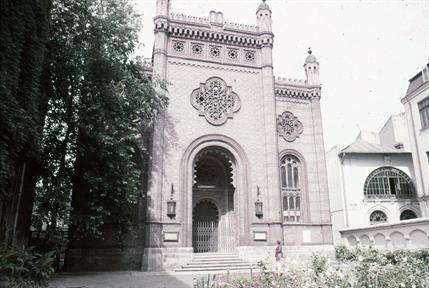
קהילת יהודי רומניה
Romania
România
A country in eastern Europe, member of the European Union (EU)
21st Century
Estimated Jewish population in 2018: 9,000 out of 19,500,000. Before the Holocaust Romania was home to the second largest Jewish community in Europe, and the fourth largest in the world, after USSR, USA, and Poland. Main Jewish organization:
Federaţia Comunităţilor Evreieşti Din România - Federation of Jewish Communities in Romania
Str. Sf. Vineri nr. 9-11 sector 3, Bucuresti, Romania
Phone: 021-315.50.90
Fax: 021-313.10.28
Email: secretariat@fcer.ro
Website: www.jewishfed.ro
שמעון בר
(אישיות)שמעון בר (1927 - 1983) היה זמר, שחקן, בדרן ומתרגם ישראלי.
יוסף מוסקוביץ
(אישיות)Joseph Moskowitz (1879-1954), cimbalom player, composer, and restaurant owner, born in Galati, Romania, the son of Moses Moskowitz, known as Moshe Tsimbler, a klezmer and cimbalom player. During his youth, Moskowitz toured Hungary, Romania, Galicia, and Istanbul, and entertained audiences on riverboats along the Danube. He also seems to have joined Broder singer troupes for performances. He immigrated to the United States in 1907. After initially making appearances in cafes in New York, he spent the next five years on a tour across the United States, often collaborating with the Matus Gypsy Ensemble and performing in hotel orchestras.
Sometime between 1909 and 1913 he established the Moskowitz Wine Cellar, a restaurant located on Rivington Street in Manhattan's Lower East Side, with his wife Rebecca as the cook. He later relocated the restaurant to Houston Street and renamed it Little Rumania. This dining establishment gained significant popularity, particularly among Romanian. At this venue, Moskowitz showcased his musical talents, frequently sharing the stage with accomplished violinists and pianists. Subsequently, he opened a new upscale restaurant, Moskowitz & Lupowitz, situated on Second Avenue at Second Street. This establishment began to attract celebrities, bohemians, and writers.
In the 1920s, Joseph Moskowitz was a regular presence on the radio in the New York area. He also continued to perform on stage during this era, including notable appearances at Carnegie Hall and New York's Town Hall. In addition, he recorded tens of songs from his Jewish, Romanian, and American repertoire. In the 1930s, he both managed his restaurant and continued his musical career. Around 1940, Moskowitz left New York and relocated to Akron, Ohio, where he played concerts at the Jewish Center and the Romany Restaurant. By 1943, he departed Akron and settled in Washington, D.C., where he regularly entertained patrons at Michel's French Restaurant near Dupont Circle from 1943 until his passing. Moskowitz is believed to have composed over 100 pieces throughout his lifetime, though it is unclear how many of these were adaptations of existing folk melodies.
סמי עופר
(אישיות)Sammy Ofer (1922-2011), businessman, shipping magnate and one of Israel's wealthiest citizens, born in Romania as Samuel Herskovich. In 1924 his parents immigrated to Palestine and settled in Haifa. After completing elementary school Ofer started to work as a delivery boy for a shipping company. During World War 2 Ofer served in the British Royal Navy and then in Israel's War of Independence he enlisted in Israel's Sea Corps.
After his discharge from the services, Ofer's love of the sea was further reinforced. He became a shipping agent and then within two years bought his first ship. The Ofer fleet never ceased to grow and with it the value of his fortune. By 2011 it was estimated that the value of the fortune of Sammy and his brother Yuli exceeded $10 billion. His assets included the Zim Shipping company, the Israel Corporation, Israel Oil Refineries, Bank Mizrachi-Tefahot and Tower Semi Conductor.
Most of Ofer's time was spend abroad and his businesses were managed from Monaco. His two sons were active in managing the business activities.
Ofer became well known for his philanthropic activities. In 2007 he donated $25 million towards the construction of a fortified underground hospital attached to the Rambam medical complex Haifa. The following year he donated over $30 million towards the cost of expanding London's National Maritime Museum at Greenwich. In recognition of his assistance in 2008 he was awarded an Honorary Knight of the British Empire (KBE).
מריו ליביו
(אישיות)Mario Livio (b.1945), astrophysicist and writer of books which popularize science, born in Bucharest, Romania. He was brought up by his grandparents when his parents were forced to leave Romania for political reasons. In 1950 he immigrated to Israel together with his grandparents. He studied mathematics and physics at the Hebrew University of Jerusalem before obtaining a masters degree in theoretical particle physics from the Weizmann Institute in Rehovot, Israel. He was awarded a Ph.D. degree from Tel Aviv University for his work on theoretical astrophysics. He served with the Israeli Defense Forces as a paramedic in the Six Day War (1967), the Yom Kippur War (1973), and the Lebanon War. (1982). Between 1981 and 1991 he was a professor of physics at the Technion in Haifa, Israel.
In 1991 Livio was appointed head of the archive branch of the Hubble Space Telescope Science Institute in the USA. During late 2000s he has been a senior astrophysicist at the Institute and head of its Office of Public Outreach and an adjunct professor in the Department of Physics and Astronomy of the Johns Hopkins University.
Livio has become best known for the books and magazine articles which he has written in order to popularize astronomy and mathematics. He has addressed many seminars on the sciences at the Smithsonian Institute in Washington DC, at the Glasgow Science Centre and other venues and he has appeared on many television and radio programs on similar subjects.
Throughout his studies he was always fascinated by aspects of astronomy including black holes, neutron stars and ‘white dwarfs’. During the 2000s he focused his research on supernova explosions and their use in determining the rate of the expansion of the universe. He has also studied black holes and the formation of the planetary systems.
Livio’s first book was ‘The Accelerating Universe’ (2000) which explained to laymen the theory that the universe is expanding at an ever increasing rate and the implications of such a theory. In ‘The Golden Ratio: The Story of Phi’ (2002) he traced the influence of this magic ratio through the ages. ‘The Equation that Couldn’t be Solved’ (2005) explains how efforts to solve the quintic equation led to group theory and to the mathematics of symmetry. ‘Is God a Mathematician?’ (2009) describes the ability of mathematics to predict the physical world.
Livio has received a number of awards from his fellow scientists in recognition of his work and he is a fellow of many learned societies.
וילהלם קליין
(אישיות)Wilhelm Klein (1850-1924), classical archeologist born in Karansebes, Hungary (now Caransebes, Romania). He studied Jewish theology, and later philosophy at the universities of Vienna and the German University of Prague, where later he became professor of classical archeology. The Austrian government sponsored several expeditions by him to Italy and Greece for the study of ancient pottery. In 1879 he published a book on Euphronios, one of the outstanding Attic red-figure vase painters who worked between the years 515 and 500 BCE. This was the first comprehensive study of the Athenian ceramists and their important pottery workshops. In 1898-1899 he published two books on Praxiteles. In these he attempted to reconstruct the work of the leading sculptors of the Greek classical period, whose work had been lost or destroyed, with the help of surviving Roman copies. In his last publication, "Vom antiken Rokoko" (1921), Klein distinguishes between the baroque and the rococo style trends within the development of Hellenistic sculture. Klein was a member of the "Gesellschaft zur Förderung Deutscher Wissenschaft, Kunst, und Literatur" as well as of the German Archeological Institute.
ביהארי, שנדור (אלכסנדר)
(אישיות)Sandor (Alexander) Bihari (1856-1906), painter, born in Rezbanya, Bihar county, Hungary (then part of the Austrian Empire, now Nucet, in Romania). The son of a poor housepainter, he spent his childhood in Nagyvarad (now Oradea, in Romania). Bihari became a leading figure among realistic portrayers of life in the 1880s. Following many hardships in Budapest, Vienna, and Paris, he soon attained success in the French capital, having studied at the Académie Julian with Jean-Paul Laurens.
In Paris he painted "Kereszttuz" ("Cross-fire", 1885), which was purchased by the Austrian Emperor Franz Joseph I for the Museum of Fine Art in Vienna.
Bihari was granted several national and international prizes, medals, and other distinctions in Budapest, Munich, Berlin, Vienna, Rome. His striking historic canvases made him a favorite of aristocratic and royal circles. Notable among these are "Zsigmond kiraly fogadja Ulaszlo lengyel kirajt St. Laszlo sirjanal" ("King Zigmund Receives King Ladislaus of Poland at the Tomb of St. Ladislaus", 1898), "Programm- beszed" ("Declaration of Policy", 1891), which was purchased by the Hungarian Crown.
Bihari's best known portraits include Karoly Eotvos (now in the Jewish Museum of Hungary), Adolf Agai, and Self-Portrait, all revealing sensitive characterization.
Bihari settled in the town of Szolnok, where he established (1900) an art colony that produced some of Hungary's finest talents. Fifteen years earlier he and Bertalan Karlovszky founded an art school in Budapest. Bihari convedrted to Christianity on his deathbed.
אברהם גולדשטיין-גורן
(אישיות)Avram (Dolphi) Goldstein-Goren (1905–2005), financer, industrialist and philanthropist, born in Podu Turcului, Romania, the son of Yitzhak Moshe Goldstein, a prominent businessman, and Betty (Bracha) Wechsler of Iasi.
After his studies in economics and law at Bucharest University (1924-1927), he became director of the Commercial Bank (Banca Comerciala) in Tecuci, Romania. He also was active as a lawyer, until 1941, when following the adoption of the anti-Semitic legislation by the Romanian government, he was expulsed from the Romanian Bar.
In 1939 he married Stela Cukier, the daughter of Jewish merchants and textile industrialists from Poland. Goldstein-Goren immigrated to the Land of Israel 1944. In Israel he started a successful career as an industrialist founding two textile companies in Dimona and Beer Sheva, respectively. He also was co-owner of the Palestine British Bank.
At the end of 1945 Avram contracted to buy very large quantities of the raw cotton that had accumulated in Egypt during the war in order to have it spun in Italy into yarn to be shipped back to the Middle East. In mid 1946 he settled in Milan, Italy, living there for the rest of his life.
In the 1950s he extended his commercial activities abroad being involved in real estate projects in France and Canada and various financial and commercial companies in the United States. In the 1970s he was a shareholder and director of Keyser Ullman Ltd., a merchant bank that was eventually merged into the Charterhouse Group. He remained a director of Keyser Ullmann in Geneva, Switzerland, until 1983.
Goldstein-Goren was an enthusiast philanthropist dedicated to the advancement of Jewish culture, education and heritage. Among other projects he supported the establishment of a Center of Jewish Studies at the University of Bucharest, and a similar center at the University of Milano, supported the Ben Gurion University of the Negev in Beer Sheva, established a number of community centers and synagogues in Tel Aviv, Dimona, Raanana, and Jerusalem, and the Goldstein-Goren Diaspora Research Center at Tel Aviv University. He was awarded a Doctor Honoris Causa by Beer Sheva University in 1989, and a Honorary Citizenship of the town of Tecuci.
אמיל דוריאן
(אישיות)Emil Dorian (born Emil Lustig)(1891-1956), poet, novelist and translator, the son of a teacher of German, born in Bucharest, Romania. Educated at Jewish schools in Bucharest he went on to graduate from medical school and served as a physician during World War I despite the fact that as a Jew he was not a Romanian citizen. After the war he went to France where he specialized. Dorian returned to Romania and practiced medicine until the end of his life. He published several works of popular medicine. After World War II he became involved in Jewish community life serving as a secretary general and afterward as director of the documentary library and archives of the Federation of Jewish Communities of Romania.
Despite his full time medical career, Dorian was a prolific writer. His works, initially published under various pseudonyms, appeared initially in several literary journals. He wrote poetry and novels, and translated several books incךuding the works of Henrich Heine and Eliezer Shteynbarg from German and Yiddish to Romanian. His poems generally focused on intimate and peaceful family settings; some described his wartime experience in pacifist tones. Dorian developed a keen interest in Yiddish poetry. In Antologie de poezie idis (:Anthology of Yiddish Poetry") he translated and collected more than 400 poems.
Dorian’s novels depict the social and ideological conflicts of the interwar years in Romania, focusing on Jewish life. The hero of Profeti si paiate ("Prophets and Clowns", published in 1930), Avram Gut, is a young man growing acquainted with both materialism and idealism. The story describes the struggles of Romania’s Jewish community at the end of World War I, and the political options available to its members.
From 1937 until the end of his life, Dorian maintained a remarkable diary. The journal presents the daily life of the author, revealing his literary struggles, the situation in Romania during the period of right-wing extremism, and the hardships of living in the Jewish community. The diary was first published in English in 1982 as Quality of Witness: A Romanian Diary, 1937–1944. The Communist regime in Romania banned his books after he attacked the permanence of anti-Semitism in Romanian society.
גולדשטיין, מקס
(אישיות)Max Goldstein (1898–1924), a communist and anarchist born in Barlad, Romania. Goldstein, also known as Coca, moved to Bucharest and became a Communist sympathizer. He was arrested and sentenced to prison for ten years. He managed to escape from prison and fled to Odessa, Ukraine (then part of the Russian Empire) where he became close to Anarchist circles. Goldstein lost one hand, apparently while preparing explosives. He replaced it with a hook, hence his nickname "The Man with the Hook".
Having returned to Romania, he tried to assassinate the Minister of the Interior in 1920, but did not succeed. The same year, along with Gelber Moscovici, Leon Lichtblau, and Saul Ozias, another Jewish Communist activists, he planted a bomb which killed the Romanian Minister of Justice, two members of the Romanian Senate and wounded the President of the Senate. This bombing eventually led to the banning of the Communist Party. Goldstein then fled to Bulgaria but was again arrested when he tried to get back to Romania in 1921. He was sentenced to life imprisonment but died in prison after a 32 day hunger strike.
שמיל (שמואל) מרקוביץ'
(אישיות)Smil Marcovici (1893-1940), communist activist and, known also by the name of Moraru, born in Iasi (Jassy), Romania. During World War I he fought in the Romanian army before joining a revolutionary battalion which was established in Odessa, Ukraine (Then part of Soviet Russia). Employed by the Soviet Russian authorities he smuggled printing presses and money into Romania in order to promote socialist ideas and support left wing terrorist groups there. In 1920 he was arrested by the Romanian authorities, accussed of being a a spy and consequently sentenced to 20 years in prison. Marcovici escaped and joined the Romanian communist party becoming chief of the central committee's technical operations, organizing networks and clandestine links with other communist parties. He was appointed head of the party's internal police keeping an eye on party members suspected of collaborating with the secret police. He was responsible for running connections with anti-fascist front organizations which were financed by the communist party.
He was arrested in 1935, and was one of the defendants at the "The Trial of Craiova", the largest anti-communist trial in Romania before WW 2. Marcovici was sentenced to prison. He died at Doftana prison, when the building collapsed during the November 1940 earthquake.